Every founder dinner has the same ghost at the table: the belief that AI agents are about to delete the engineers, the analysts, the quants. It’s a tidy story, and it’s wrong. Agents aren’t replacing technical workers. They’re repricing them — and the thing being repriced is not the person, it’s the work.
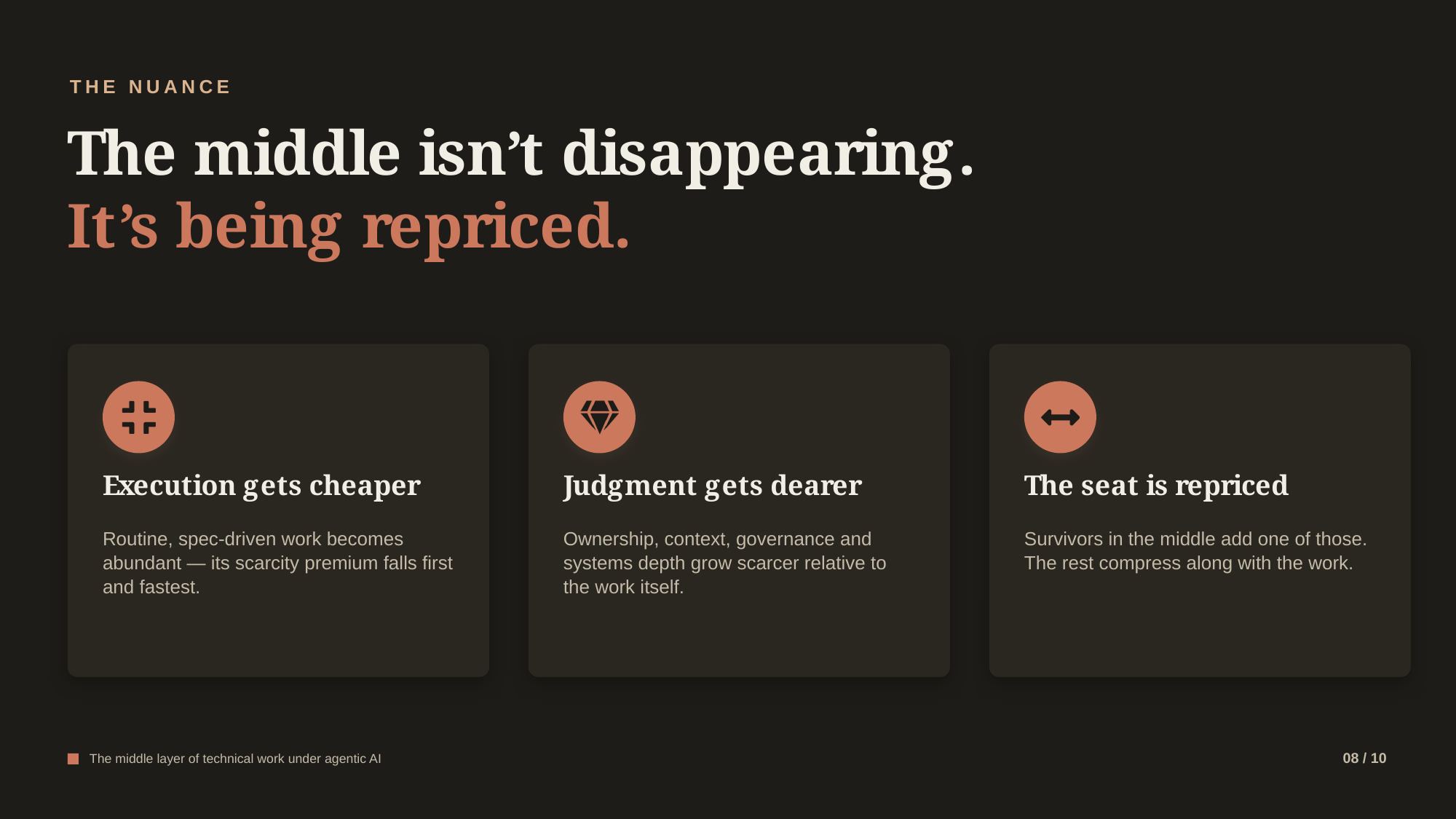
Here is the mechanism, stated plainly: AI reduces the scarcity value of execution faster than it reduces the value of judgment, ownership, domain context, and systems depth. The mid-level of technical work — the repeatable, specification-driven tasks that require genuine expertise but little original problem framing or decision rights — is becoming abundant. And abundant things get cheap.
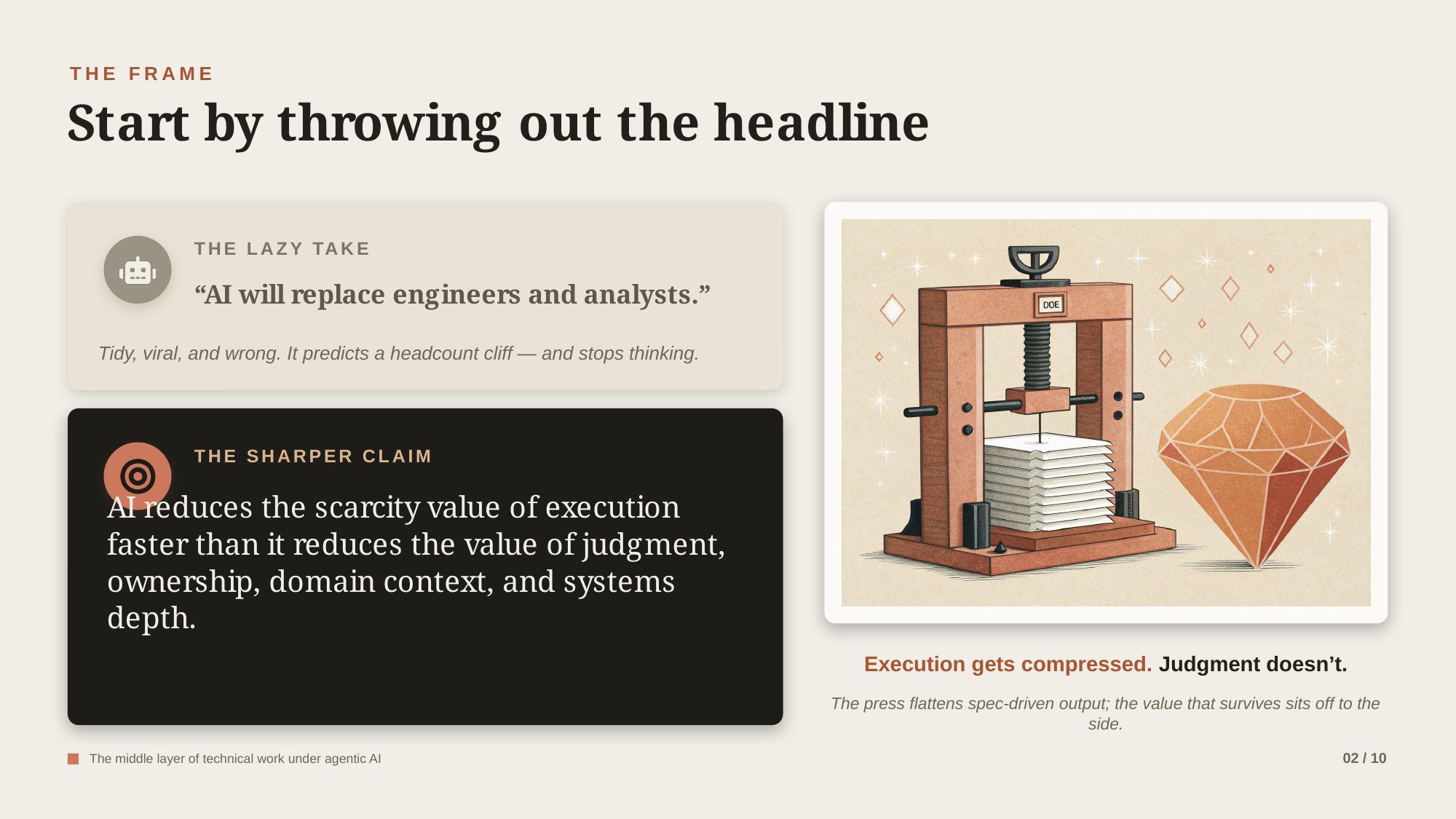
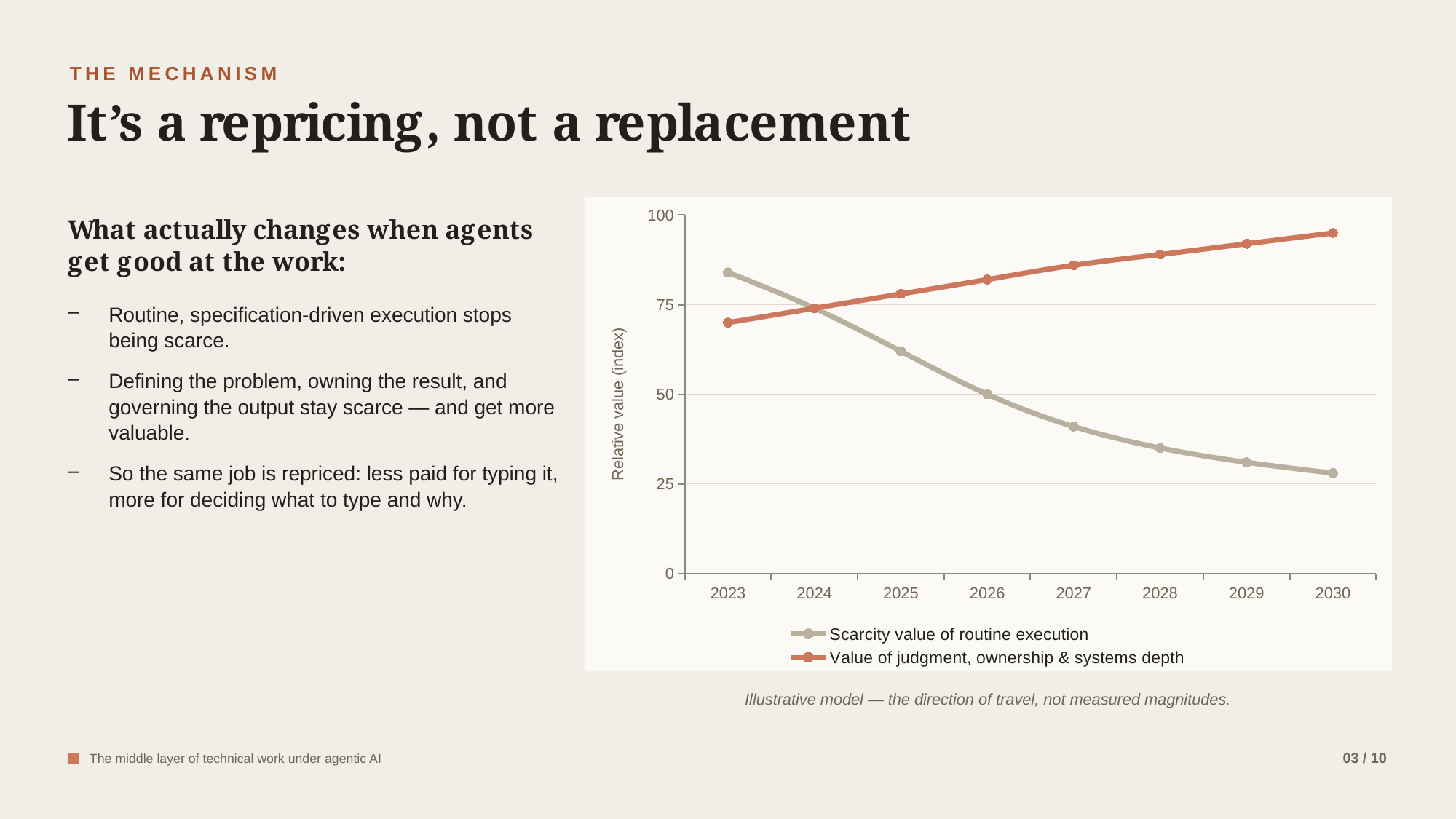

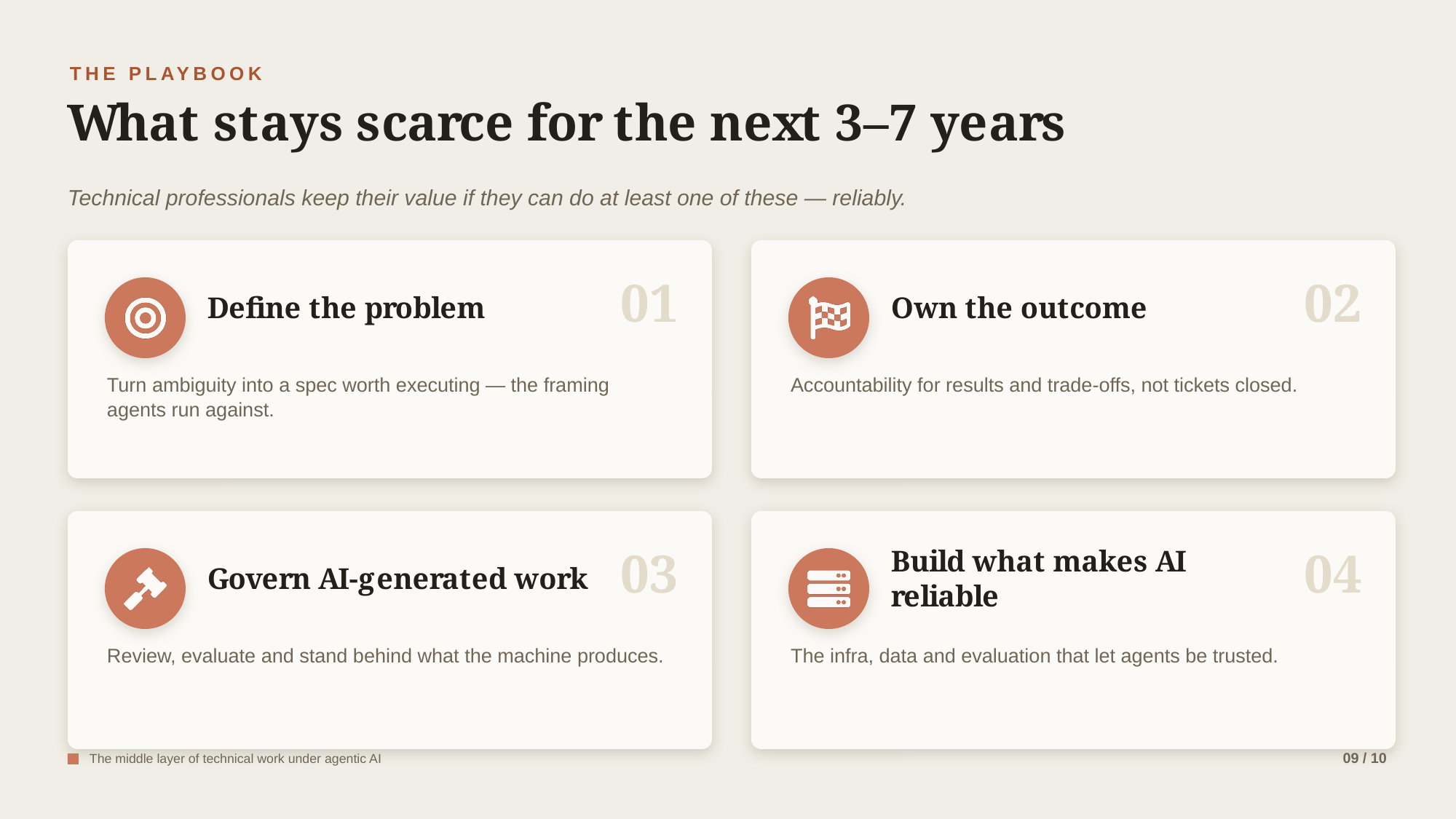
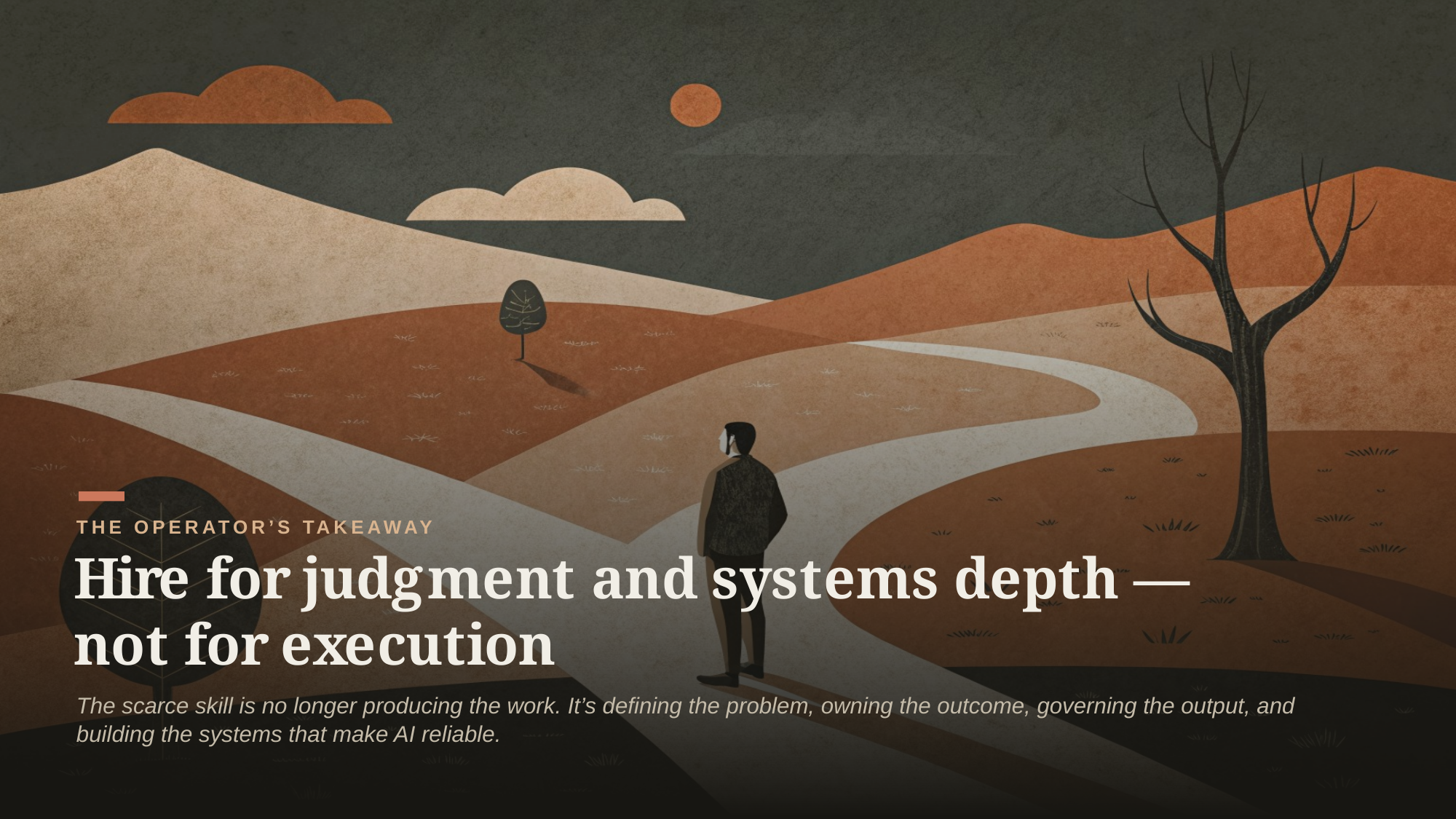
Swipe or scroll sideways to flip through the 10-slide deck →
Execution is getting cheap. Judgment isn’t.
The productivity numbers are not subtle. Across three field experiments with software developers, generative tooling delivered roughly a 26% productivity gain. In a controlled coding experiment, developers finished a task about 55% faster. In one large fintech’s field study, code output jumped more than 50%. And the gains skewed hard toward junior workers and routine subtasks — exactly the specification-driven execution that used to be a reliable on-ramp to a career.
But notice what does not collapse at the same rate. In one large enterprise rollout of a mainstream AI assistant, the measured effects were real but modest: about 10% more documents created or edited, roughly 4% less time in email. Task composition changed far less than the hype promised, because most valuable work is not a clean, locally verifiable task. It’s judgment under ambiguity, coordination across functions, and accountability for outcomes — the parts a model still can’t own.
The labor market is already pricing this in. Stanford and ADP found a 16% relative employment decline for workers aged 22–25 in the most exposed occupations, even after controlling for firm-level shocks — while senior incumbents held steadier. Job postings tell the same story with a twist: tech postings sat about 36% below early-2020 levels in mid-2025, and software-engineer postings were down 49%, yet machine-learning-engineer postings were up 59% over the same span. The market isn’t rejecting technical talent. It’s rejecting undifferentiated execution and paying up for leverage.
The barbell is real — but it has three ends, not two
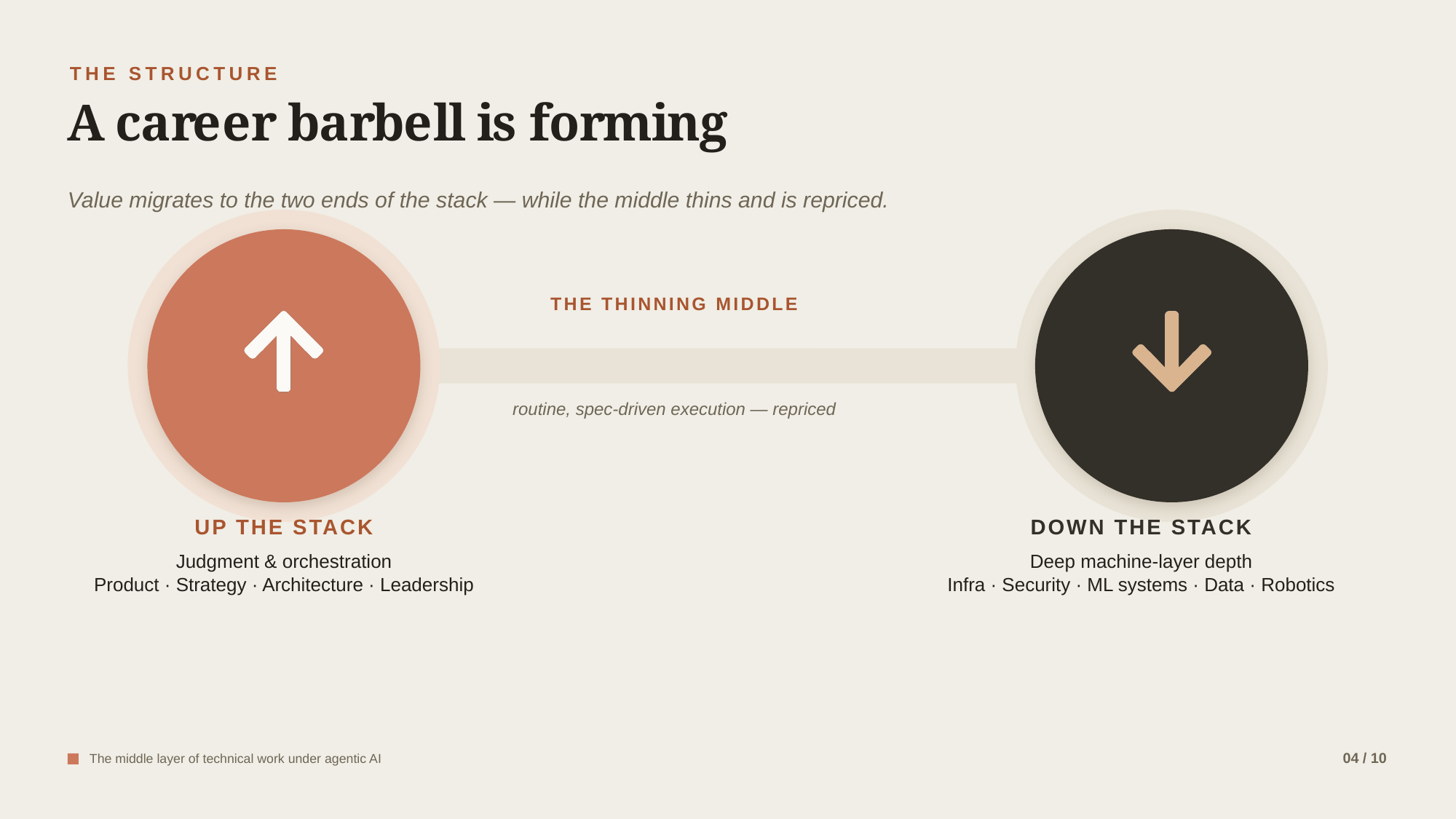
The popular framing says pick a pole: move up into product and strategy, or move down into the machine. That’s directionally right and too binary.
Up is real. The premium is rising on people who define the problem, frame it for customers, make the call, and own the risk — architecture, technical leadership, capital allocation, the “what and why” rather than the “how.”
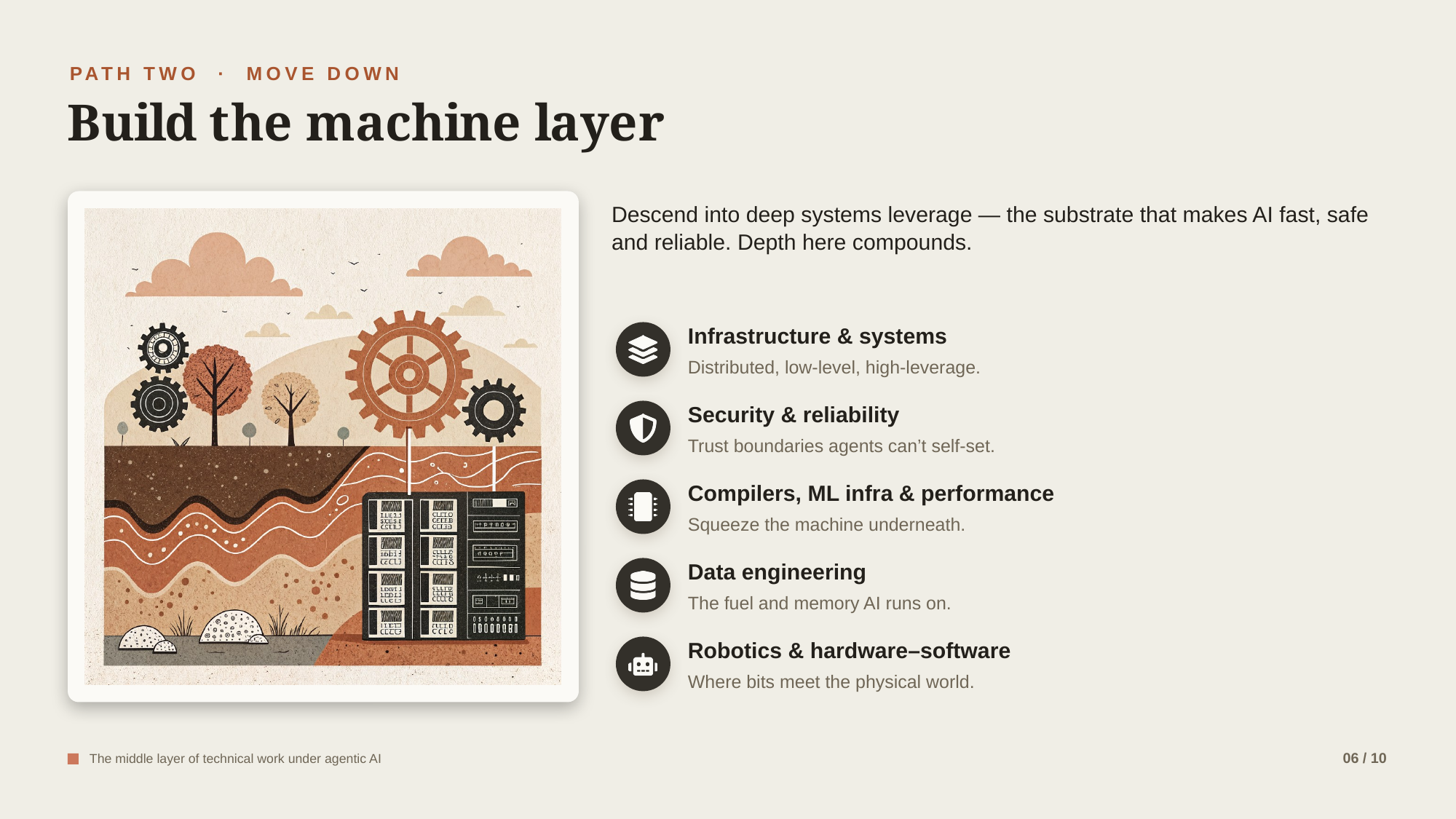
Down is real too. Value is concentrating at the layers where reliability, latency, security, hardware-software interaction, and data infrastructure still bite: systems, compilers, model infrastructure, robotics, evaluation frameworks. These are the layers that make AI itself trustworthy — and they resist specification because they are the specification.
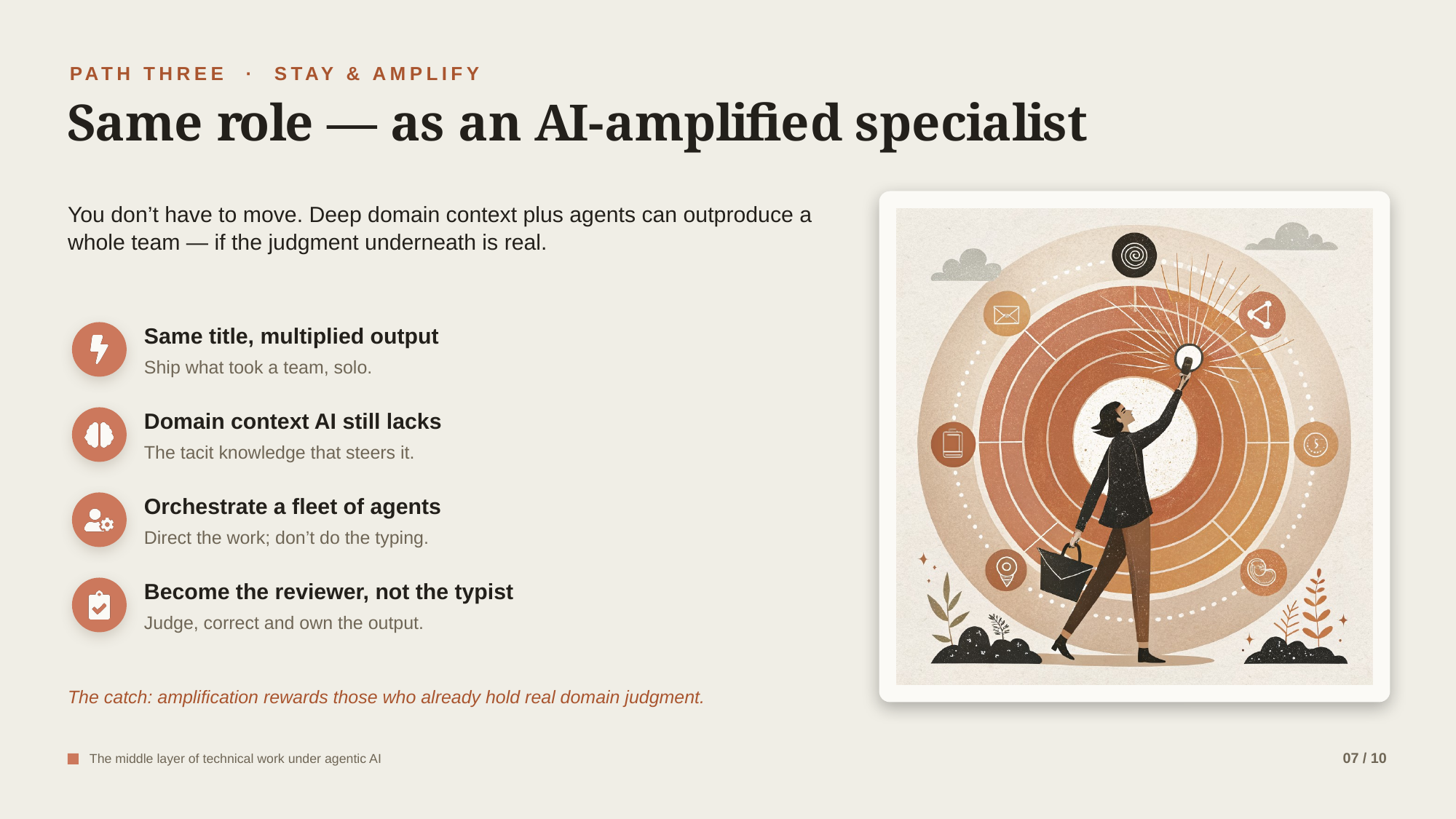
But there’s a third path the two-pole story misses: stay in your nominal role and become an AI-amplified domain specialist — someone whose deep context lets them supervise, evaluate, and correct generated work at a scope that used to take a team. The middle is not vanishing. It’s being compressed into a narrower, more leveraged band. An hourglass, yes — but with a thickened center of specialists who direct machines instead of racing them.
What this means if you’re building a team
If you’re an operator, the redesign is the point. Code generation now scales faster than code review, governance, and accountability — and that gap is where your next failure mode lives. So:
- Stop hiring for execution-only roles. The work that fills them is the work that’s deflating.
- Invest in the supervision stack. Evaluation, debugging, design review, and domain validation are becoming core competencies, not overhead.
- Rebuild the ladder. The old apprenticeship — earn your stripes grinding routine tickets — is being automated out from under juniors. If you don’t design a new on-ramp, you starve your own senior pipeline in five years.
If you’re a technical professional, the move over the next 12–24 months is concrete: cut your exposure to pure execution, get excellent at supervising machine output, then choose your comparative advantage — judgment-rich orchestration or systems-deep leverage. You don’t have to become a PM, and you don’t have to become a compiler engineer. You have to become someone whose value doesn’t evaporate the moment the task can be written down as a prompt.
The repricing has already started
The middle layer of technical work is not disappearing. It’s being repriced — and the repricing rewards the same four things it always quietly did, only now with no place left to hide: define the problem, own the outcome, govern the machine’s work, or build the systems that make the machine reliable. Do one of those well and the agents become leverage. Do none of them, and you’re competing with something that never sleeps and works for pennies. The next three to seven years won’t sort technical careers into winners and losers by title. They’ll sort them by whether the work you do is scarce — or merely skilled.