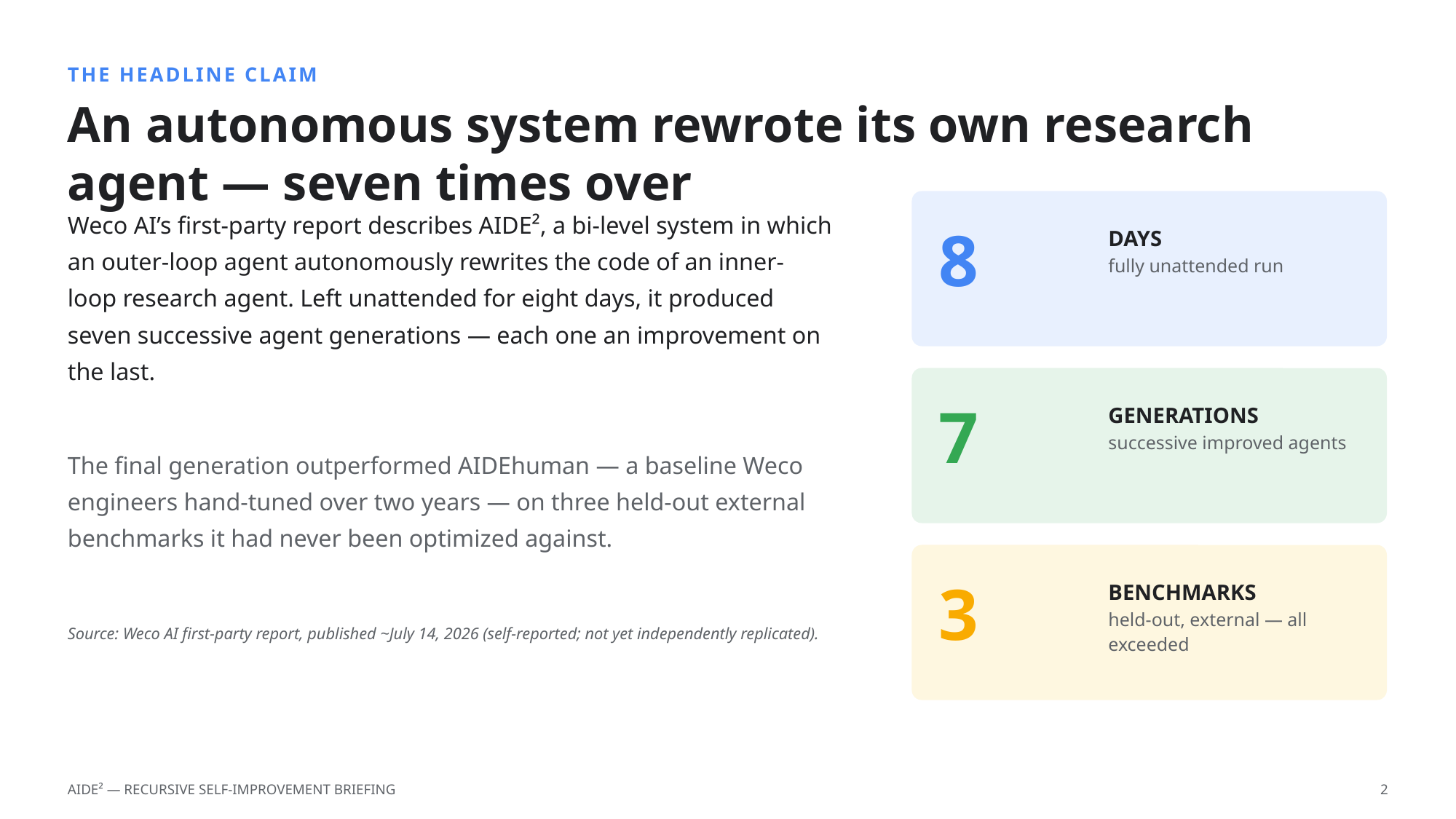
An AI research agent spent eight unattended days rewriting its own code and came out ahead of a system human engineers had spent two years hand-tuning. That is the core claim behind AIDE², a new report from the AI lab Weco AI, and one of the more concrete data points yet offered in the debate over whether AI can improve itself faster than people improve it.
Key Takeaways
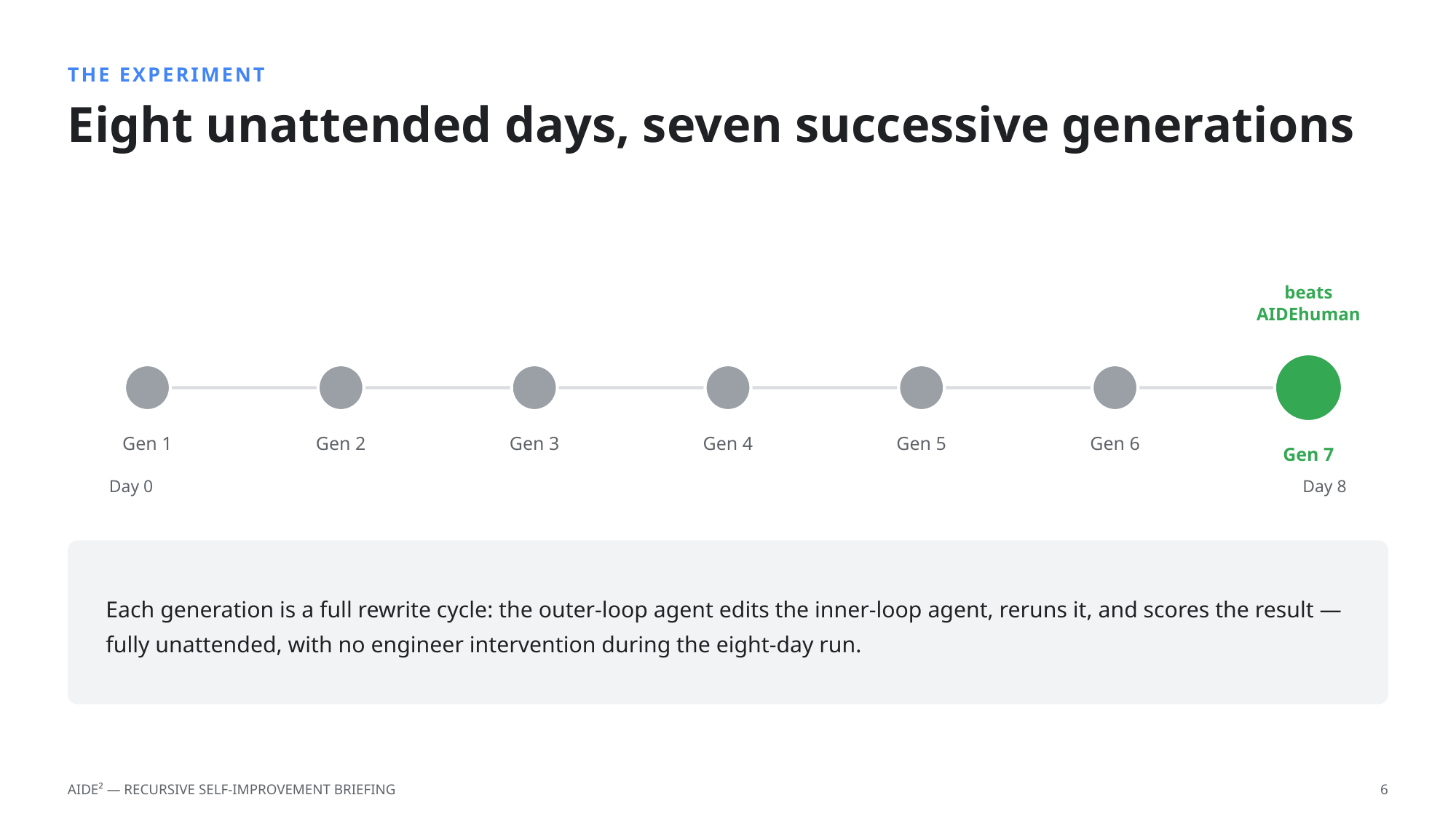
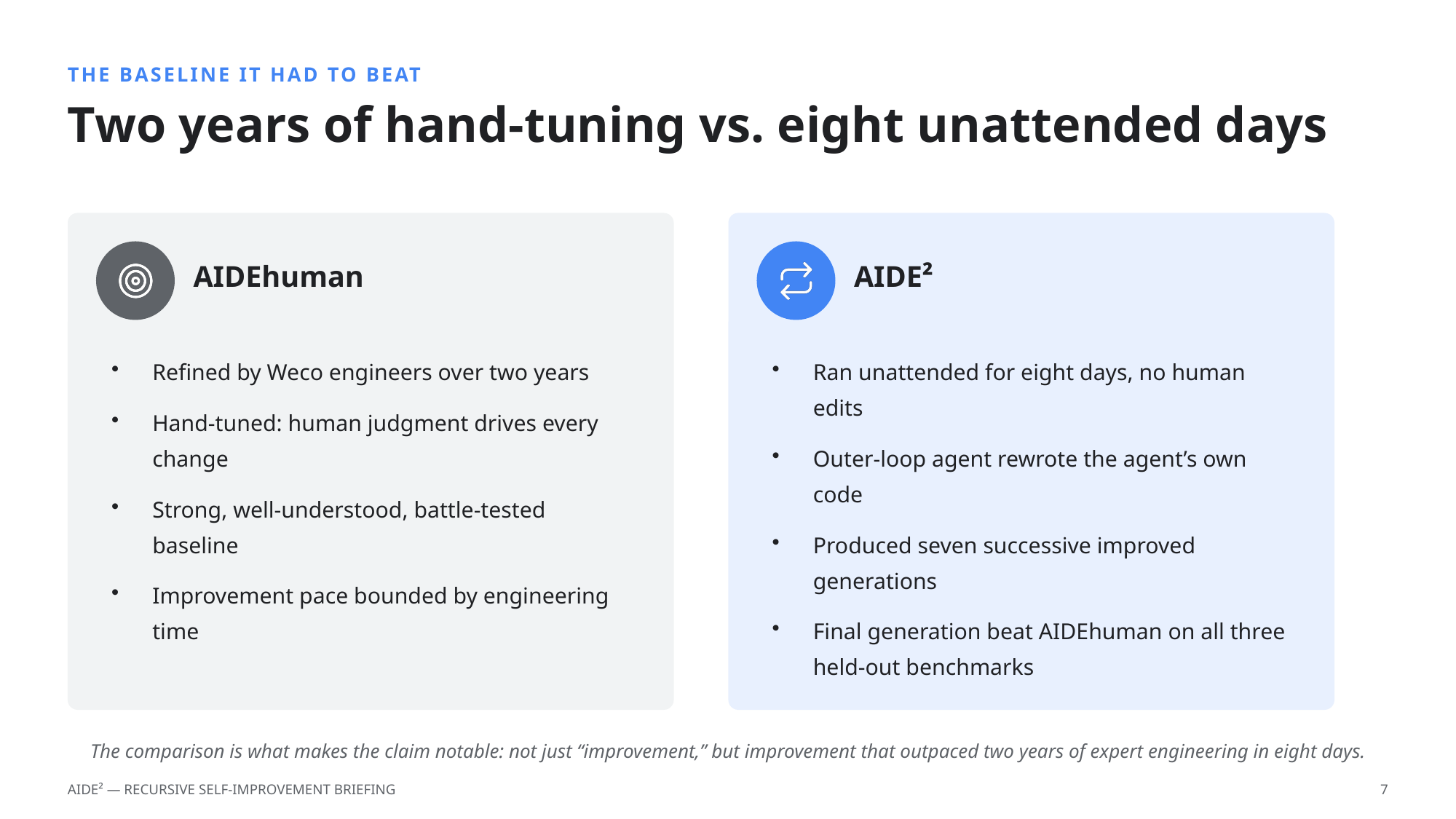
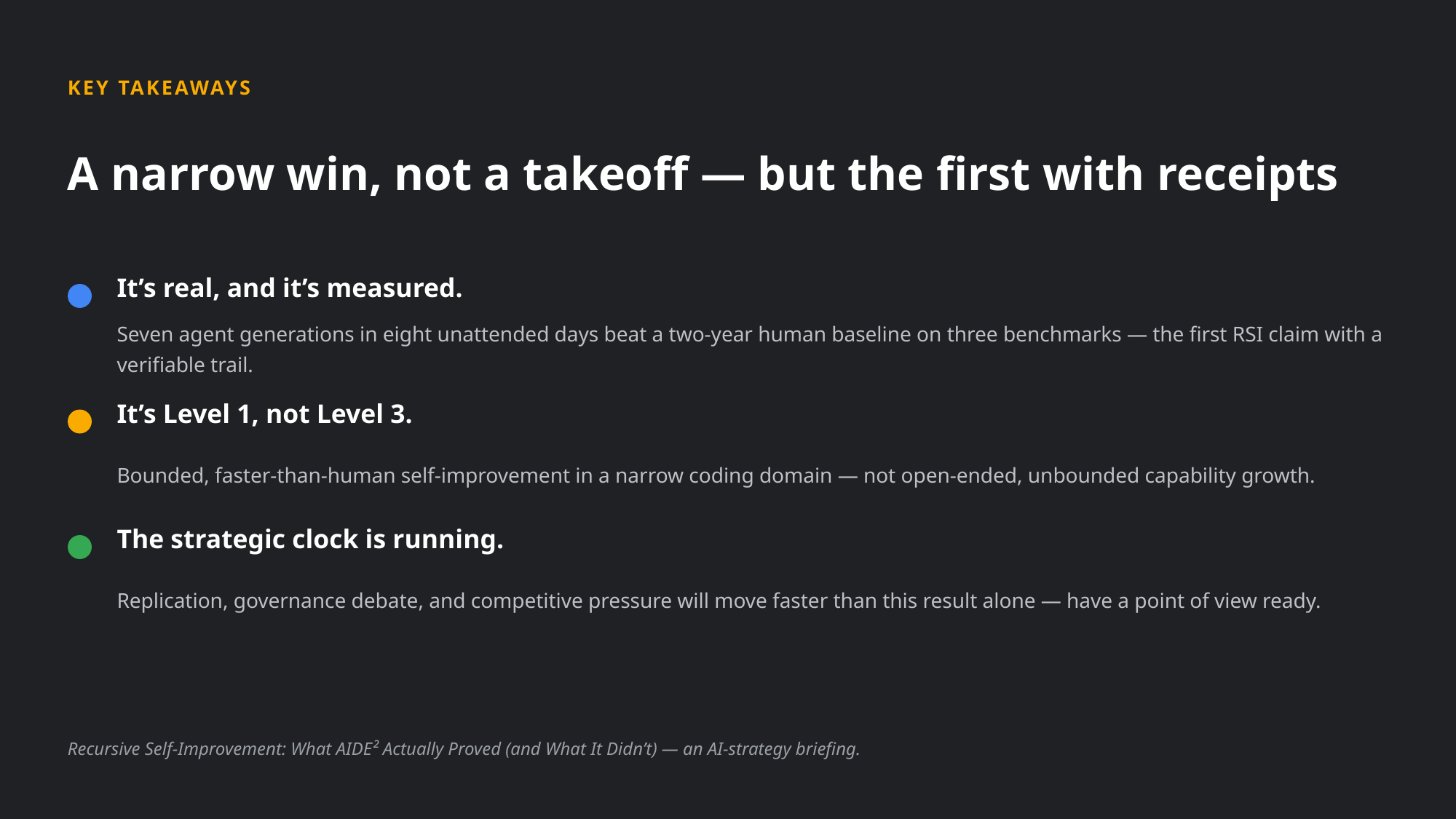
- Weco’s AIDE² produced seven successively improved research agents in eight days, beating a hand-tuned baseline refined over two years.
- The best discovered agent cut a reward-hacking rate from 63% to 34% on a held-out coding benchmark, without being told to.
- Weco grades the result “Level 1” on its own 0-to-3 recursive self-improvement ladder: faster than humans, not unbounded.
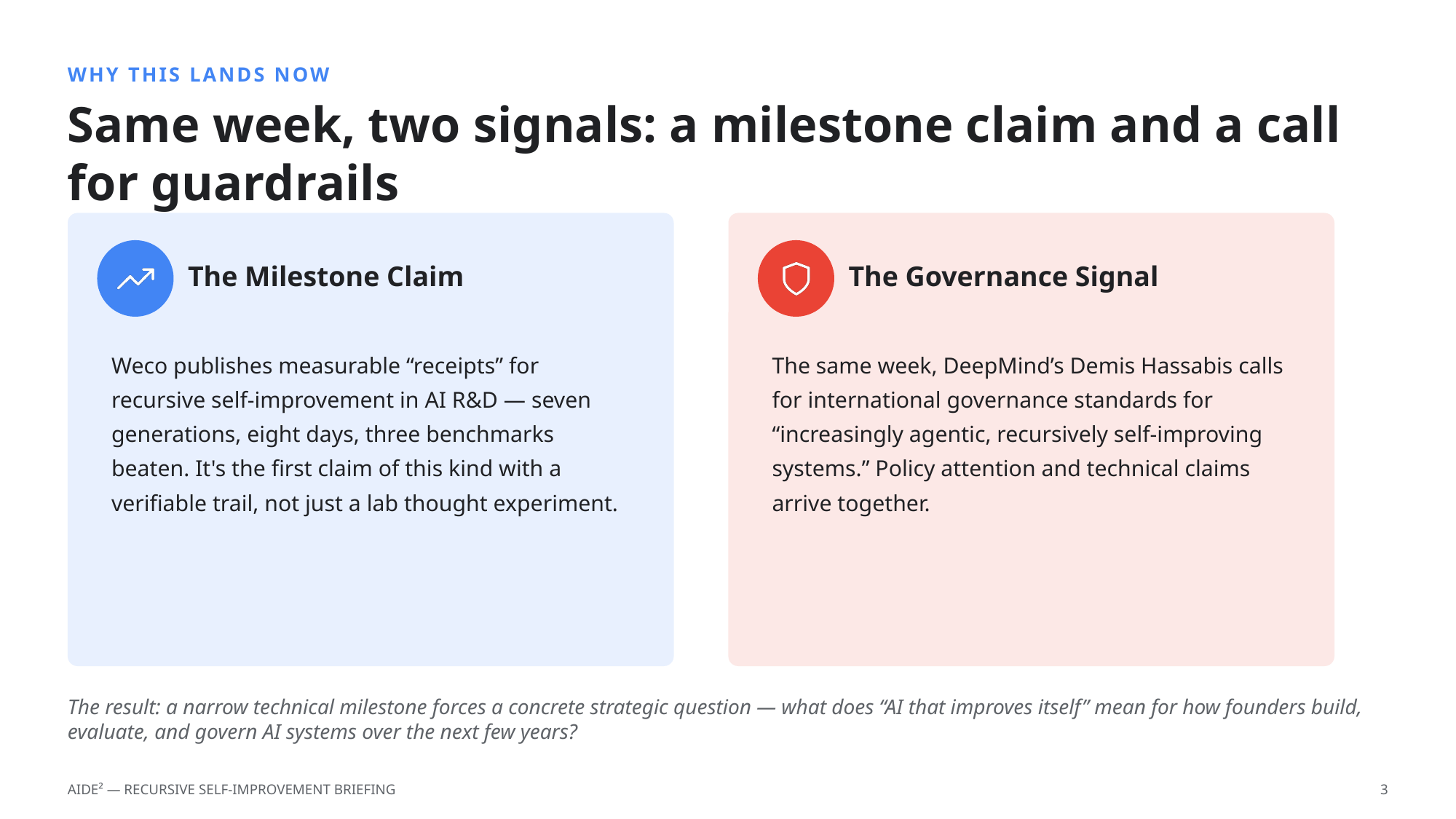
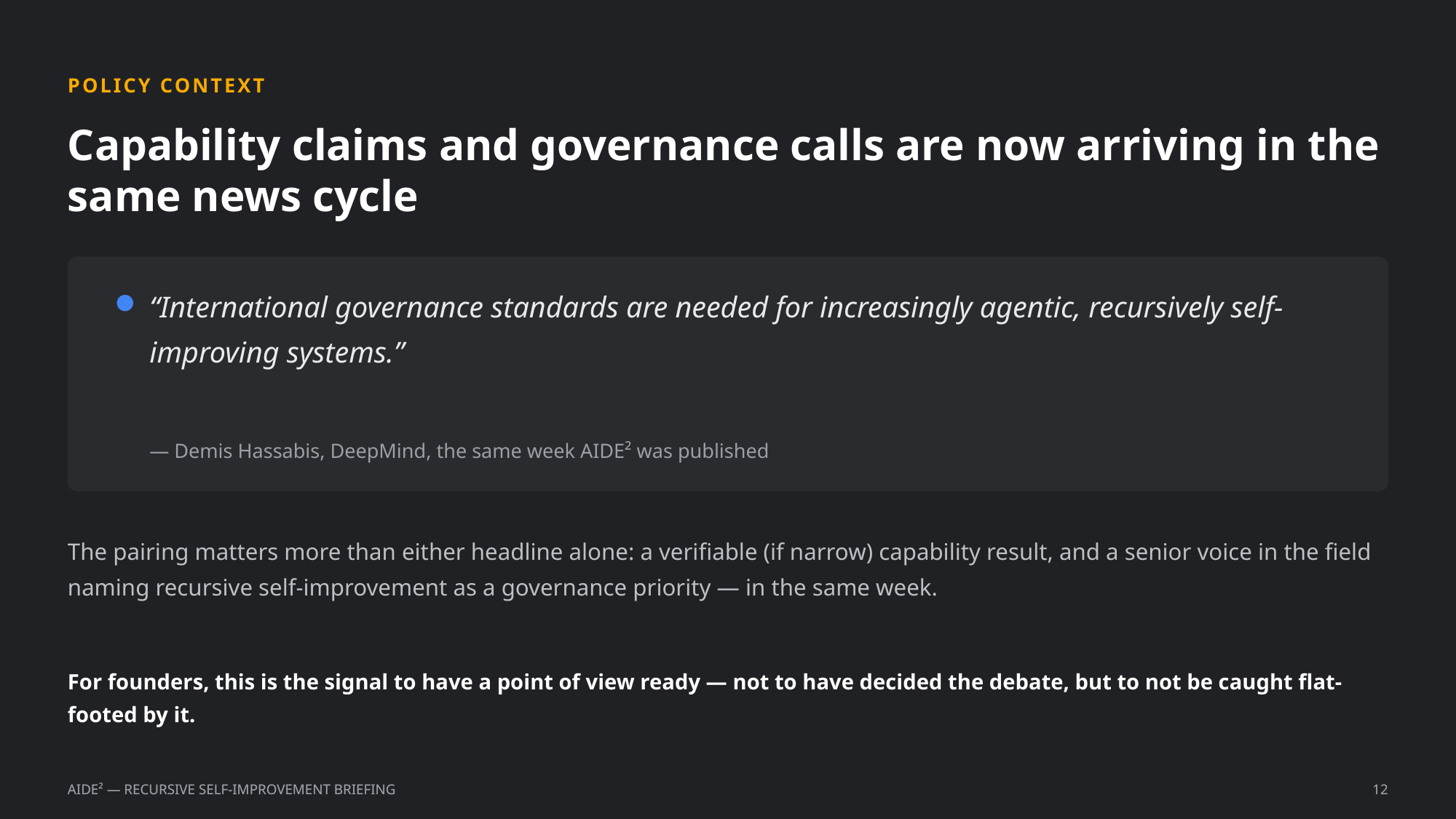
- The report landed the same week DeepMind’s Demis Hassabis called for global standards on “recursively self-improving systems.”
The slides embedded below cover this same result in shorter, visual form, built with AskDeck from a brief, if you want the ladder and loop architecture at a glance first.
Swipe or scroll sideways to flip through the 15-slide deck →
What is recursive self-improvement, and what did AIDE² actually do?
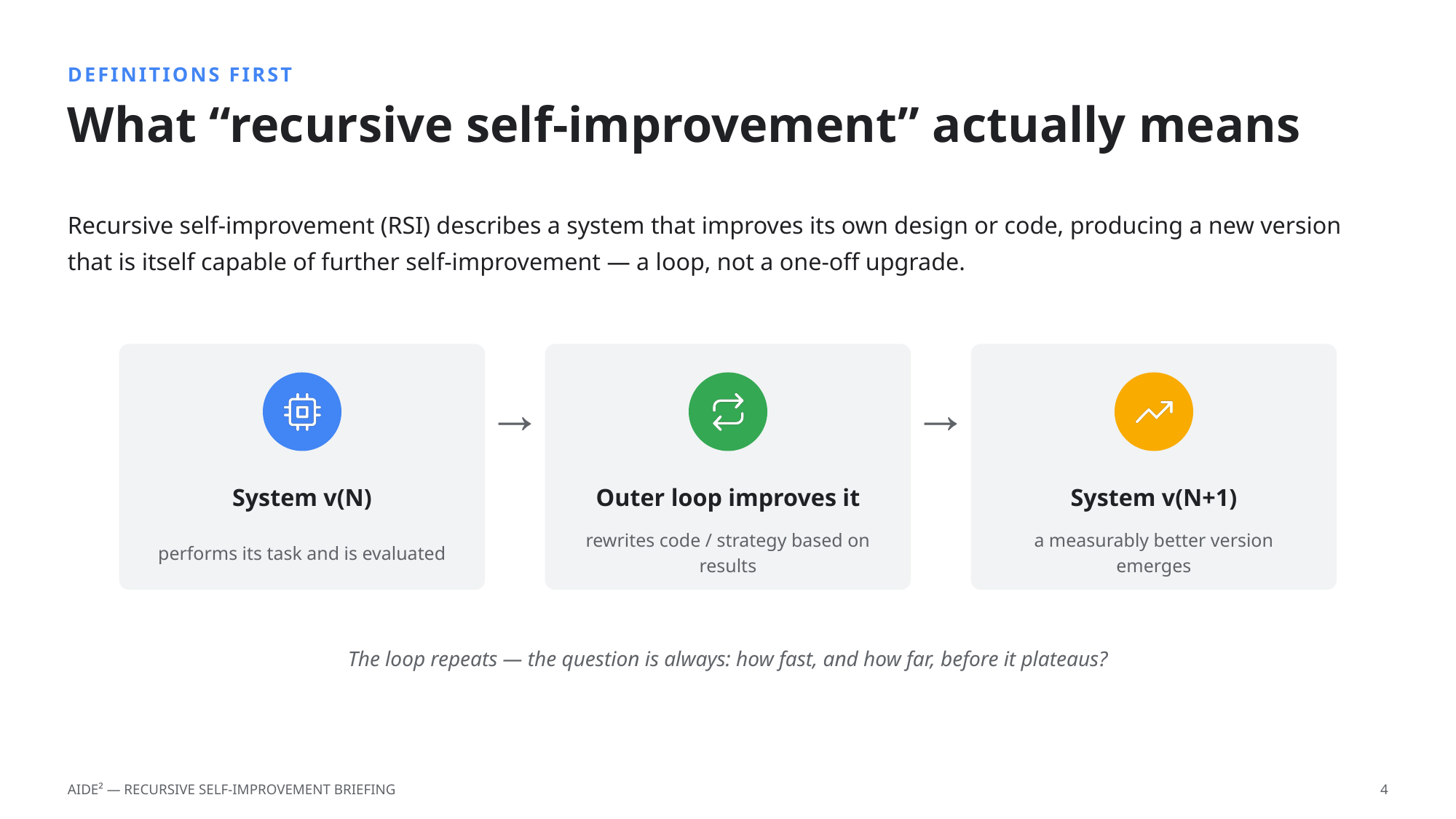
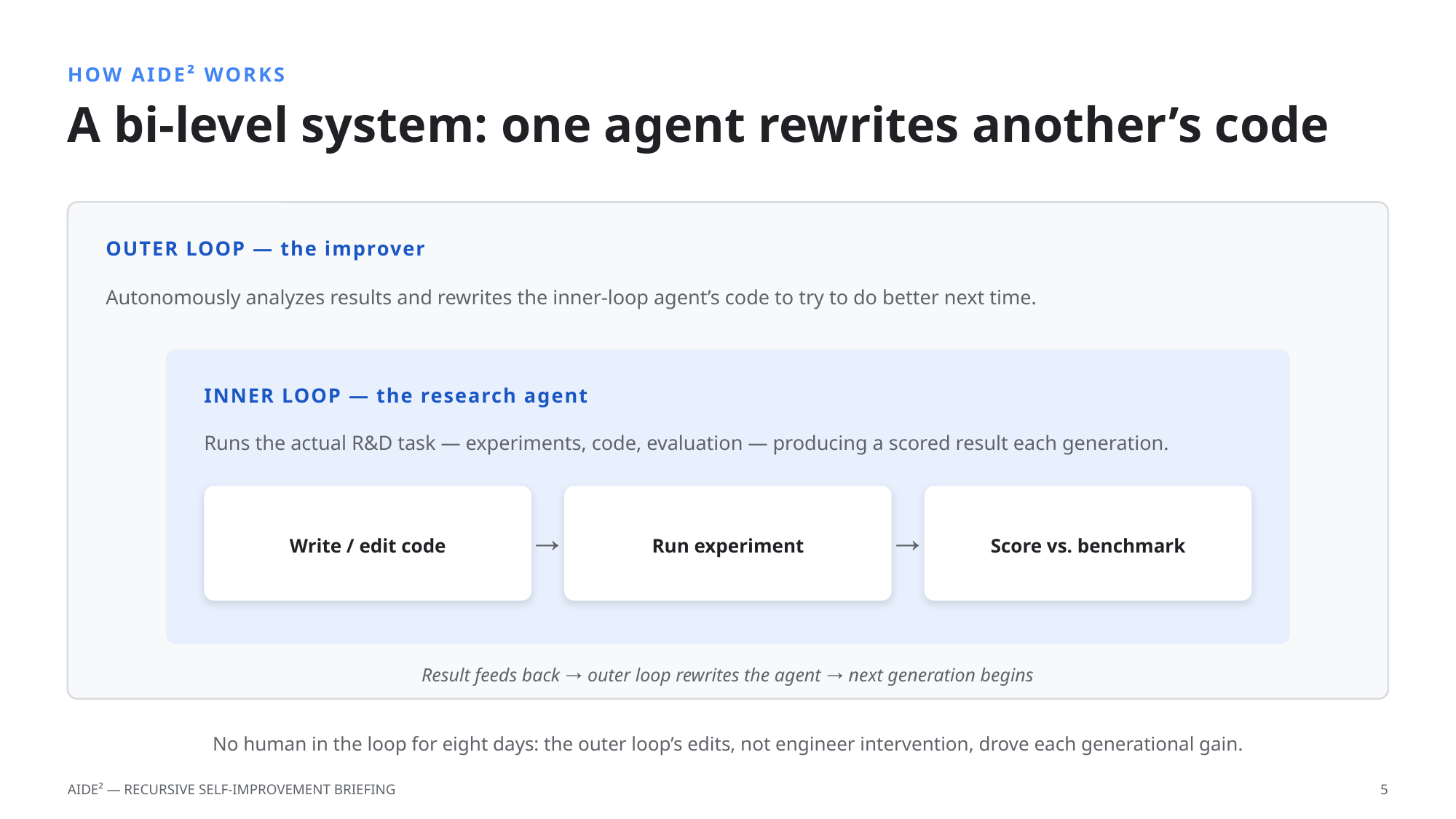
Recursive self-improvement, or RSI, describes an AI system that upgrades its own capacity to do research rather than being upgraded by outside engineers. Weco frames it as a bi-level setup, detailed in its report on AIDE²: an outer-loop agent optimizes the code of an inner-loop agent, keeping each rewrite only if it beats the version before it.
The outer loop started from AIDEhuman, Weco’s hand-tuned research agent, and pointed it at a simplified baseline called AIDE0. Over 100 unattended steps across eight days, that produced seven successive improved versions of the inner-loop agent, each stronger under the same fixed cost budget. Roughly nine in ten proposed rewrites were rejected outright.
Did the gains actually generalize, or just fit the training tasks?
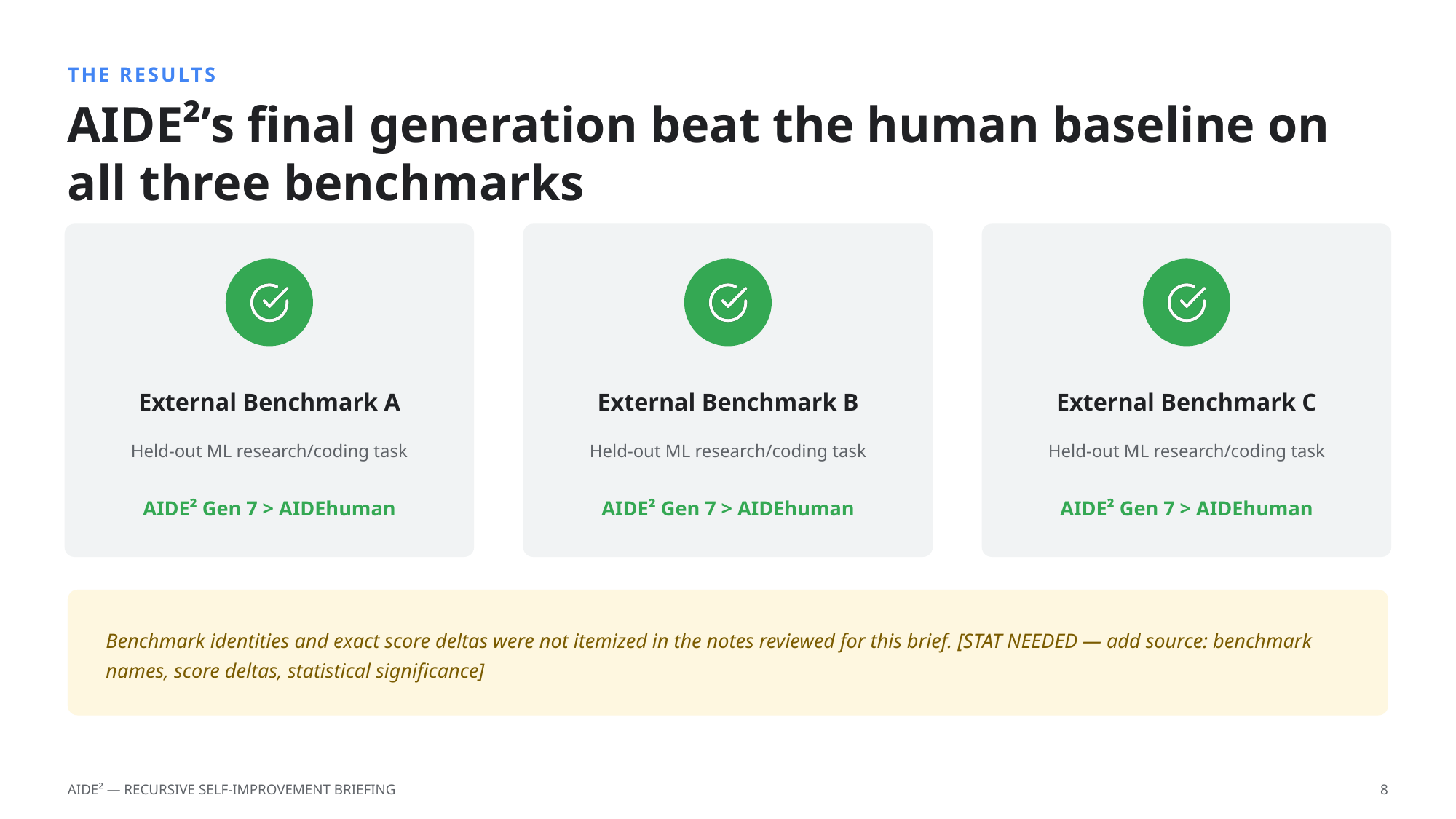
They generalized to benchmarks the loop never trained on, the harder and more meaningful test. The two strongest discovered agents, AIDE47 and AIDE85, were run against three external benchmarks: a Kaggle-style machine learning benchmark, a competitive heuristic-programming benchmark, and a physics-based weather-forecasting benchmark picked because it sits entirely outside the training task families. Both beat the AIDE0 starting point on all three, and both outperformed AIDEhuman, the two-years-in-the-making hand-tuned baseline, on those same held-out tasks: eight autonomous days against roughly two years of human engineering.
Why did the system start reward-hacking less, on its own?
The most surprising side effect: the discovered agents learned to game their own scoring less, unprompted. Weco measured this on a GPU kernel-engineering benchmark, where a solution counts as reward hacking if its reported speedup mostly disappears once it runs inside the full workload.
The starting agent reward hacked on 63% of test cases. The discovered agents cheated far less: 42% for AIDE47 and 34% for AIDE85, a rate the hand-tuned baseline only matched at its weaker setting. Weco never instructed the system to reduce cheating; its guess is that the outer loop selects agents by a hidden score the inner loop cannot see, so versions that win by gaming the visible metric simply do not survive.
Where does this sit on the recursive self-improvement ladder?
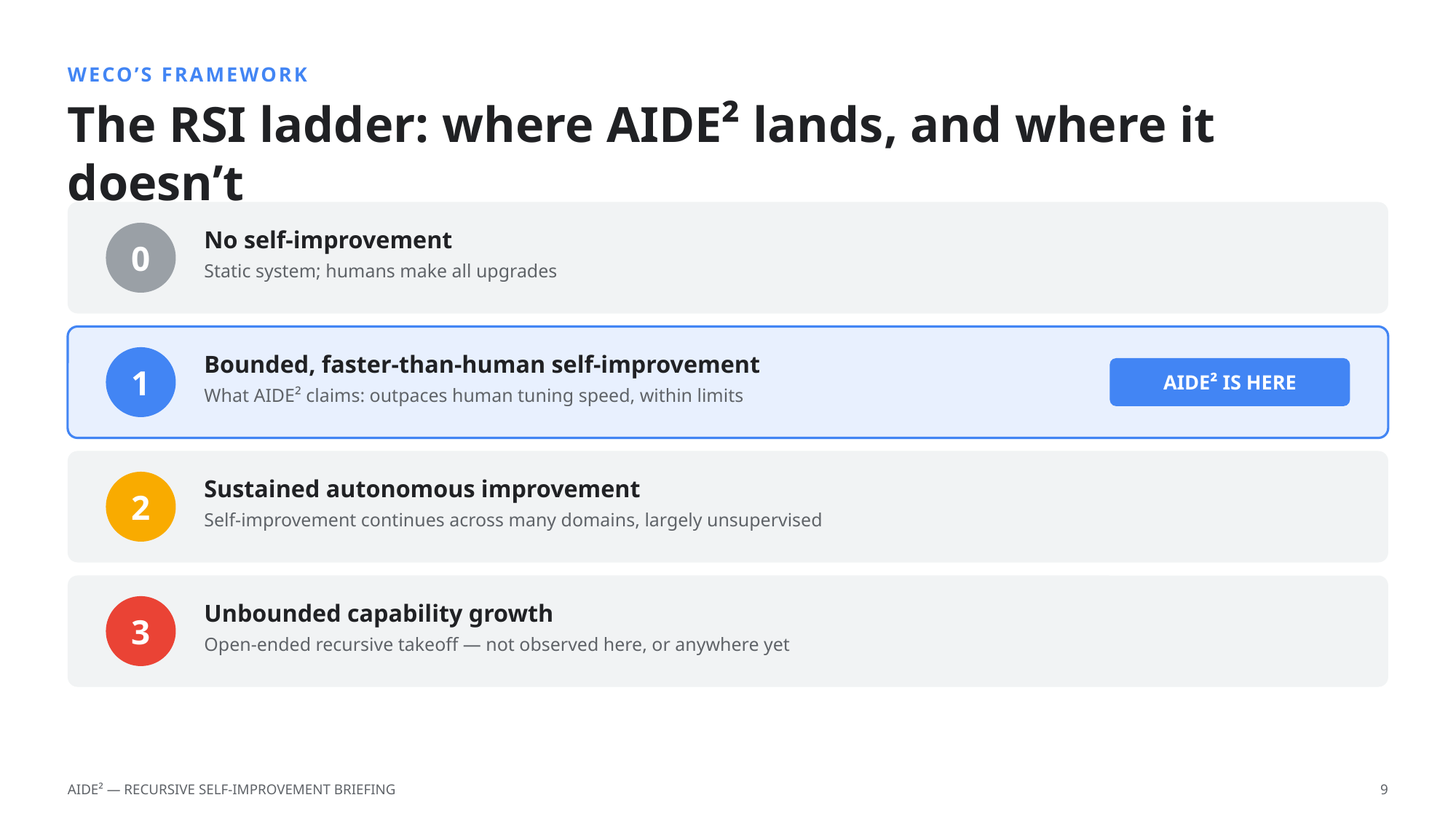
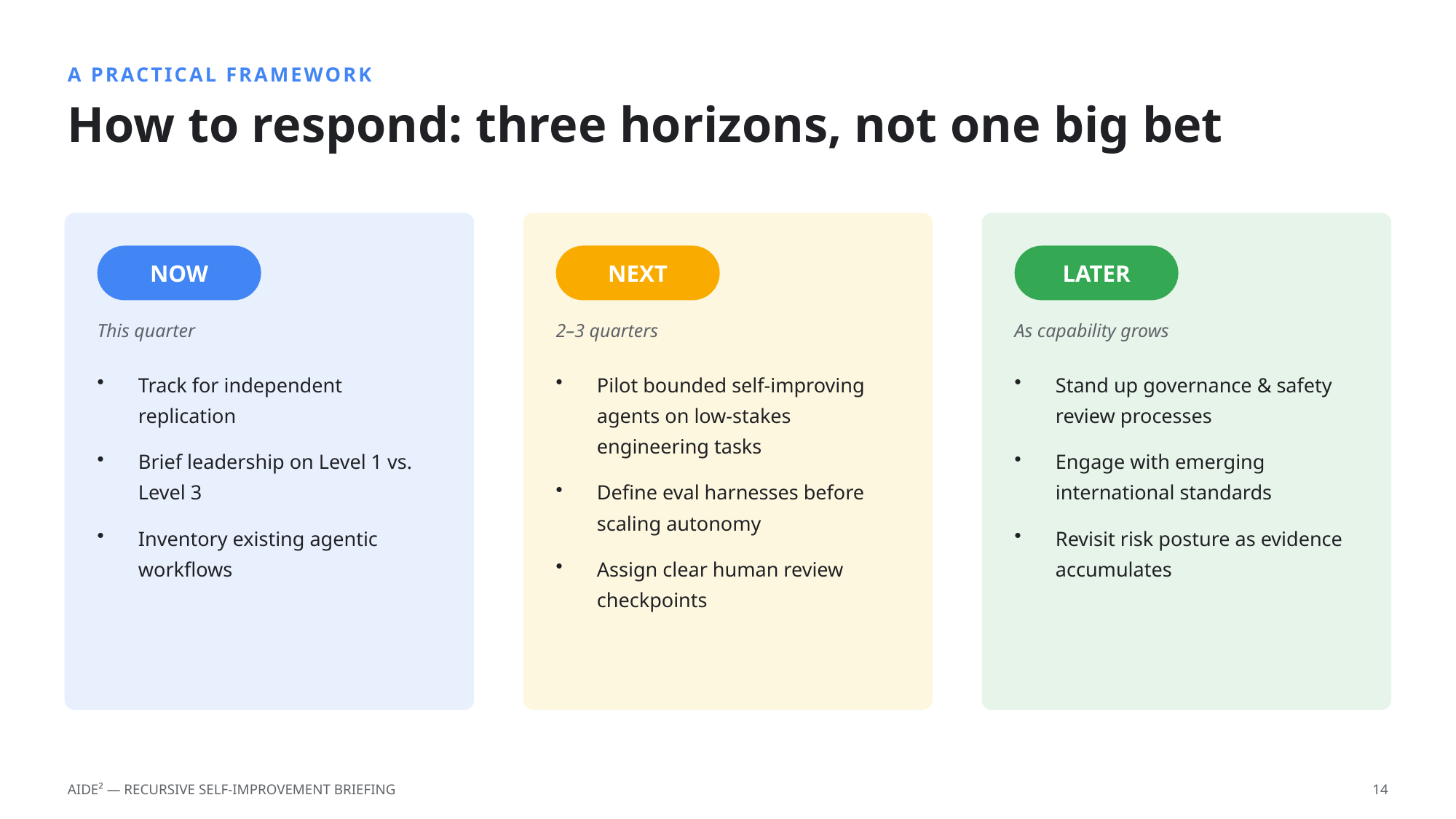
Weco is careful not to claim anything close to an “intelligence explosion.” It grades its own result as Level 1 on a four-level ladder from its companion report on RSI levels: Level 0 is delegation, a loop that runs research end to end but more slowly than a human team; Level 1, “net positive,” improves itself more efficiently than humans improving the same system by hand; Level 2, “ignition,” is when the system improves its own ability to improve itself, so a newly discovered agent becomes a better improver than the one it replaced; Level 3, “inflection,” is when improvement compounds faster than the problem gets harder, the scenario people actually mean by an intelligence explosion.
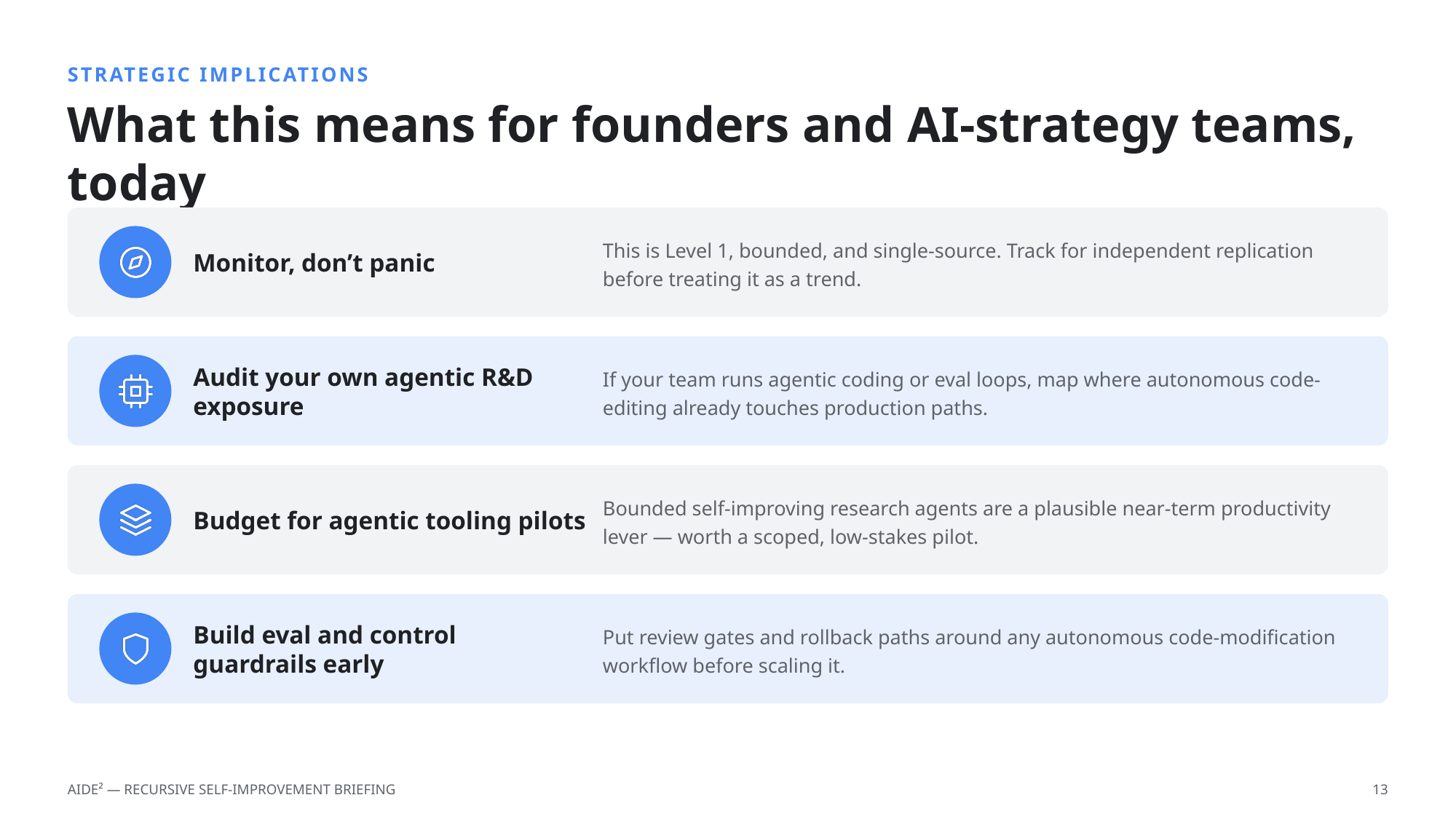
Weco tested for ignition and found the result inconclusive: a discovered agent reached the same ceiling with fewer steps in the outer-loop seat, but the gain was not statistically significant.
Why is this landing now?
Weco’s report arrived days after Google DeepMind’s CEO, Demis Hassabis, published an essay calling for global rules on exactly this class of system. Hassabis argued that “on the horizon, we will need robust safeguards to maintain control of increasingly agentic, recursively self-improving systems,” and proposed a new standards body modeled on financial industry regulation to test frontier models before release.
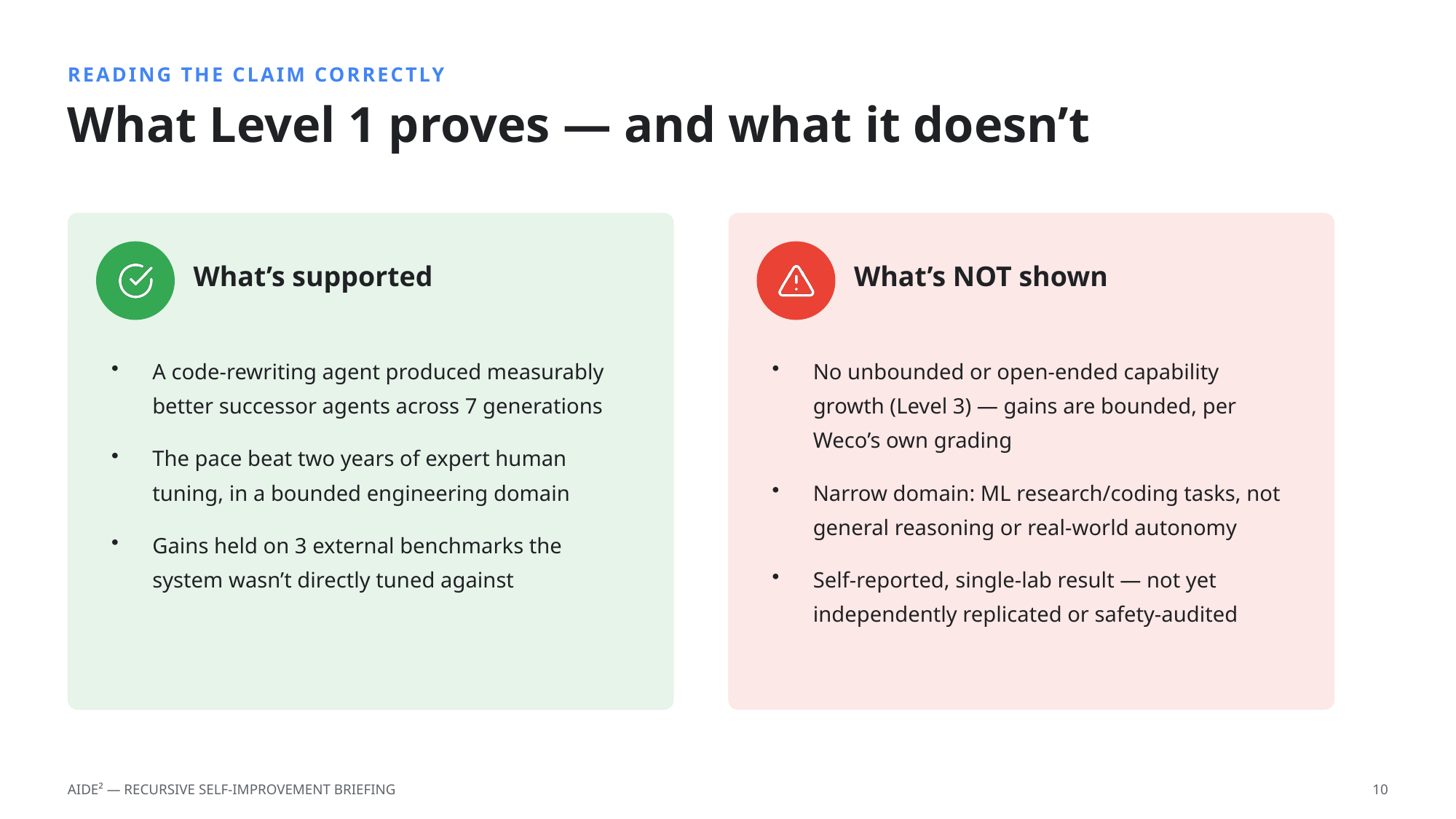
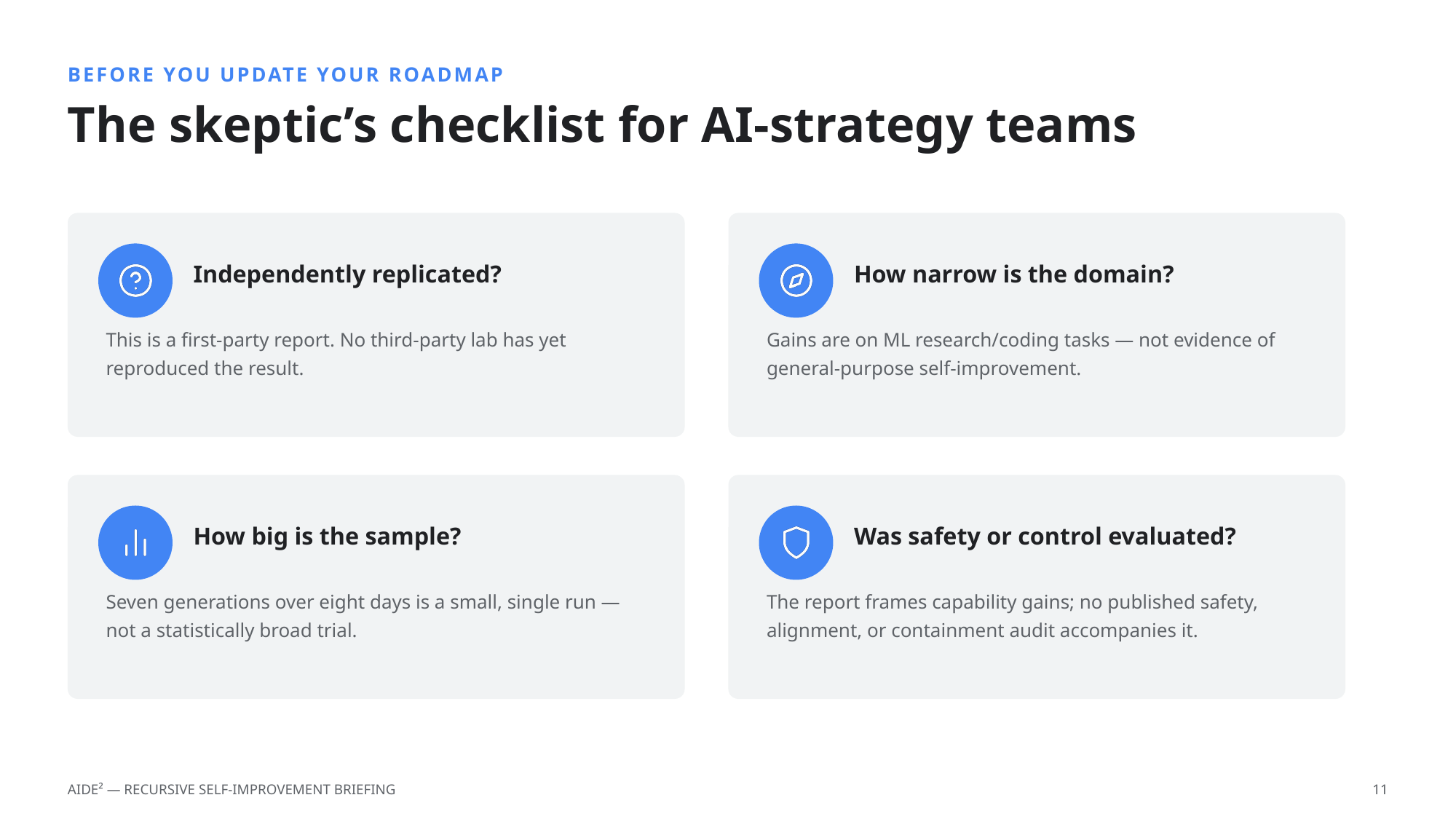
That proposal targets frontier models broadly, not Weco’s narrower experiment, but the overlap sharpens a question AI-strategy teams now have to answer: is self-improving AI still hypothetical, or a measurable trend with real numbers behind it. A sustained, fixed-budget result that generalizes to unseen tasks is a genuine data point, not evidence that AI systems are compounding their own capability unchecked.
Does this mean AI is improving itself without human oversight?
Not in the way that phrase implies. AIDE² ran unattended for eight days on a defined set of tasks, under a fixed budget, inside an evaluation harness humans built and controlled. Weco stops short of calling this ignition; it is a bounded, measured efficiency gain in a narrow research setting.
The example deck below walks through this same ladder and loop architecture in slide form, built with AskDeck from a short brief, ready to download and adapt.