A support ticket lands in your queue. Routing it used to mean a brittle keyword rule or a full call to a large language model that writes a paragraph you then parse. A new class of AI model skips both and just answers.
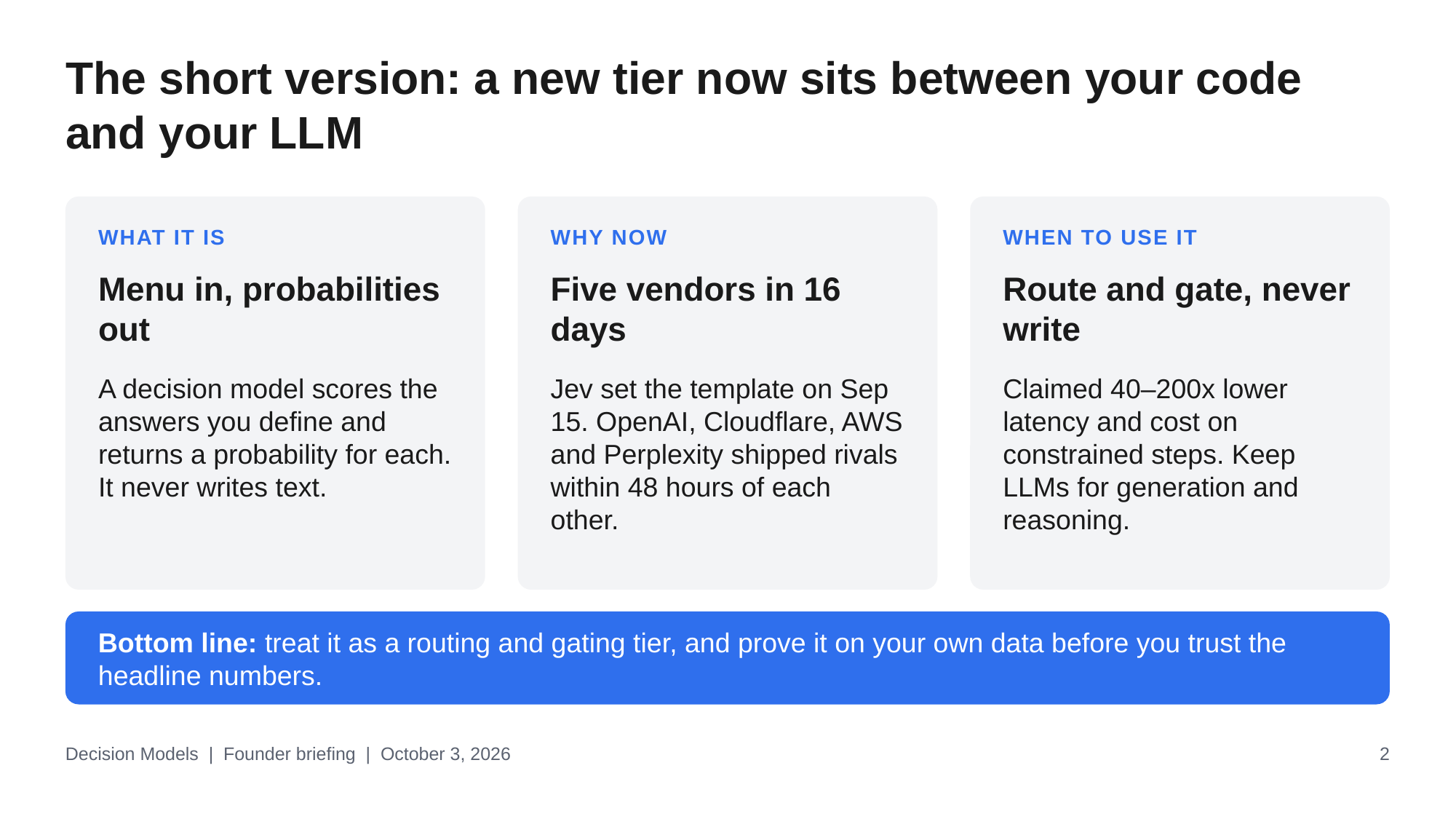
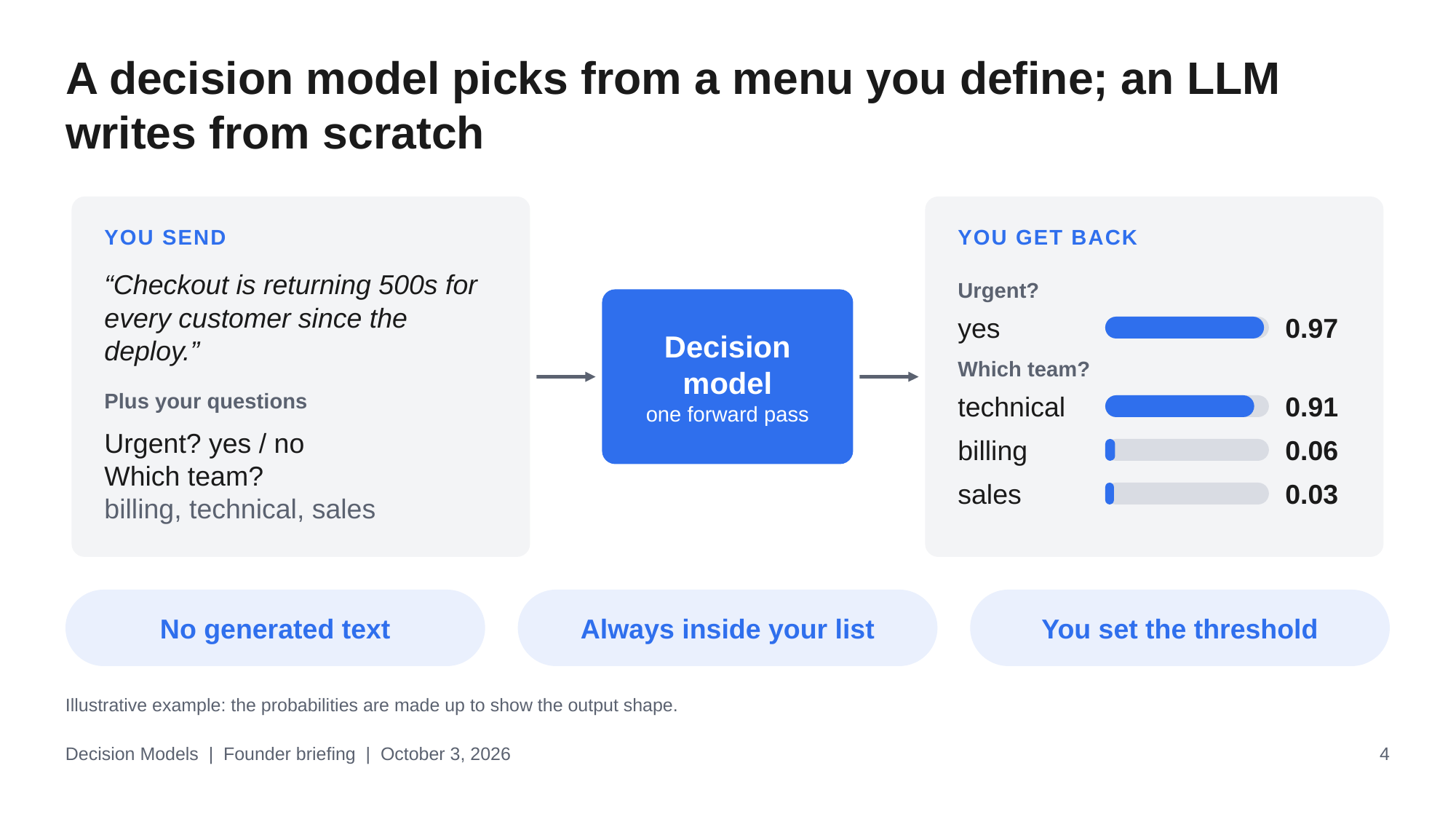
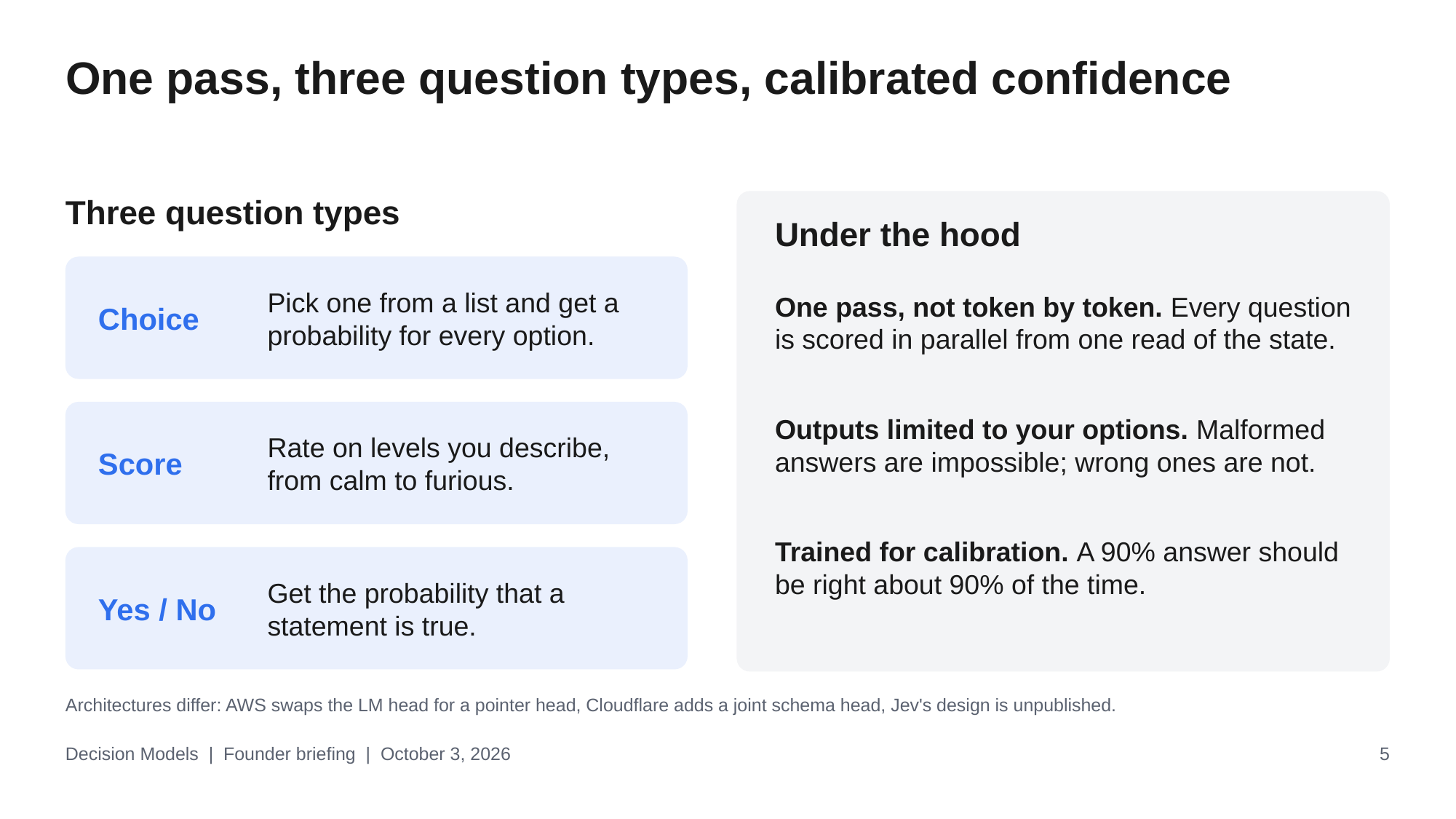
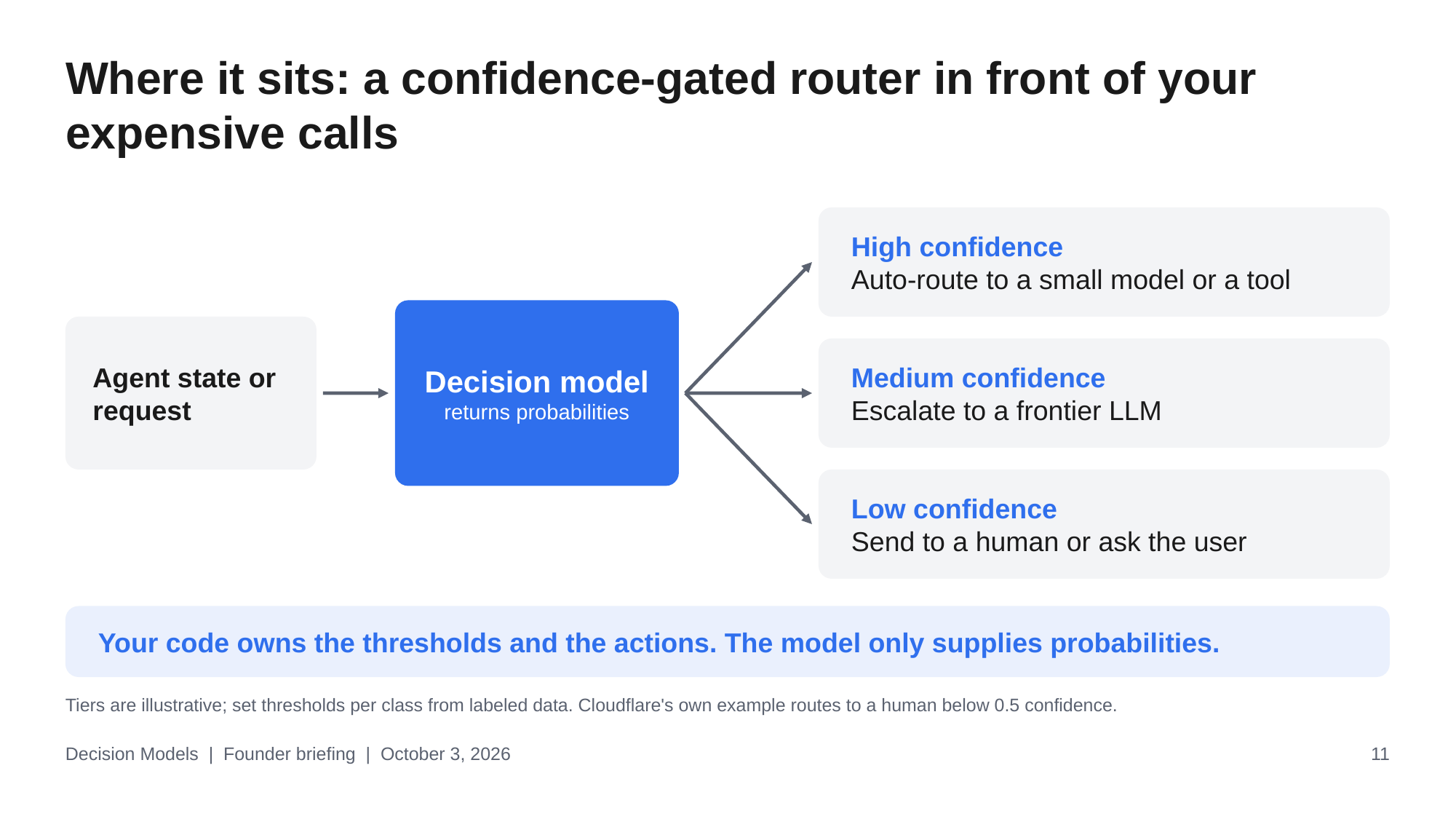
It’s called a decision model: instead of generating text, it reads a piece of state (a message, document, or image) against questions defined in advance, then returns a probability for each allowed answer, a yes or no, a choice, or a score.
Key Takeaways
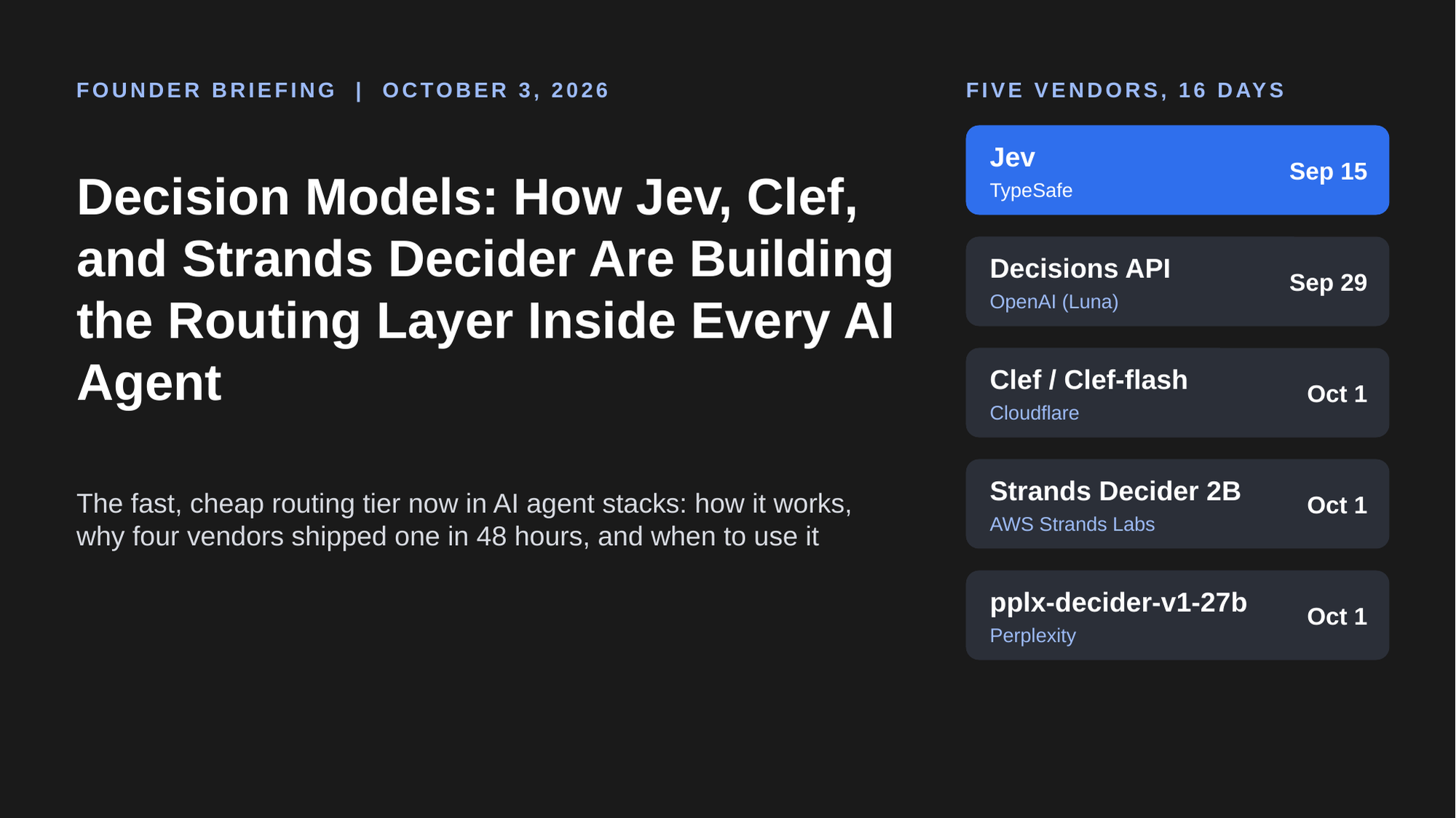
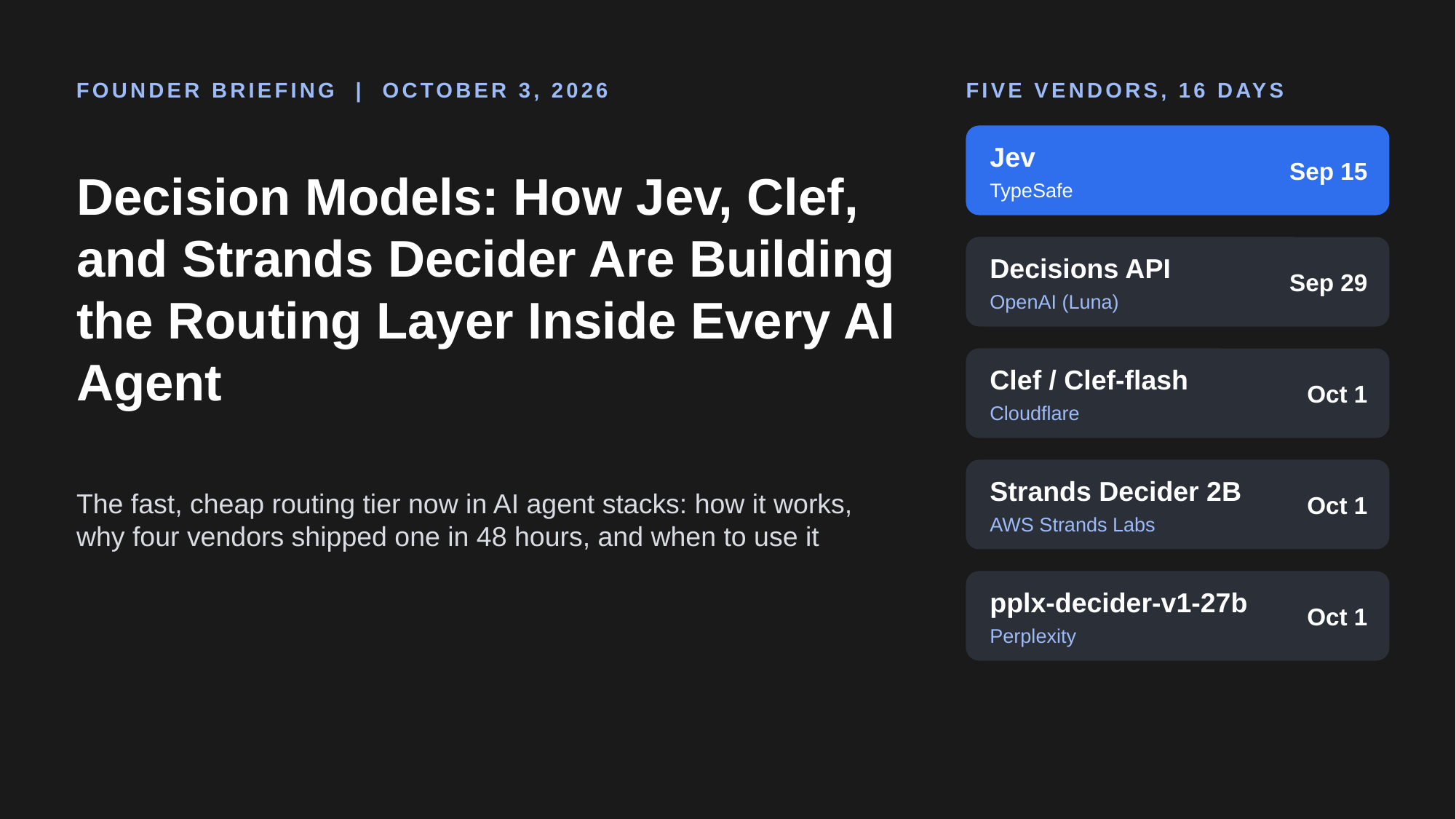
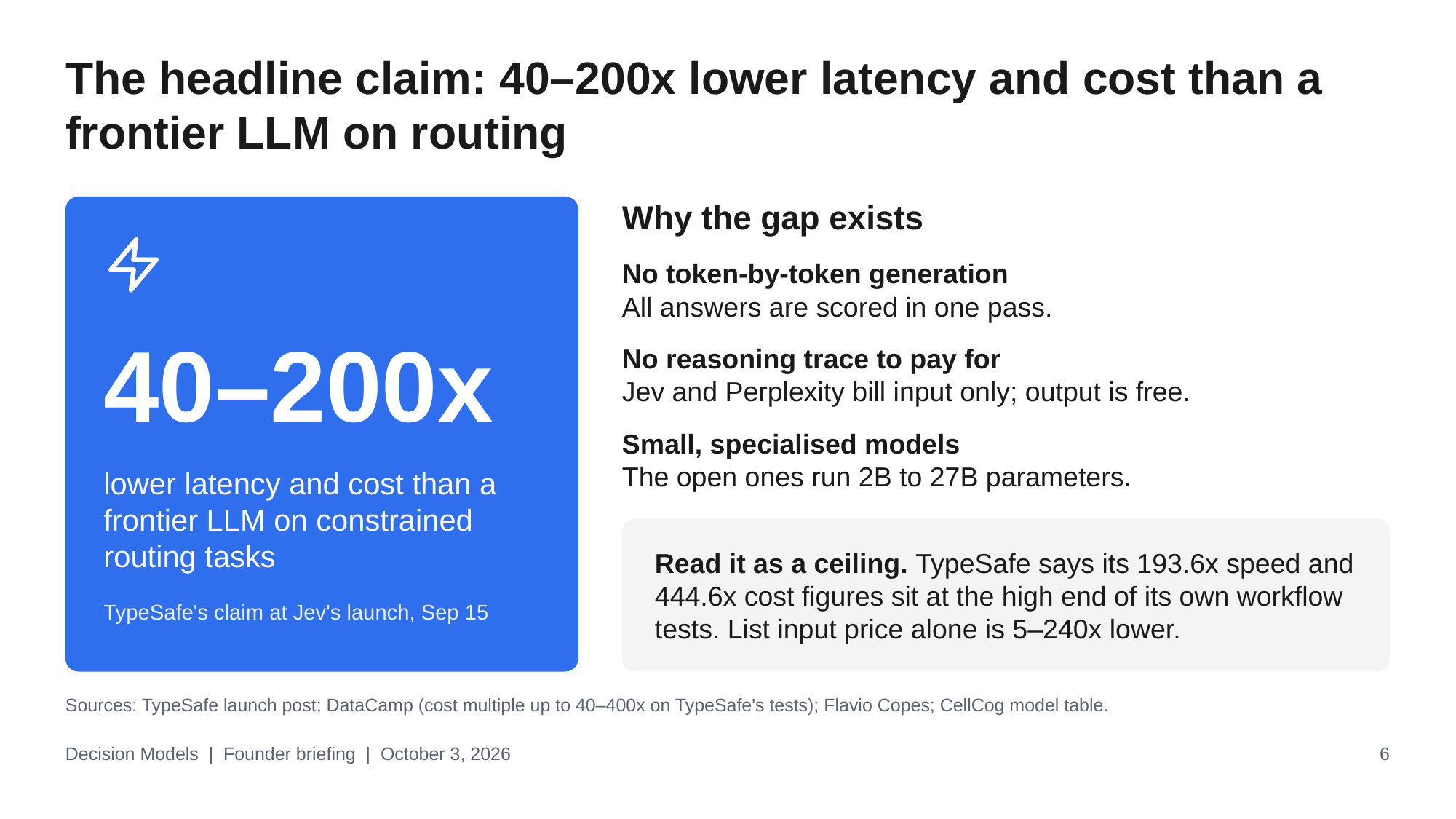
- TypeSafe AI’s Jev, launched September 15, 2026, started the category as the first “System One model,” priced at $0.042 per million input tokens with free output, claiming 40 to 200 times lower cost and latency than frontier LLMs.
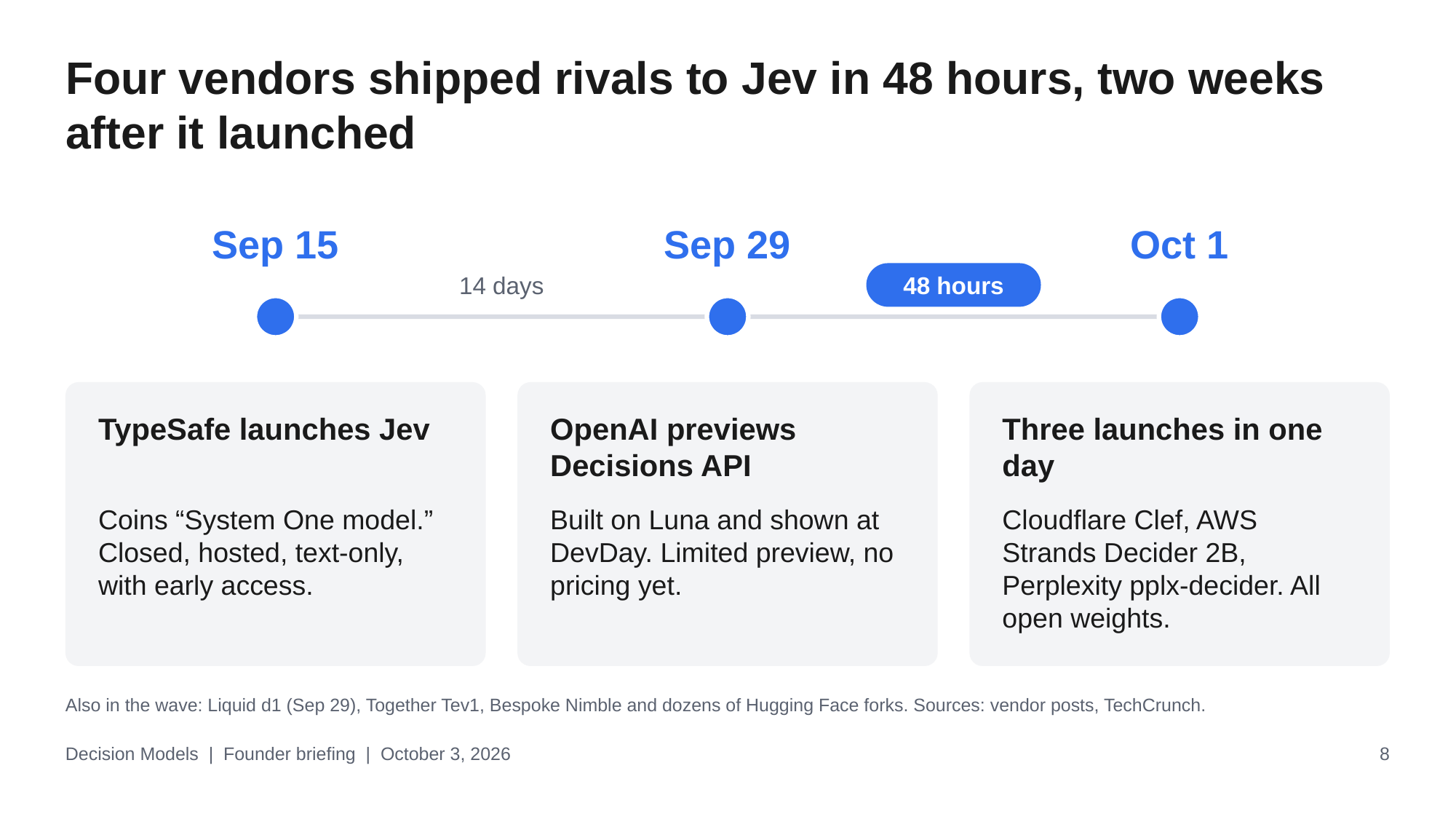
- On October 1, 2026, Cloudflare, AWS, and Perplexity each shipped open-weight rivals under Apache 2.0, and OpenAI added a Decisions API built on its Luna model.
- All return typed, calibrated probabilities over a fixed answer set instead of free text, meant for routing and classification inside AI agents.
A set of 15 example slides on this shift sits below this post, built by AskDeck from a short brief, worth a skim for the architecture at a glance. Back to the substance.
Swipe or scroll sideways to flip through the 15-slide deck →
What Is a Decision Model, Exactly?
A decision model makes structured decisions that software can act on directly, never a written reply. Perplexity’s documentation puts it plainly: it reads text and images like a multimodal model does, but instead of writing prose it returns typed answers with probabilities, no reasoning spelled out in words (Perplexity docs).
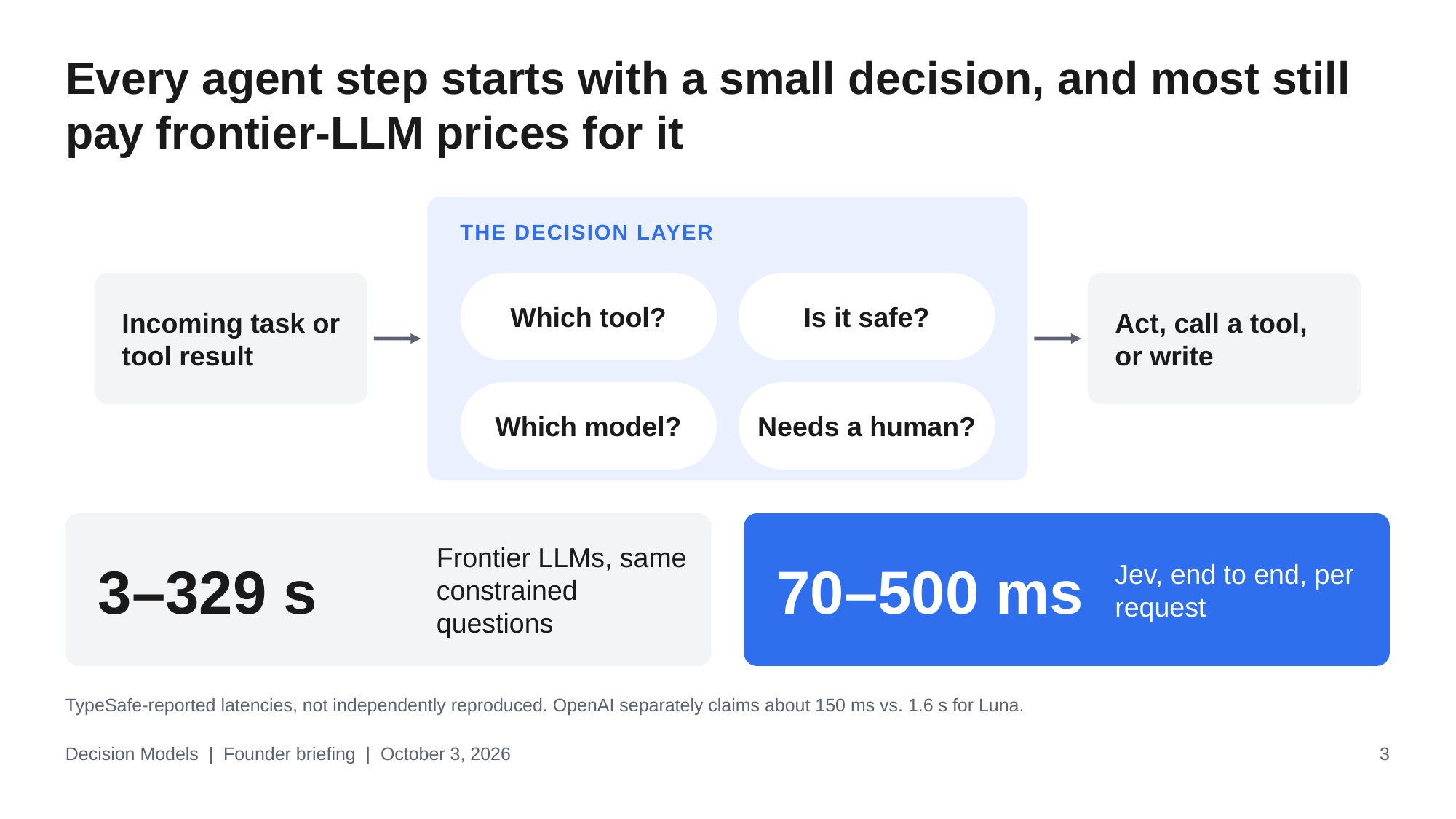
Cloudflare frames it around the job: pass in a support message, ask if it’s urgent and which team owns it, and the typed answer lets your code route the ticket or defer to a human (Cloudflare). A generative LLM reasons and writes open-ended text, useful but slower for what is really a lookup.
Why Did Four Vendors Ship a Rival in 48 Hours?
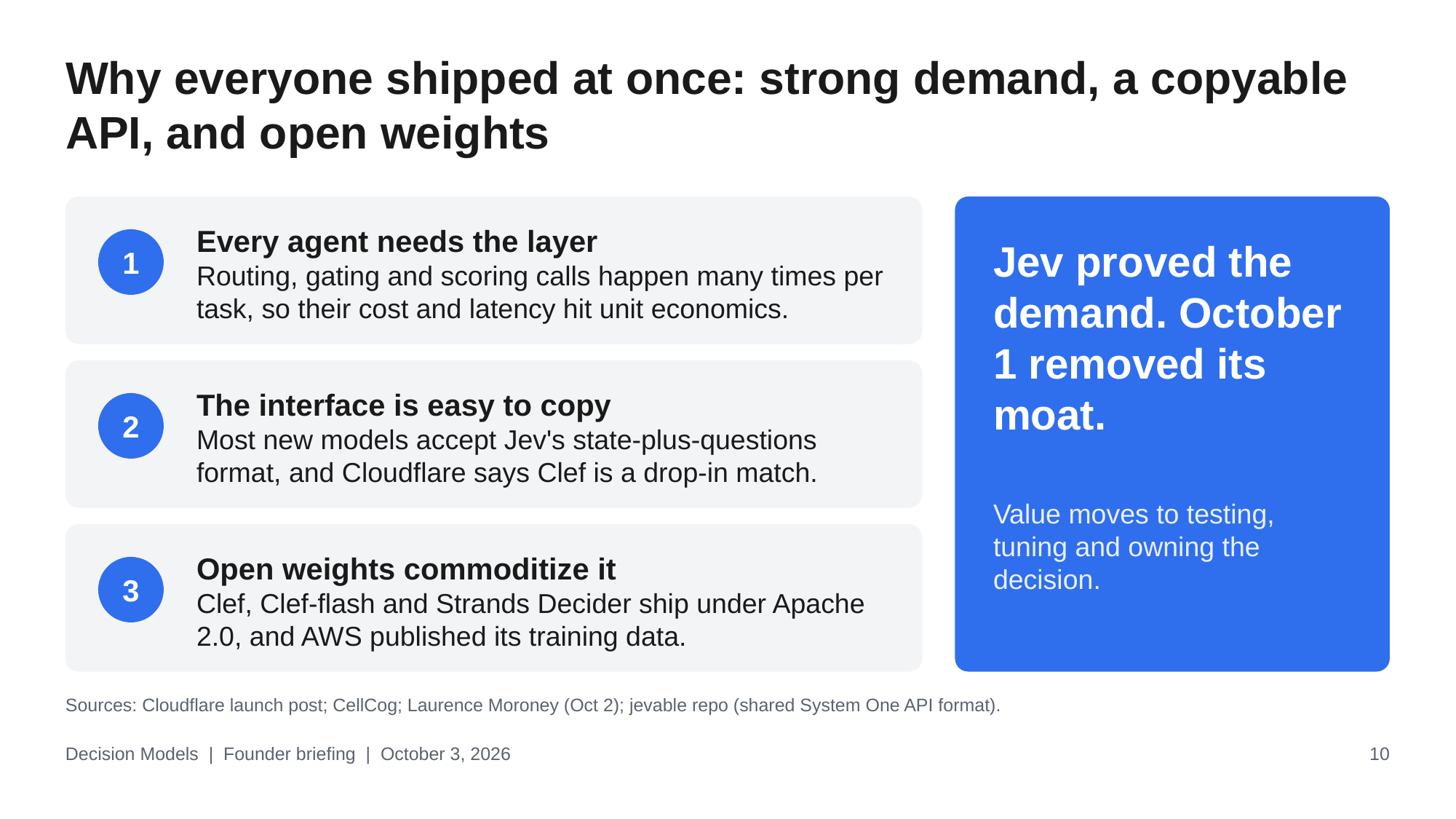
Jev proved the demand, and copying it was cheap. TypeSafe AI, a San Francisco lab founded by Diogo Almeida, a former InstructGPT co-author at OpenAI, left stealth on September 15, 2026 with $40 million in seed funding. “System One” nods to Kahneman’s fast, intuitive System 1 thinking versus slow System 2 reasoning; Jev honors economist William Stanley Jevons, whose paradox says cheaper access to a resource grows total demand for it.
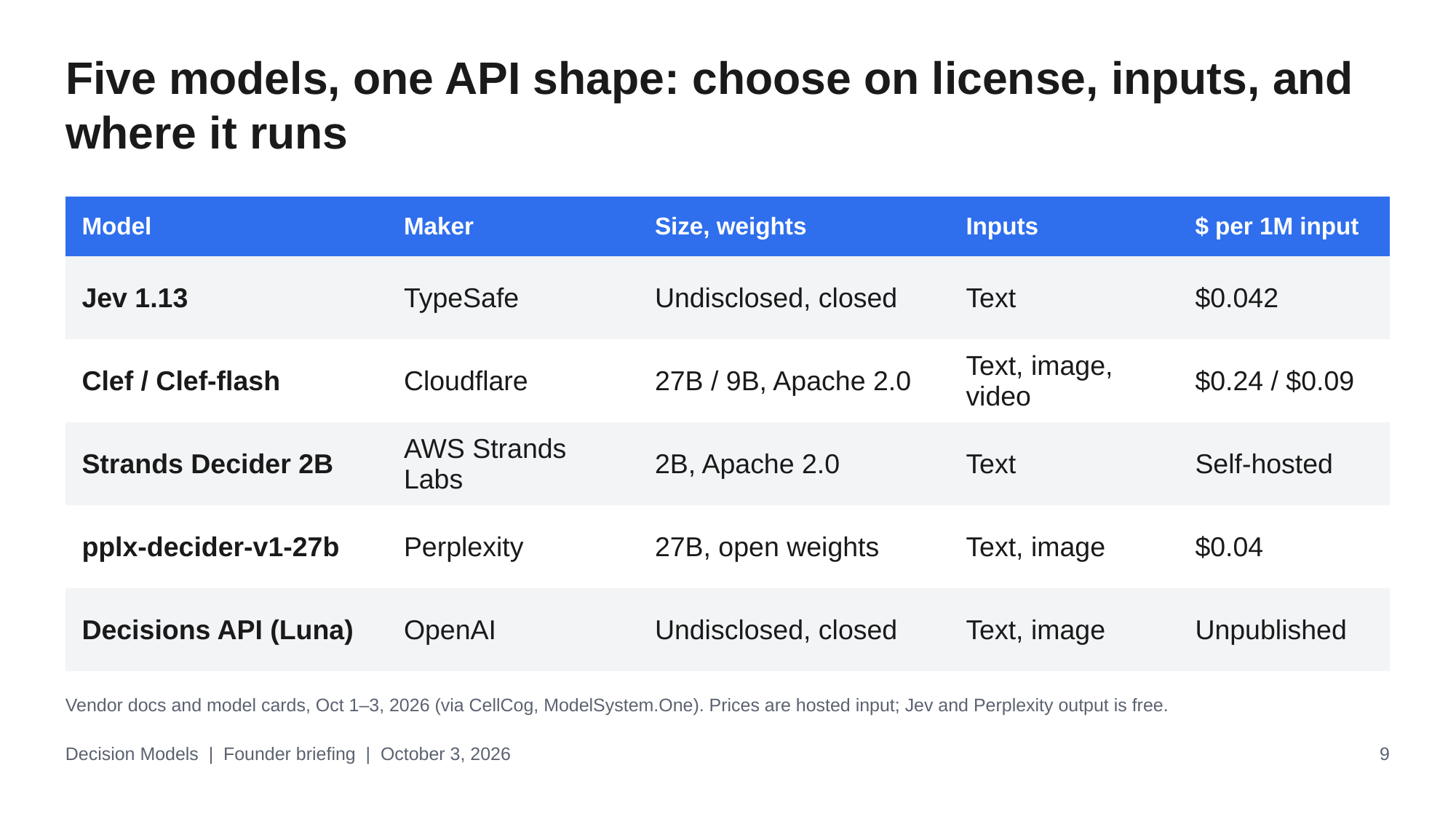
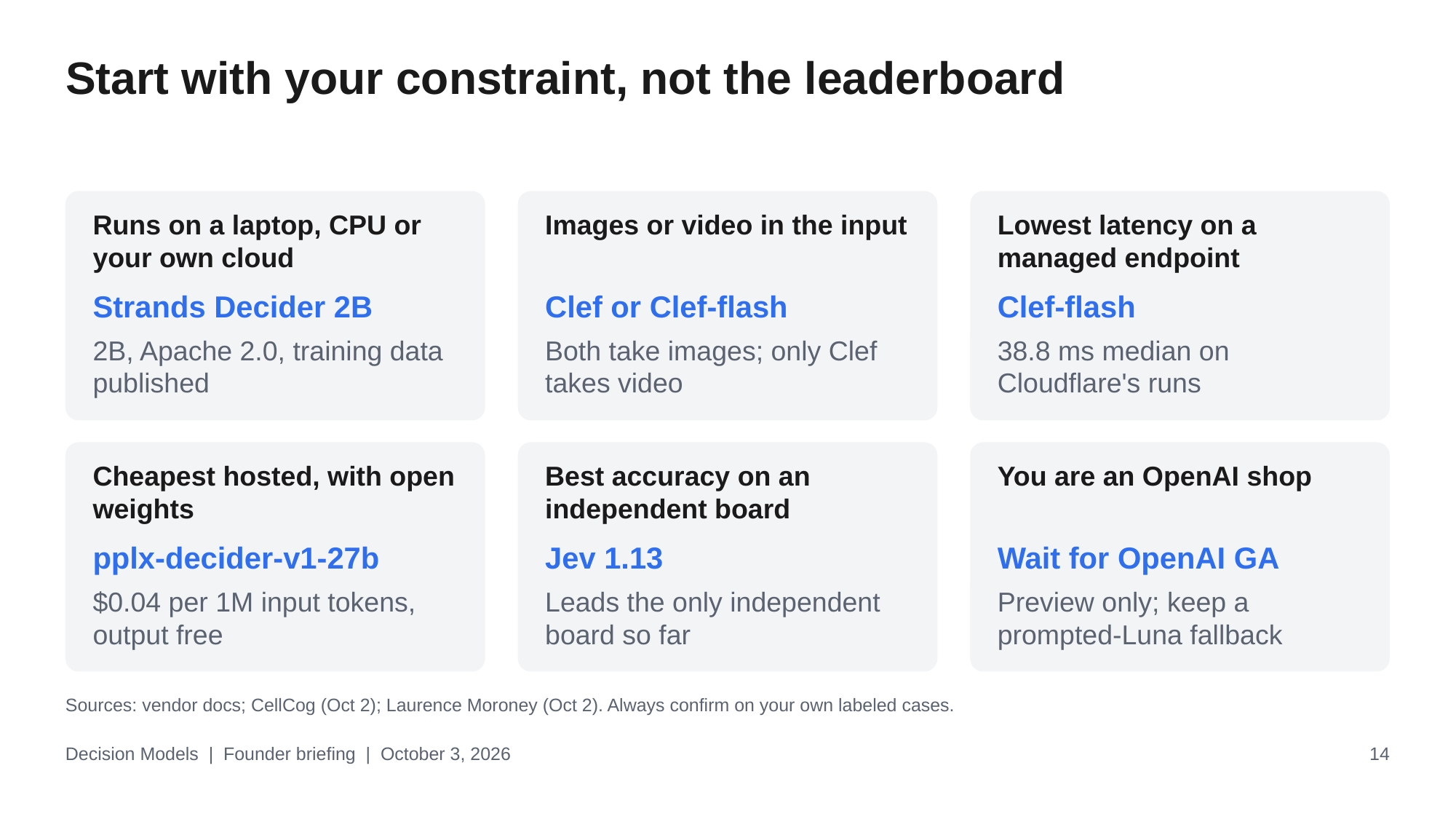
By October 1, Cloudflare had open-sourced Clef and Clef-flash under Apache 2.0, adding a vision encoder and a 64,000-token window against Jev’s 32,000. AWS’s Strands Labs released a smaller, local model built on Qwen3.5-2B, its text head swapped for a small “pointer” head that scores answer options. Perplexity shipped pplx-decider-v1-27b at $0.04 per million input tokens, and OpenAI added a Decisions API running cheap GPT-6 Luna, shown at DevDay on September 29.
How Much Cheaper and Faster Are These Than a Frontier LLM?
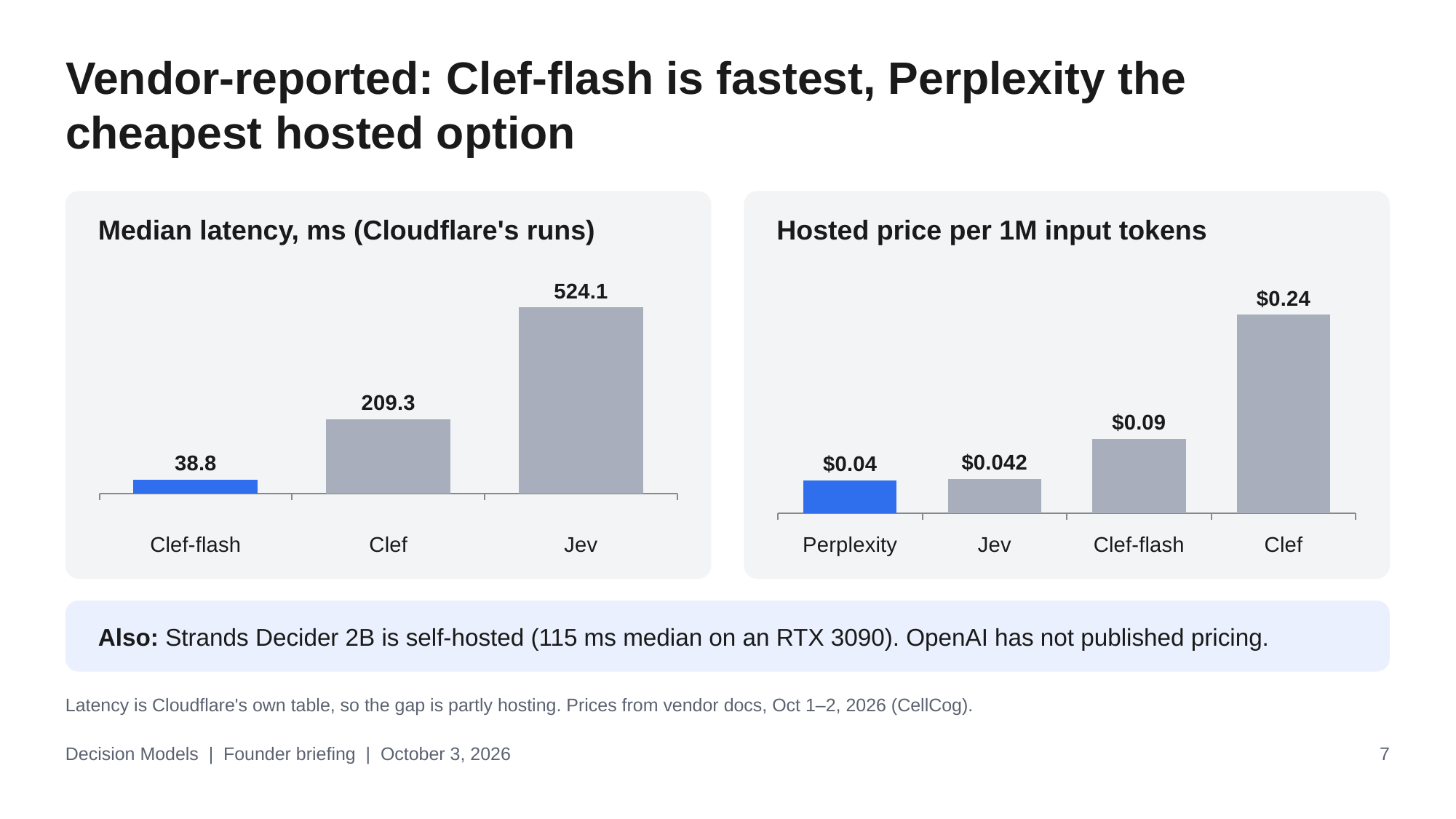
The gap is large enough to change build economics for teams running thousands of routing calls daily, though every figure below is self-reported:
| Model | Maker | Price | Typical latency | License |
|---|---|---|---|---|
| Jev | TypeSafe AI | $0.042/M input, free output | ~70-500ms hosted | Closed, hosted |
| Clef-flash | Cloudflare | Hosted on Workers AI | ~39ms median | Apache 2.0, open |
| Strands Decider 2B | AWS Strands Labs | Free, self-hosted | ~106-115ms median | Apache 2.0, open |
| pplx-decider-v1-27b | Perplexity | $0.04/M input, free output | Under 2s short prompts | Apache 2.0, open |
| Decisions API (Luna) | OpenAI | Unpublished, preview | ~150ms claimed | Closed, preview |
On hardware it controlled directly, AWS measured a 106-millisecond median and 296-millisecond 95th percentile across 230 requests on a local RTX 3090, round trip included, against TypeSafe’s reported 70 to 500 milliseconds for hosted Jev (VentureBeat).
Where Should You Actually Use One?
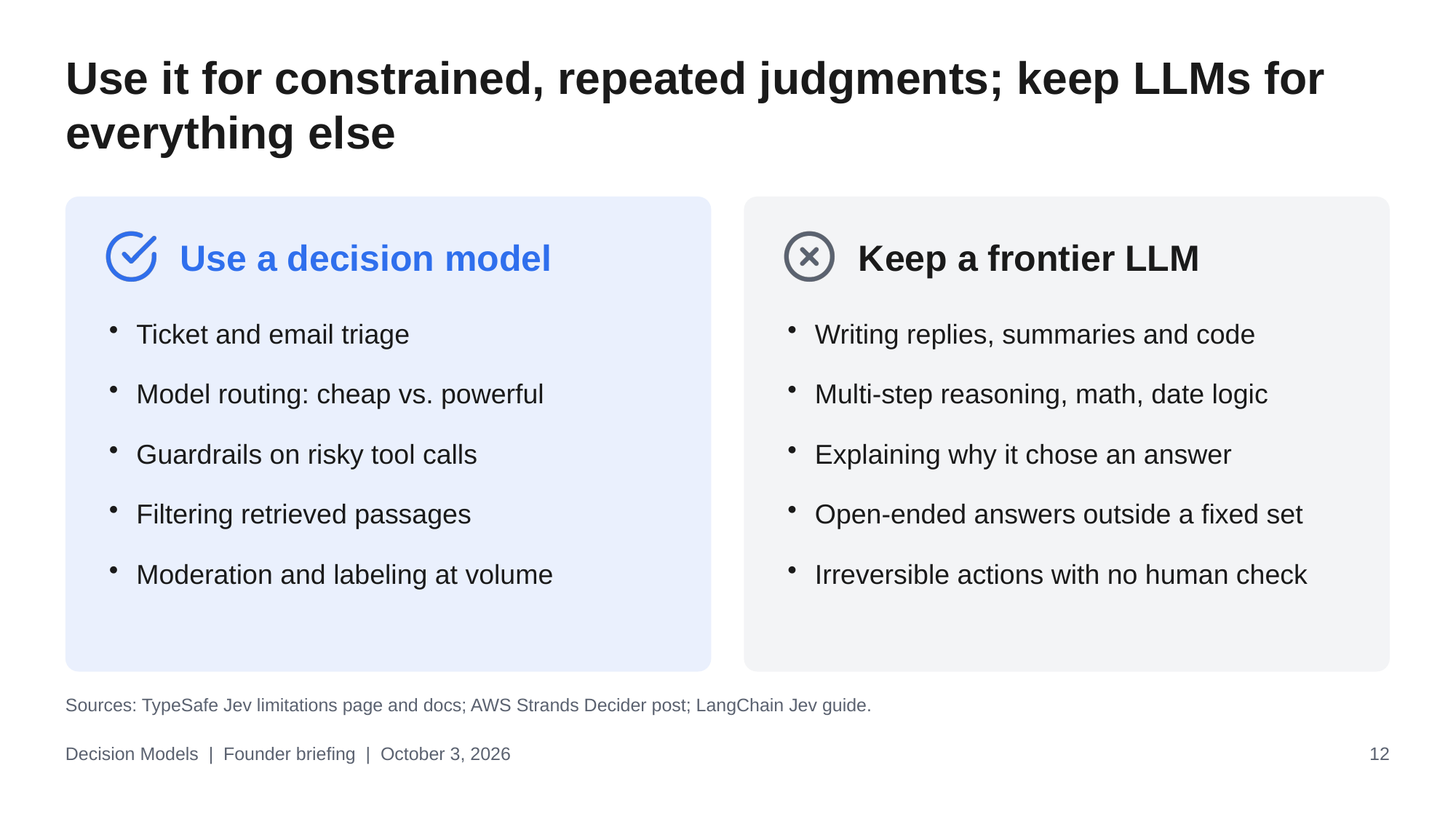
Use a decision model wherever the answer is a lookup: ticket routing, tool-call gating, moderation, or filtering retrieved passages before a generative model writes anything. A narrow, fast checkpoint sits beside a bigger model, which keeps the open-ended reasoning. AWS’s release gates a weather-tool call this way, checking whether the city argument is grounded in what the user said before the tool fires; Perplexity’s cookbook routes tickets the same way, sending only hard cases to a full agent.
What Are the Limits and Risks?
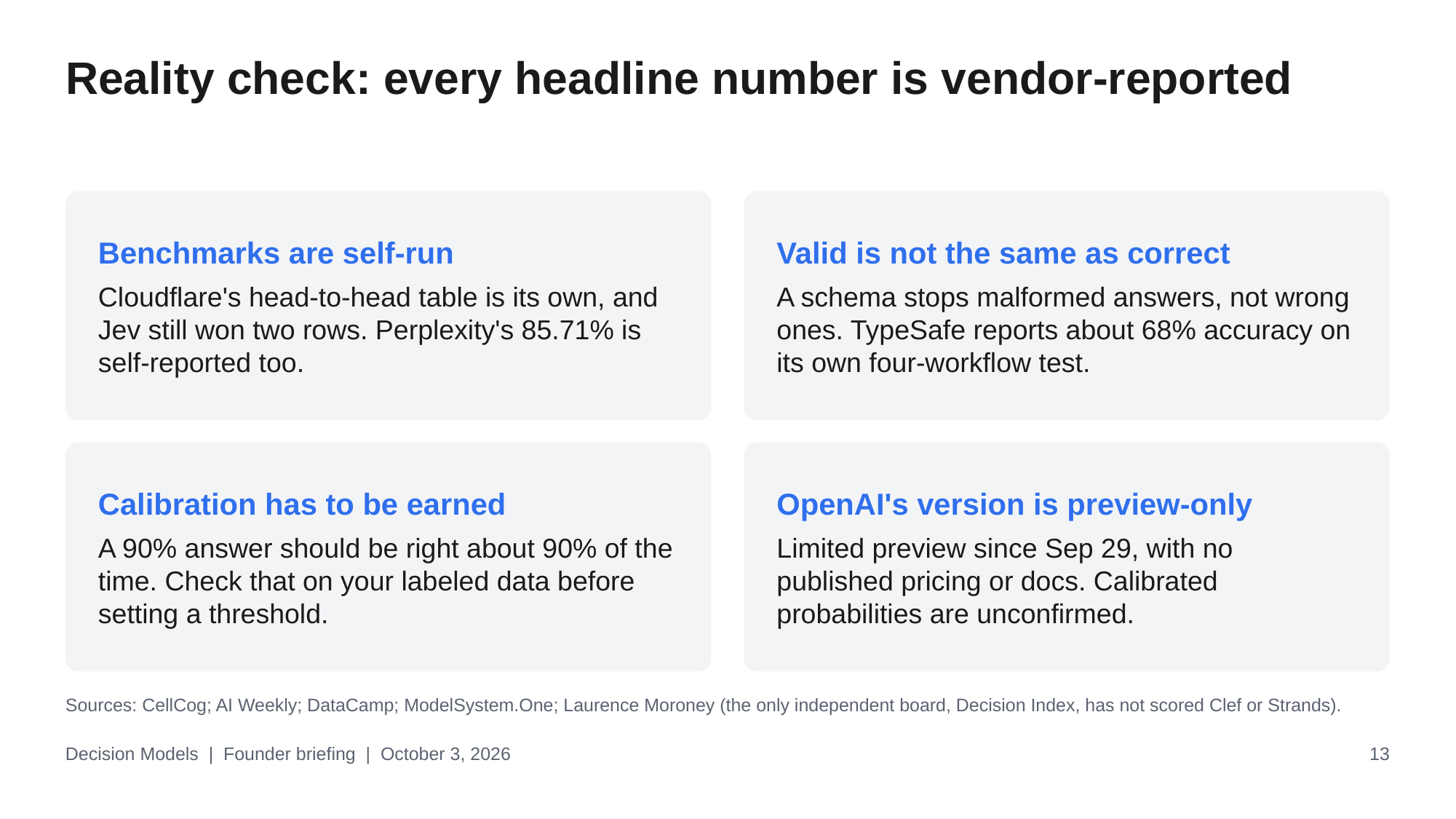
A valid answer isn’t automatically a correct one, and every headline benchmark here comes from the vendor that built the model. Perplexity’s own panel put its model at 85.71% overall against Jev’s 84.51%, yet Jev still won tests like WinoGrande and BBH, a reminder that one average score hides which model fits a given job.
Confidence scores need independent checking before they gate automated actions. One outside test of a Luna-based approach found 99%-confidence answers were right only 68% of the time across 3,600 problems, a real gap for anything run unsupervised. A related worry: adversarial text in an agent’s input can shift the verdict a decision model returns, so it is not an infallible boundary alone.
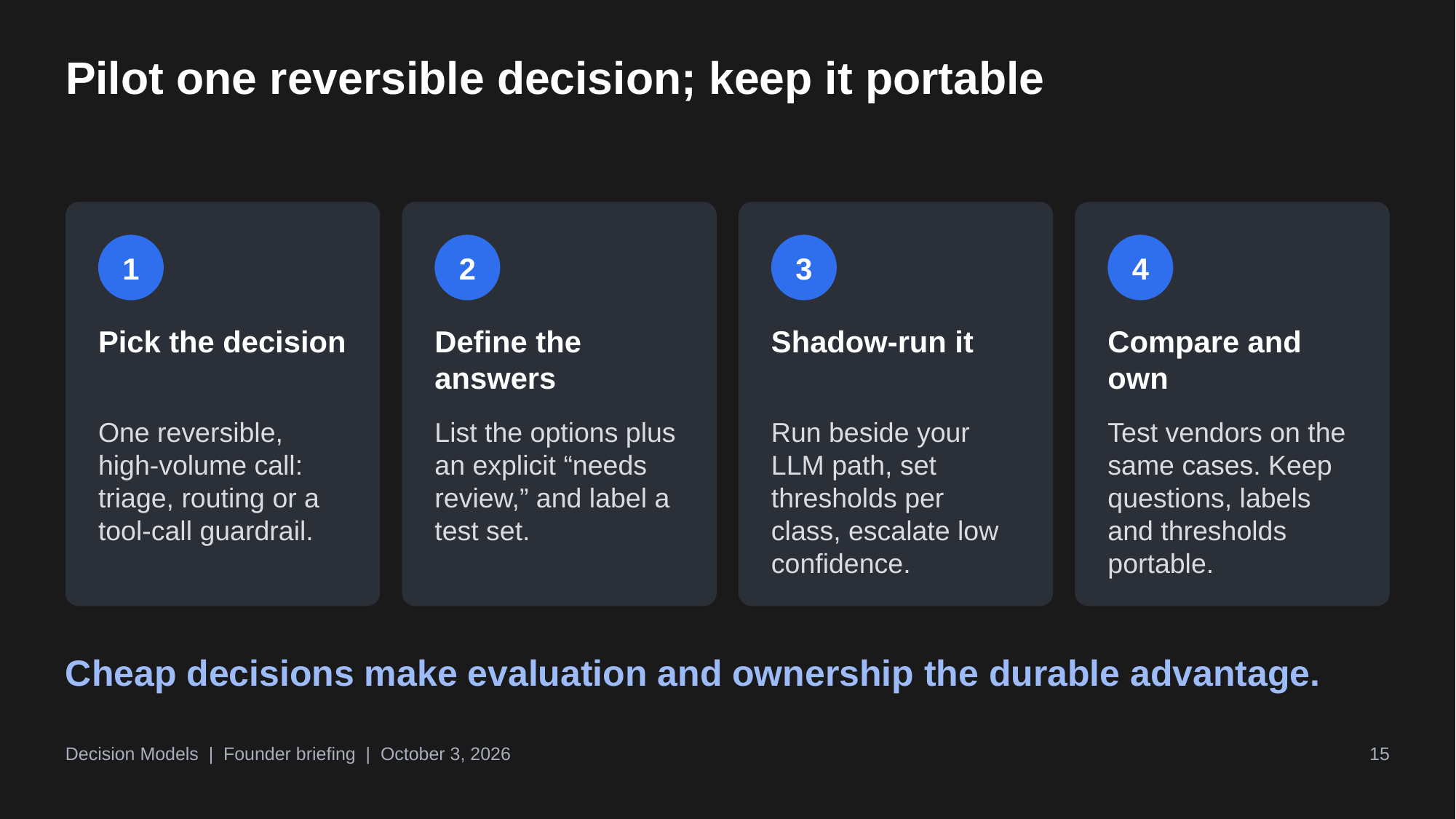
If you want the short version, the 15-slide deck below walks through the before-and-after agent architecture and a side-by-side of the four releases. It was built with AskDeck from a brief, and it’s there to download and edit.