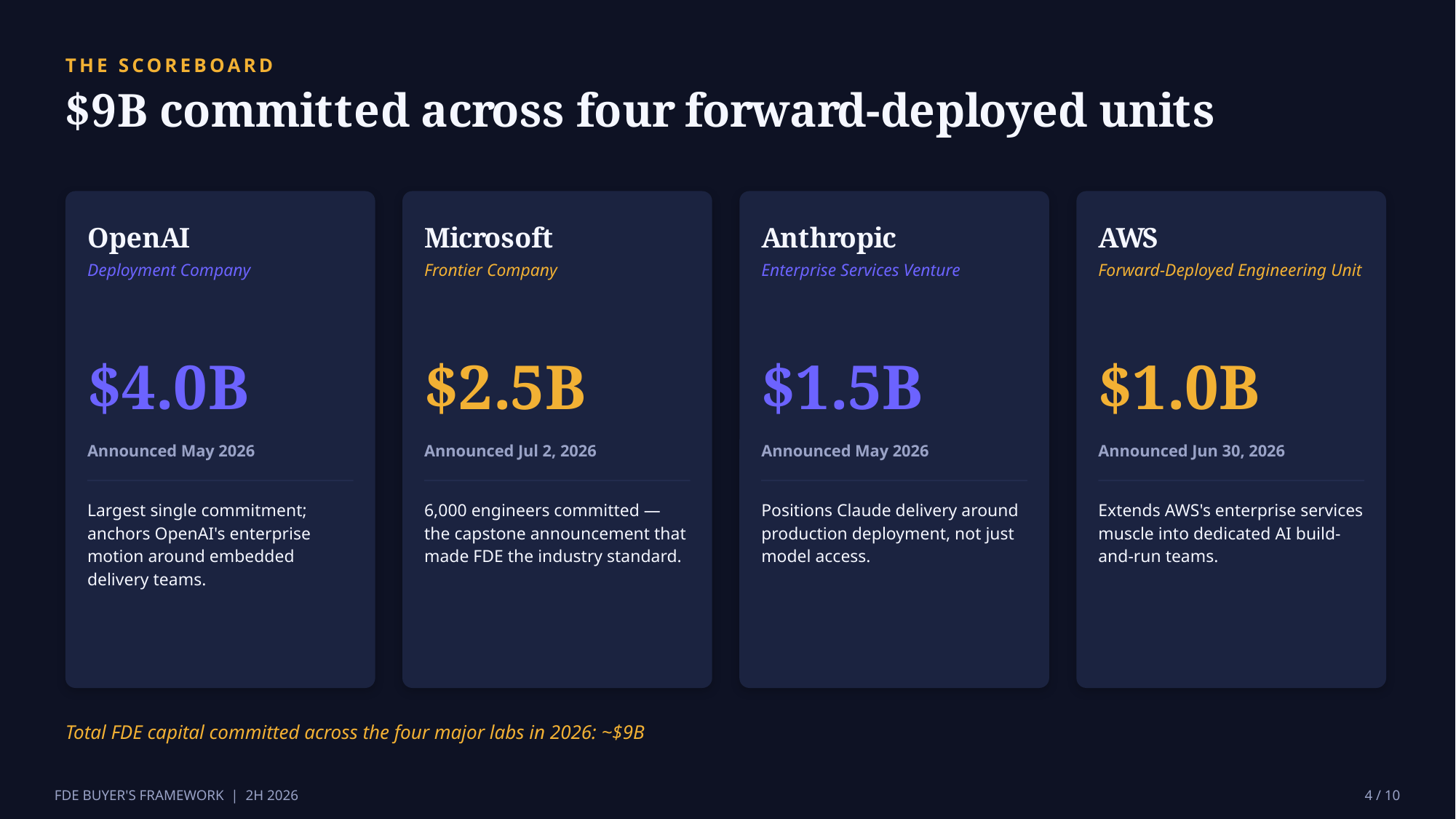
Four companies committed roughly $9 billion in nine weeks to the same idea: the way to sell enterprise AI is to stop selling software and start sending engineers to live inside the customer’s business until the thing actually works.
Key takeawaysMicrosoft, AWS, OpenAI, and Anthropic have committed roughly $9B combined to forward-deployed engineering (FDE) units since May 2026.The trigger: an MIT study found the vast majority of enterprise generative AI pilots show no measurable P&L impact.Microsoft’s $2.5B, 6,000-person Frontier Company (July 2) is the largest single commitment; AWS’s $1B unit (June 30) is the first from a hyperscaler.The model, pioneered by Palantir over a decade ago, embeds vendor engineers inside a client to build production systems, not demos.
Swipe or scroll sideways to flip through the 10-slide deck →
What is forward-deployed engineering?
Forward-deployed engineering (FDE) means a vendor sends its own engineers to sit inside a customer’s operations and build the system there, rather than shipping software and walking away. The term traces back to Palantir, which embedded engineers with intelligence-agency clients in the early 2010s because those customers could not fully specify what they needed. Palantir called the role “Delta,” and by 2016 it reportedly employed more forward-deployed engineers than conventional software engineers.
The pitch for AI vendors today is similar. Enterprise value depends on grounding a system in one company’s own data and workflows, so rather than betting a customer’s IT team can configure that fit alone, the vendor puts an engineer in the room to build it directly.
Why did four labs commit $9 billion in nine weeks?
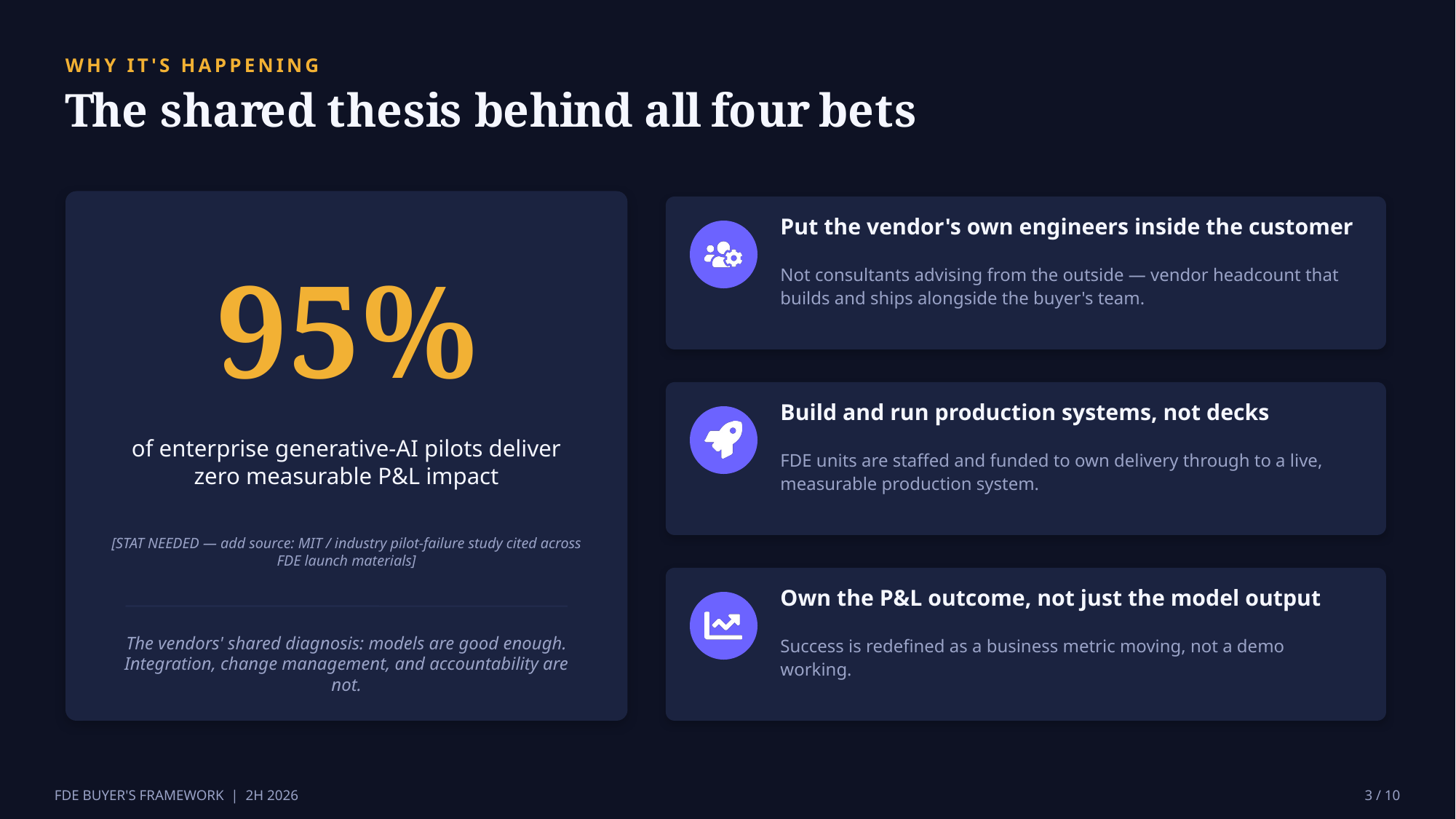
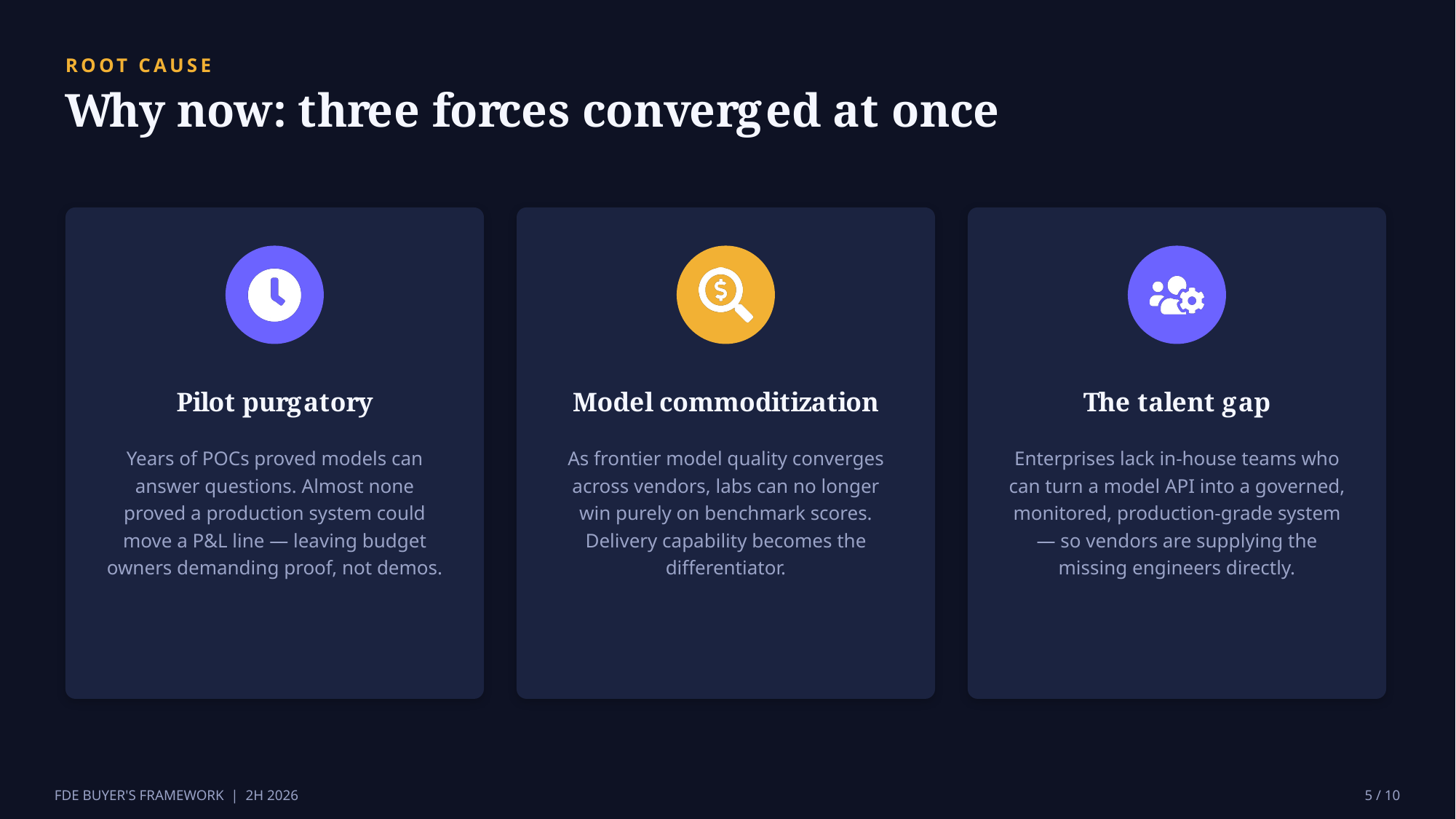
The proximate cause is a widely cited MIT Media Lab study from Project NANDA: about 5% of AI pilots achieve rapid revenue impact, while the vast majority stall with little to no measurable effect on profit and loss. That finding turned “why isn’t our AI pilot working” into 2026’s defining enterprise question, and every major lab decided the fix was engineers on-site.
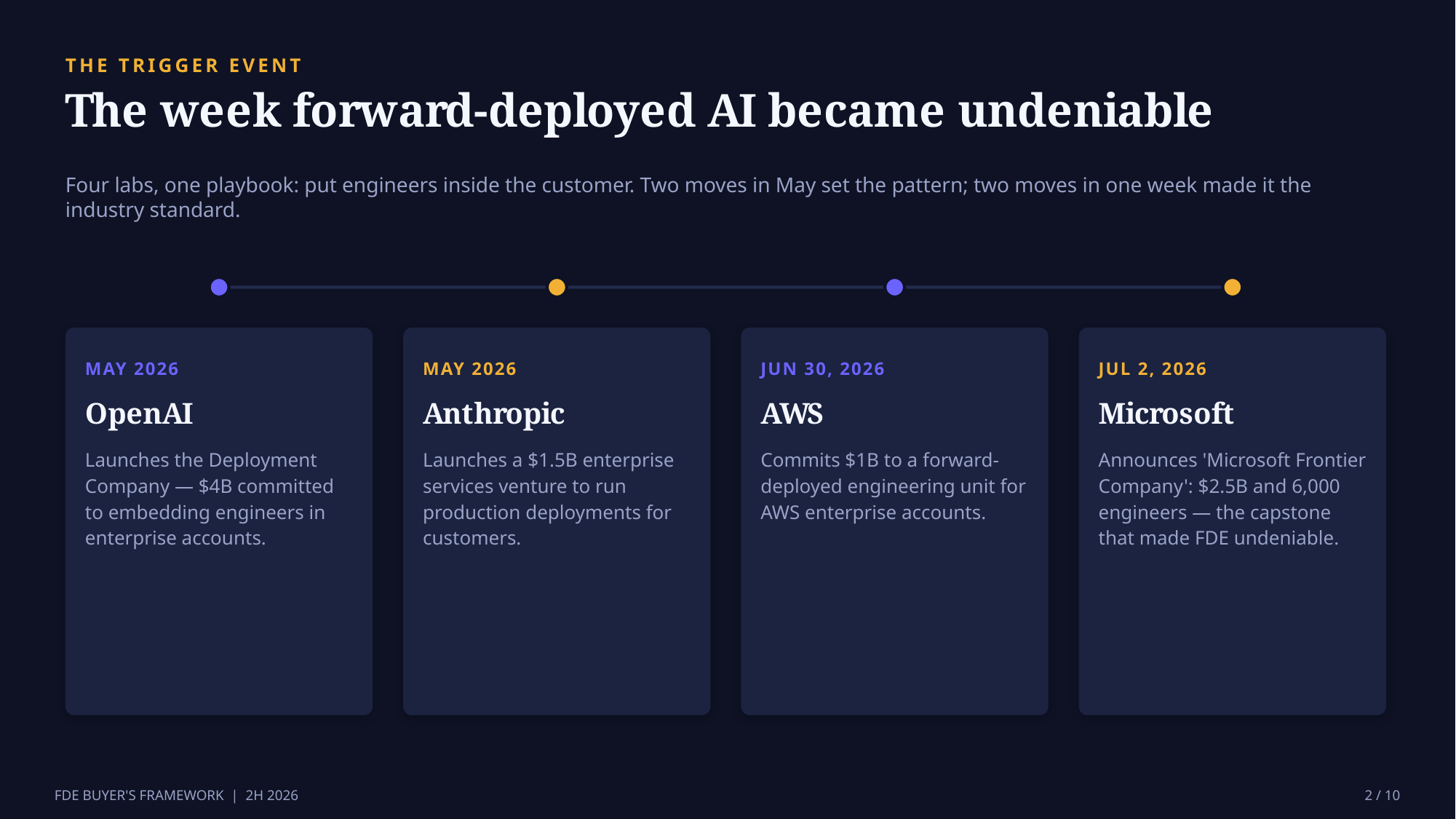
AWS moved first. On June 30, AWS announced a $1 billion investment in a dedicated Forward Deployed Engineering organization, funded from Amazon’s own balance sheet rather than a joint venture. Two days later, Microsoft announced a $2.5 billion investment in Microsoft Frontier Company, embedding 6,000 industry and engineering experts with customers to deploy and continuously improve AI systems based on measurable business outcomes, led by longtime sales executive Rodrigo Kede Lima. Both moves followed OpenAI and Anthropic, which launched rival ventures in May. OpenAI’s Deployment Company launched as a majority-owned subsidiary raising more than $4 billion from 19 investors, while Anthropic formed a parallel $1.5 billion joint venture with Blackstone, Hellman & Friedman, and Goldman Sachs aimed at mid-sized companies.
How do the four commitments actually differ?
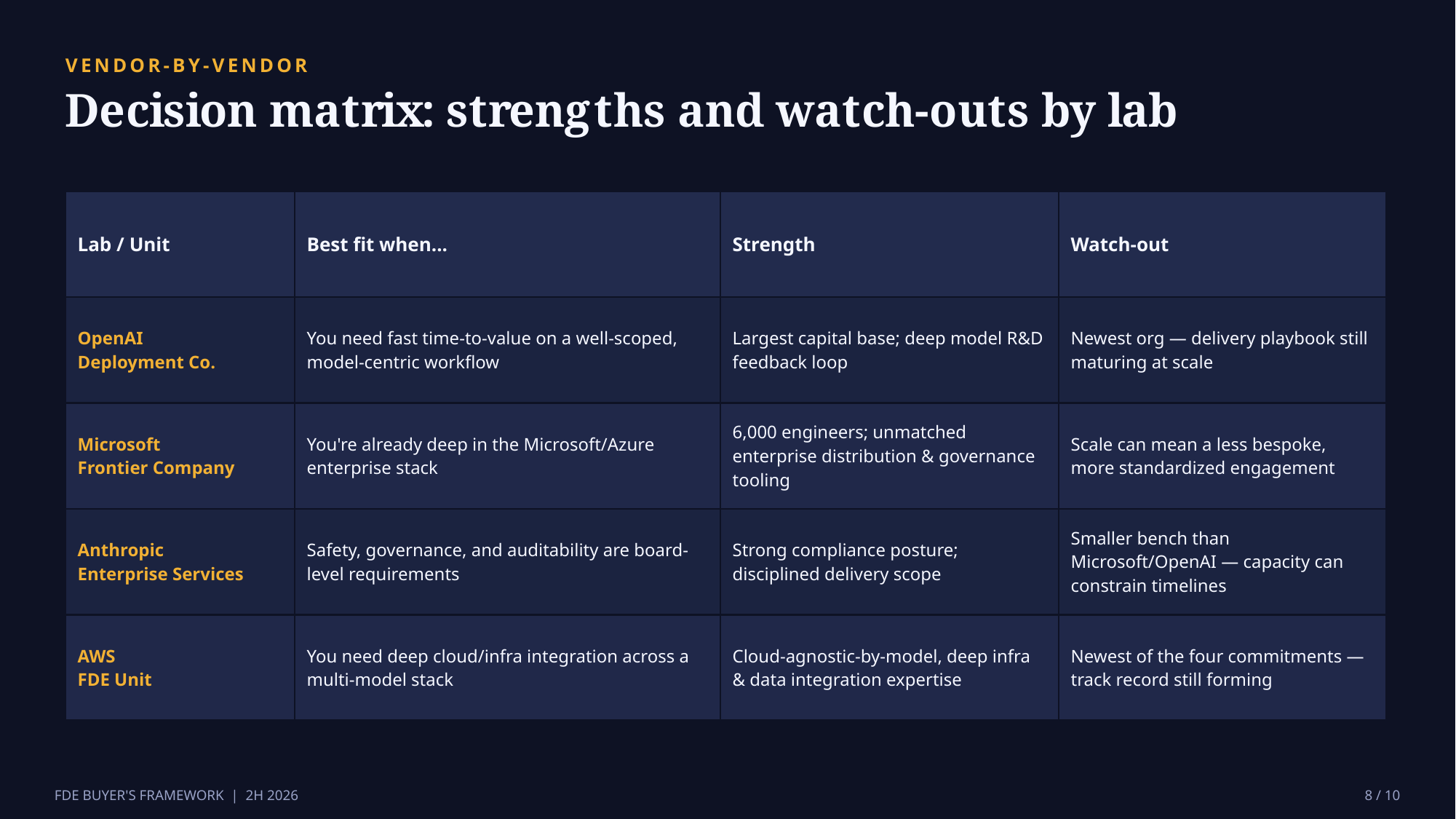
The dollar figures look similar; the structures do not. Two labs kept the work in-house; two brought in outside capital.
| Company | Commitment | Structure | Announced |
|---|---|---|---|
| Microsoft Frontier Company | $2.5B, 6,000 people | Internal business unit | July 2, 2026 |
| AWS Forward Deployed Engineering | $1B | Internal, self-funded | June 30, 2026 |
| OpenAI Deployment Company | $4B raised at a $10B valuation | Majority-owned entity, private-equity backed | May 2026 |
| Anthropic enterprise services venture | $1.5B | Joint venture with banks and private equity | May 4, 2026 |
That split matters for buyers. AWS’s money stays inside one company, so the client relationship and data exposure stay with a single vendor. OpenAI and Anthropic instead recruited private-equity backers whose own portfolio companies become a built-in distribution channel, giving those investors preferred access to deals inside their own holdings.
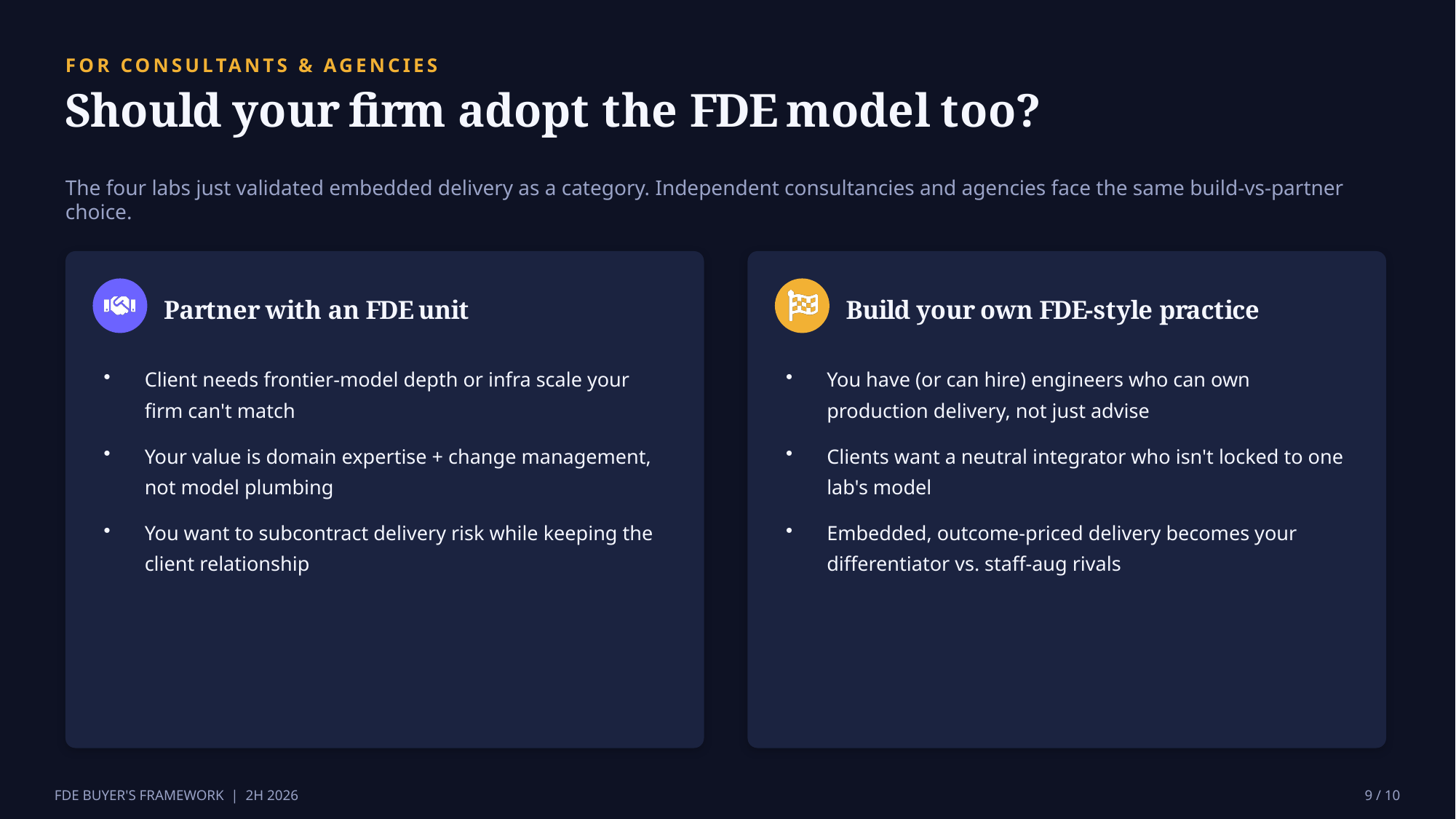
The slides embedded below sketch a shorter version of this same comparison as a ready-to-use deck, built by AskDeck from a short brief on this exact evaluation problem.
Should your company sign an FDE engagement?
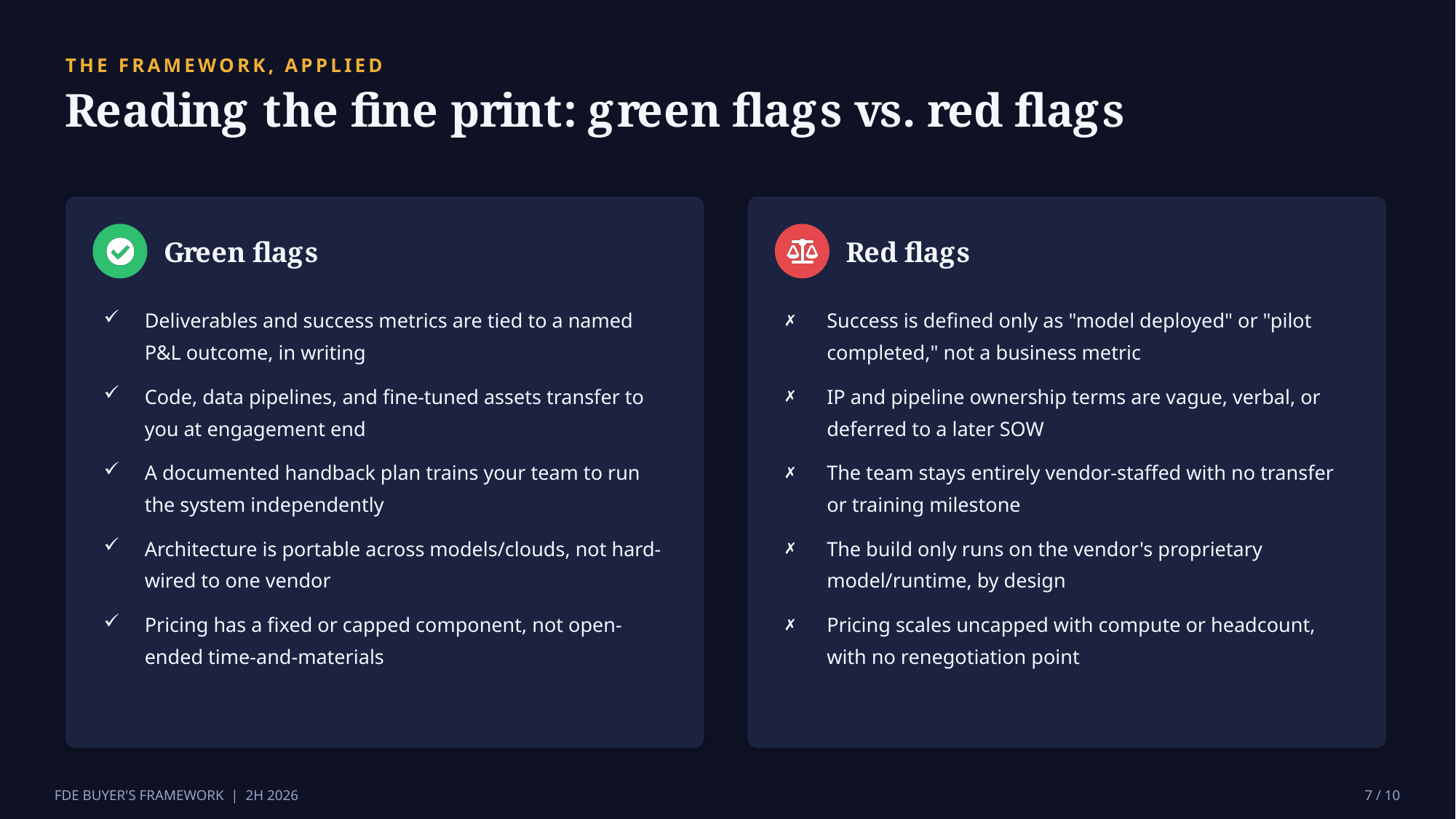
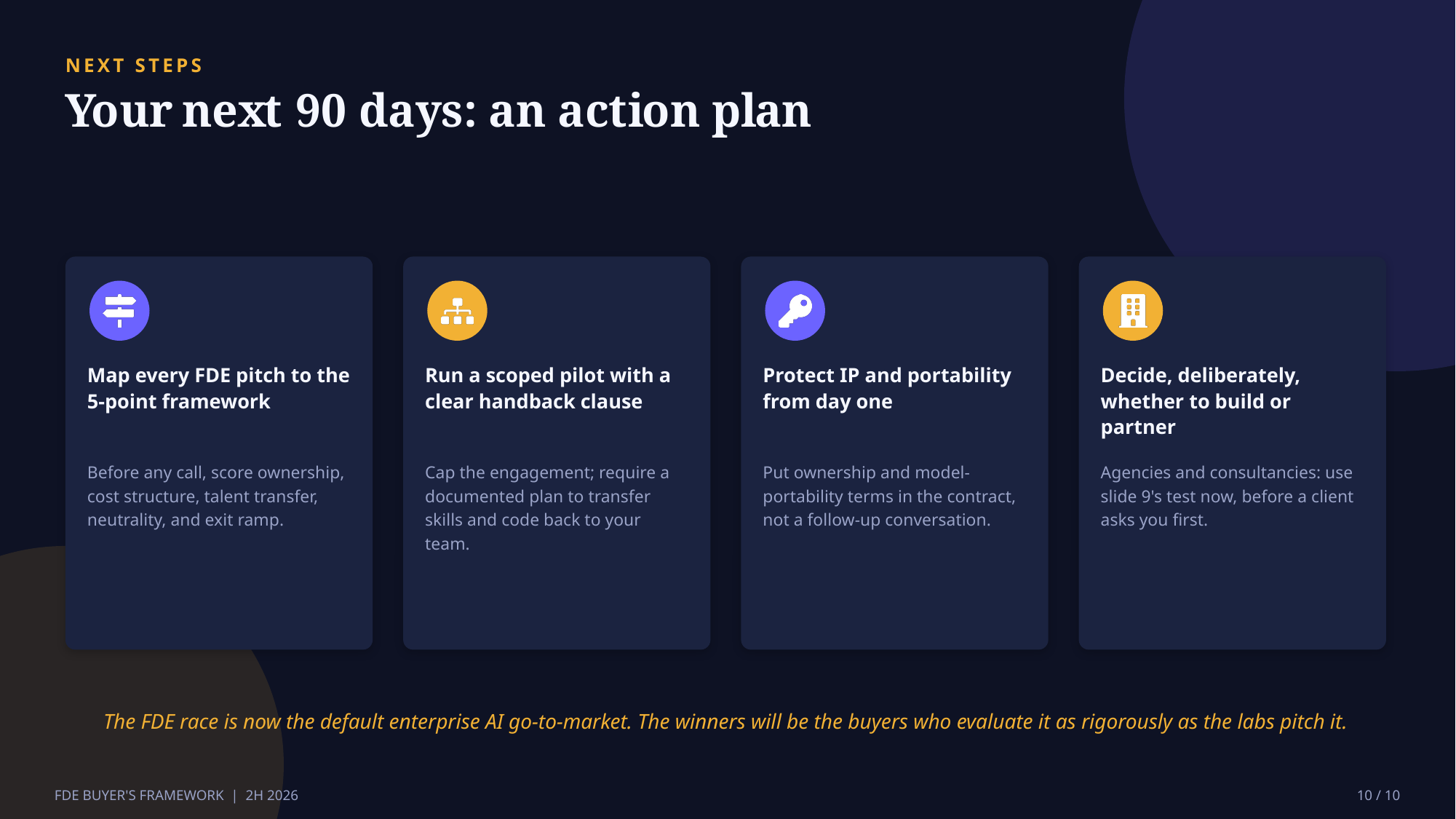
Treat an FDE pitch as a staffing decision with a contract attached, not a software purchase. AWS, for instance, organizes engagements in pods of five or six engineers on 45-day sprints, scoped to one business outcome rather than billable hours, aiming to leave the customer able to run the system without the vendor present.
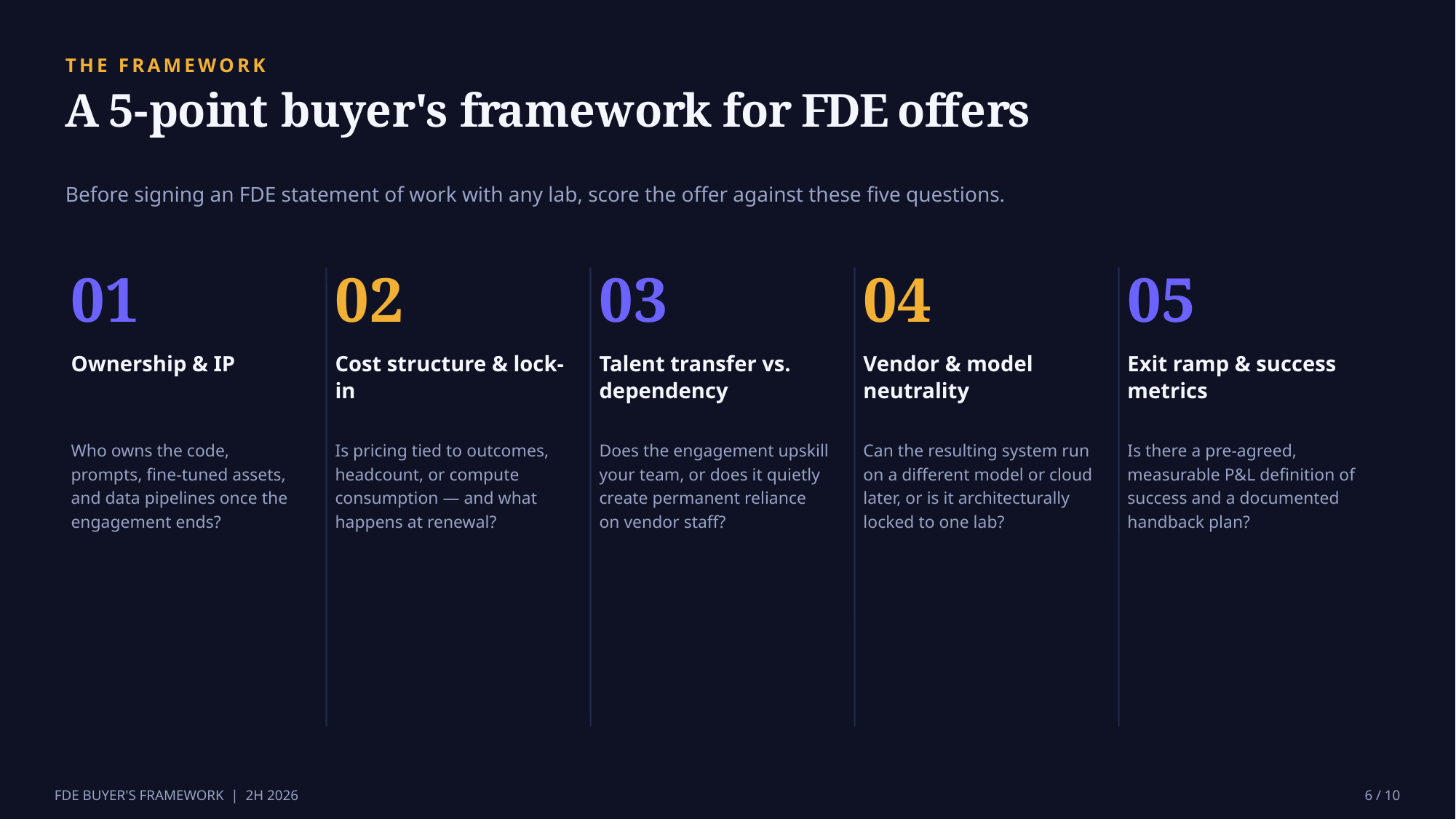
Before signing anything, ask three questions. Who owns the resulting code and data model once the engagement ends, and can it run on infrastructure you control. Is the engagement scoped to one measurable outcome with a defined baseline, since most AI failures trace back to missing outcome definitions rather than weak models. And does the arrangement quietly deepen dependence on one vendor’s stack, since deployments built around a single vendor’s tooling tend to raise switching costs even when a contract nominally allows other systems.
Common questions
Is forward-deployed engineering the same as consulting? Not quite. A forward-deployed engineer typically owns the full stack, from problem definition through shipped and running code, while consultants more often hand off recommendations and documents rather than production systems.
Why is this happening specifically in 2026? The economics flipped. As underlying AI model costs have fallen, the people needed to integrate a model into a specific business have become the expensive part of an engagement, not the compute behind the model.
If you want a compact walkthrough for sizing up these four offers, the deck below was built with AskDeck from a short brief and can be downloaded and adapted for your own vendor review.