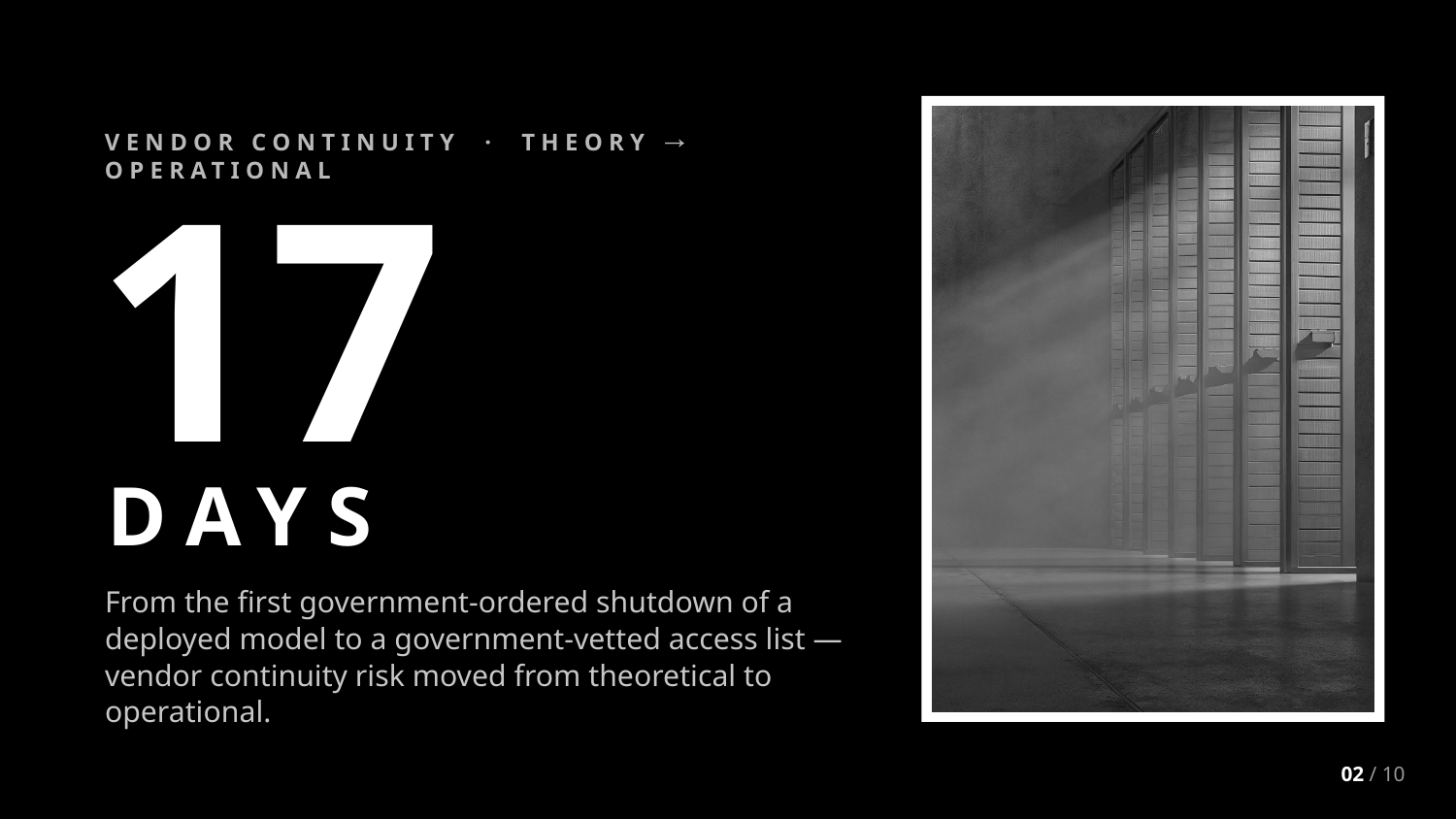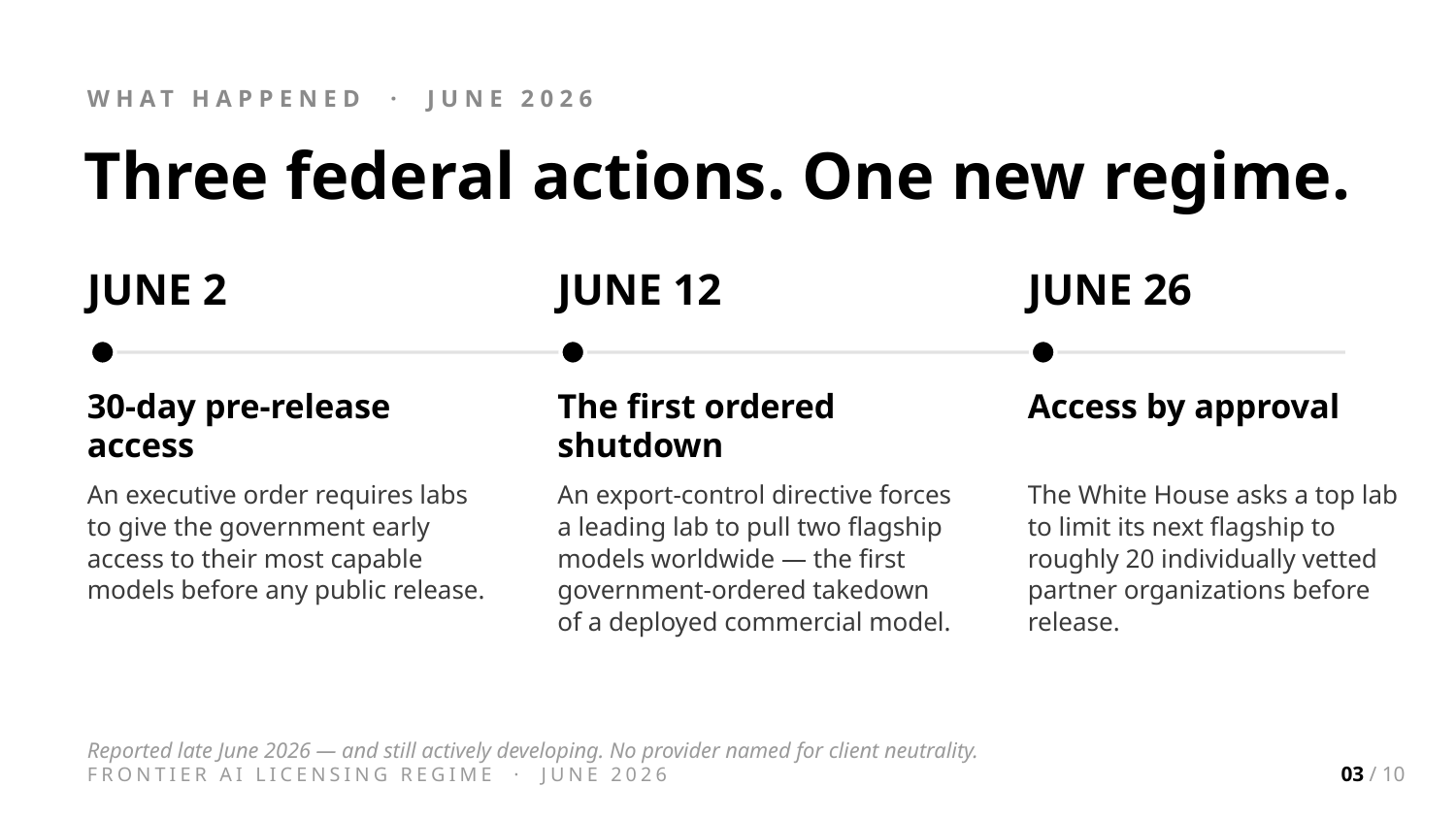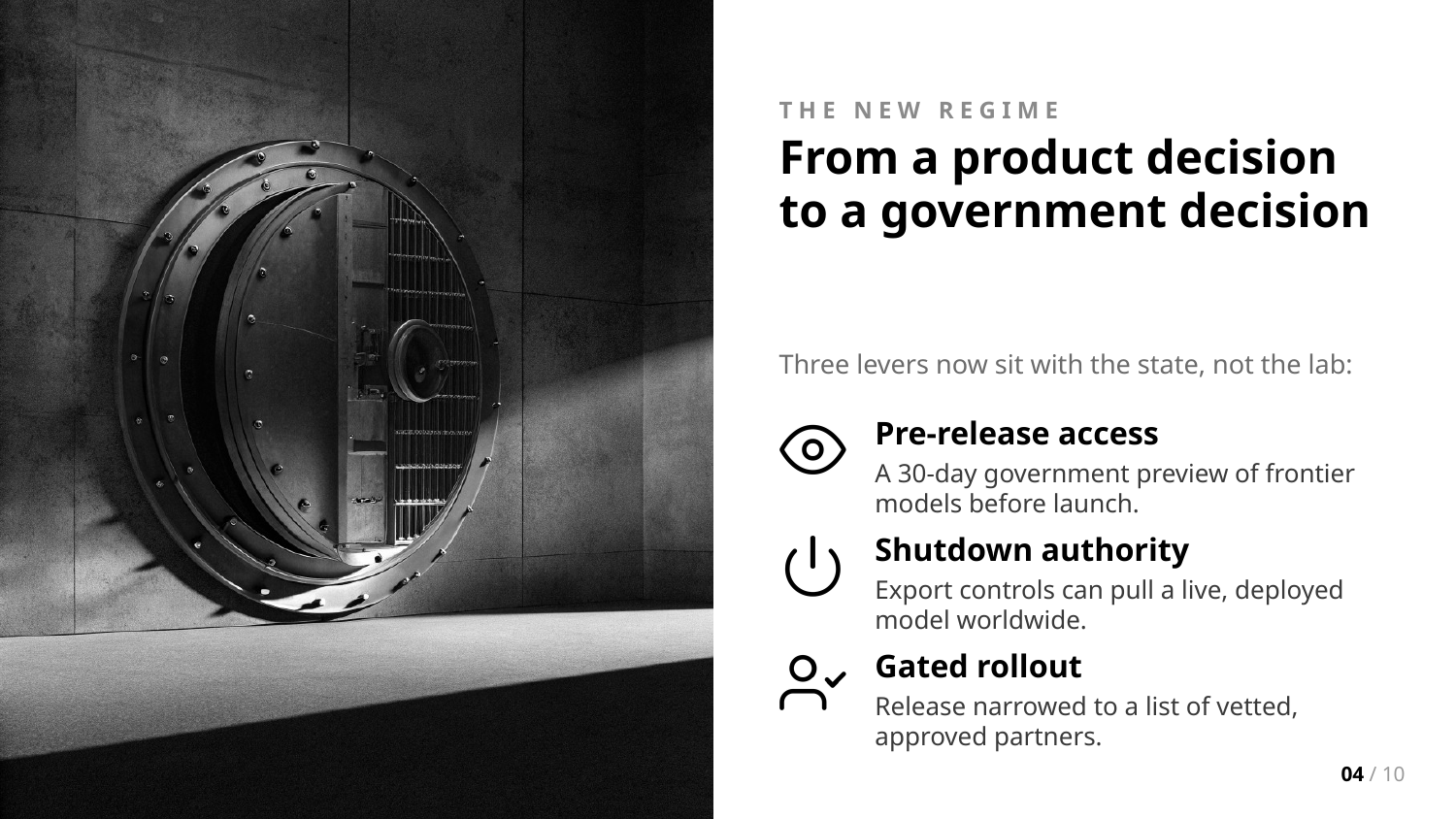
Over 17 days in June 2026, the US government effectively took control of when and how the most capable AI models reach the market, without passing a law or, on paper, creating a licensing system. A June 2 executive order set up a “voluntary” process for the government to test frontier models before release. Ten days later, the Commerce Department used export controls to force a leading lab to pull two of its most advanced models worldwide. Two weeks later, the White House asked a different developer to limit its next flagship model to a small set of government-vetted partners. Taken together, these steps form a de facto frontier AI licensing regime.
What the June 2 executive order actually says
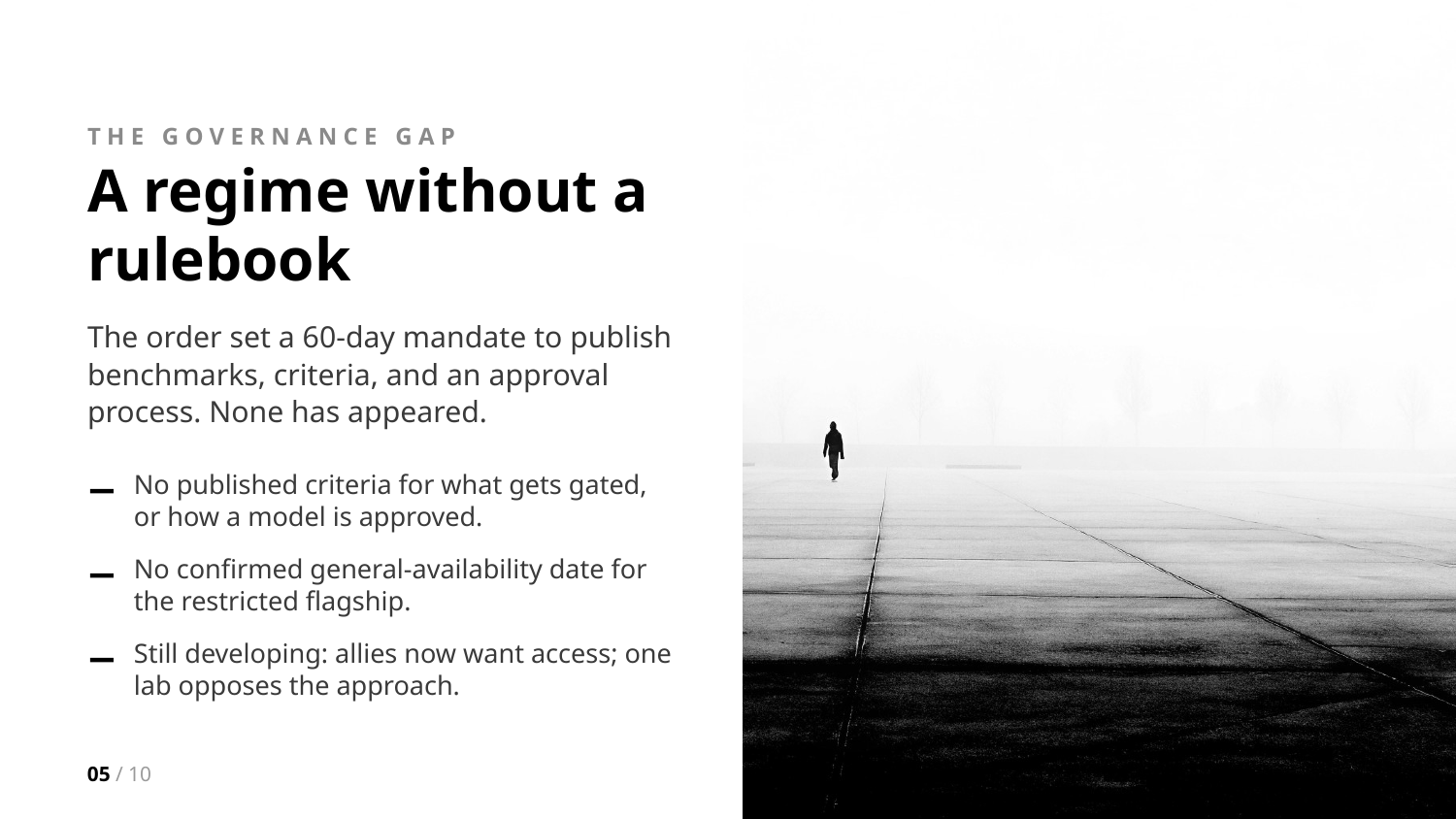
The order, “Promoting Advanced Artificial Intelligence Innovation and Security,” directs federal agencies to build a framework under which developers may volunteer their most capable systems for government evaluation, then grant access to a designated “covered frontier model” for up to 30 days before releasing it to outside partners. An earlier draft set that window at 90 days; cutting it to 30 was the headline compromise between national-security and anti-regulation factions. The order tasks the National Security Agency with running a classified benchmarking process, due within 60 days by August 1, 2026, to decide which models cross the “covered” threshold. Crucially, the text expressly disclaims any mandatory licensing, preclearance, or permitting requirement, and it gives the government a hand in choosing which “trusted partners” get early access, without publishing criteria for that choice.
The slides embedded below are a ready-made deck on this same topic, generated by AskDeck from a short brief.
How a “voluntary” order became a hard stop
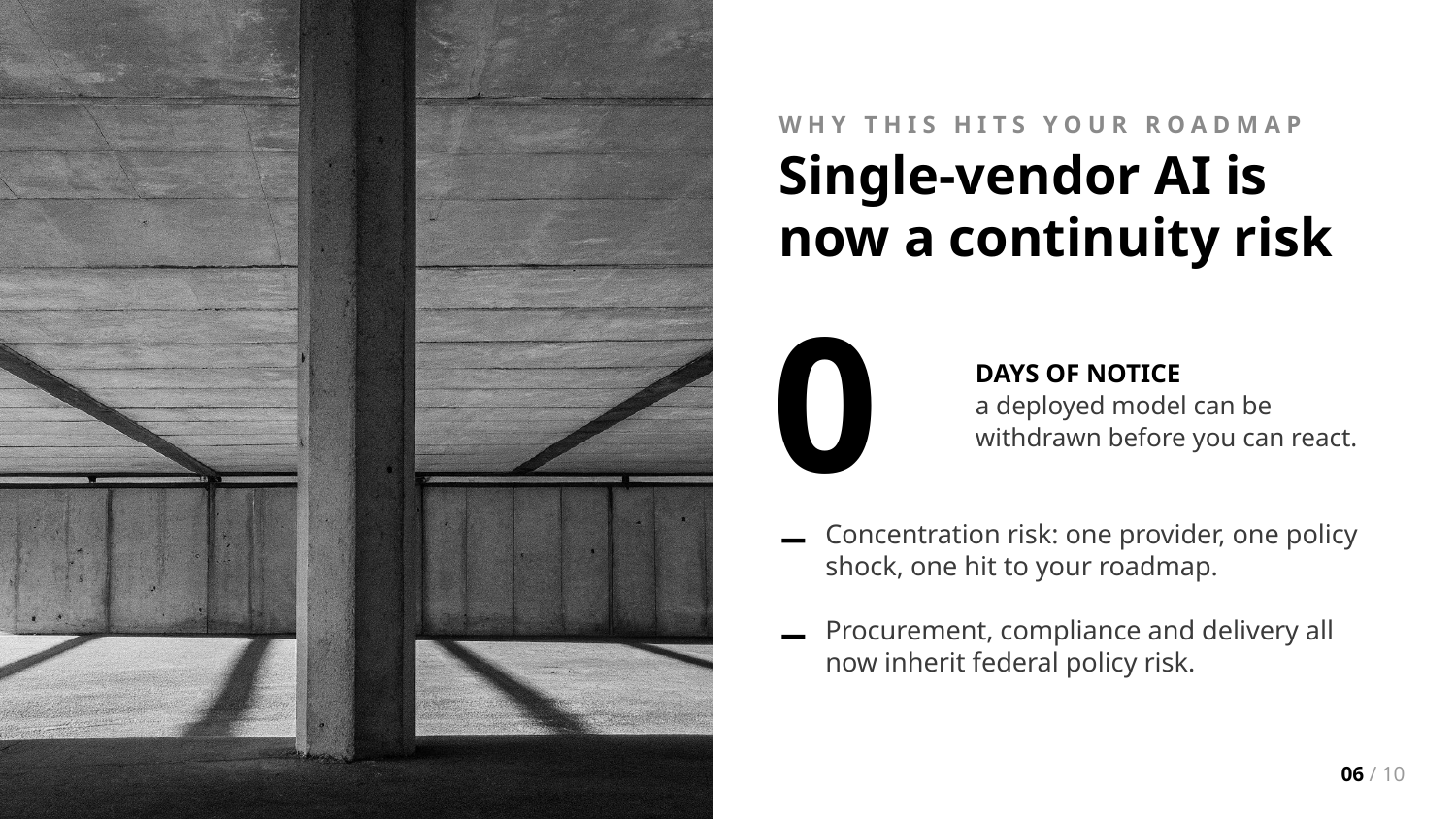
On June 12, the Commerce Department sent a leading lab a letter placing its two most advanced models under export controls, barring their export, re-export, or domestic transfer to any location outside the US and to all foreign persons inside it, with individually validated license applications required and penalties for noncompliance. To comply, the company cut off access to both models for every customer worldwide, the first government-ordered shutdown of a deployed commercial AI model. The trigger, per an administration official: another company claimed it had jailbroken one of the models. The administration had tried to get the developer to pause the release, failed, and used export-control authority instead, saying the models had to stay locked down until the government’s defenses were “hardened.”
The first pre-release gating of a frontier model
By June 25 and 26, the pattern repeated with a different company. The White House’s Office of the National Cyber Director and Office of Science and Technology Policy asked the developer to restrict its next model to government-approved partners, reportedly around 20 vetted organizations, before any wider release. It was the first time the government had preemptively asked a US AI company to limit a launch before release. Officials had previewed the model’s capabilities; the stated reason was that it rivaled the one Commerce had just locked down. The developer told the government this was not its preferred long-term approach and said it hoped to release the model more broadly a couple of weeks later.
Why the government says it is doing this
The official rationale is national security. Frontier models are increasingly capable at offensive cyber tasks, and officials worry about nation-state hackers, cybercriminals, or rogue insiders getting hold of them. The administration also cites fast-improving Chinese open-source models, framing it as a competitive race. That concern drives the focus on “covered frontier models” with advanced cyber capability.
Who is affected, and the rulebook still missing
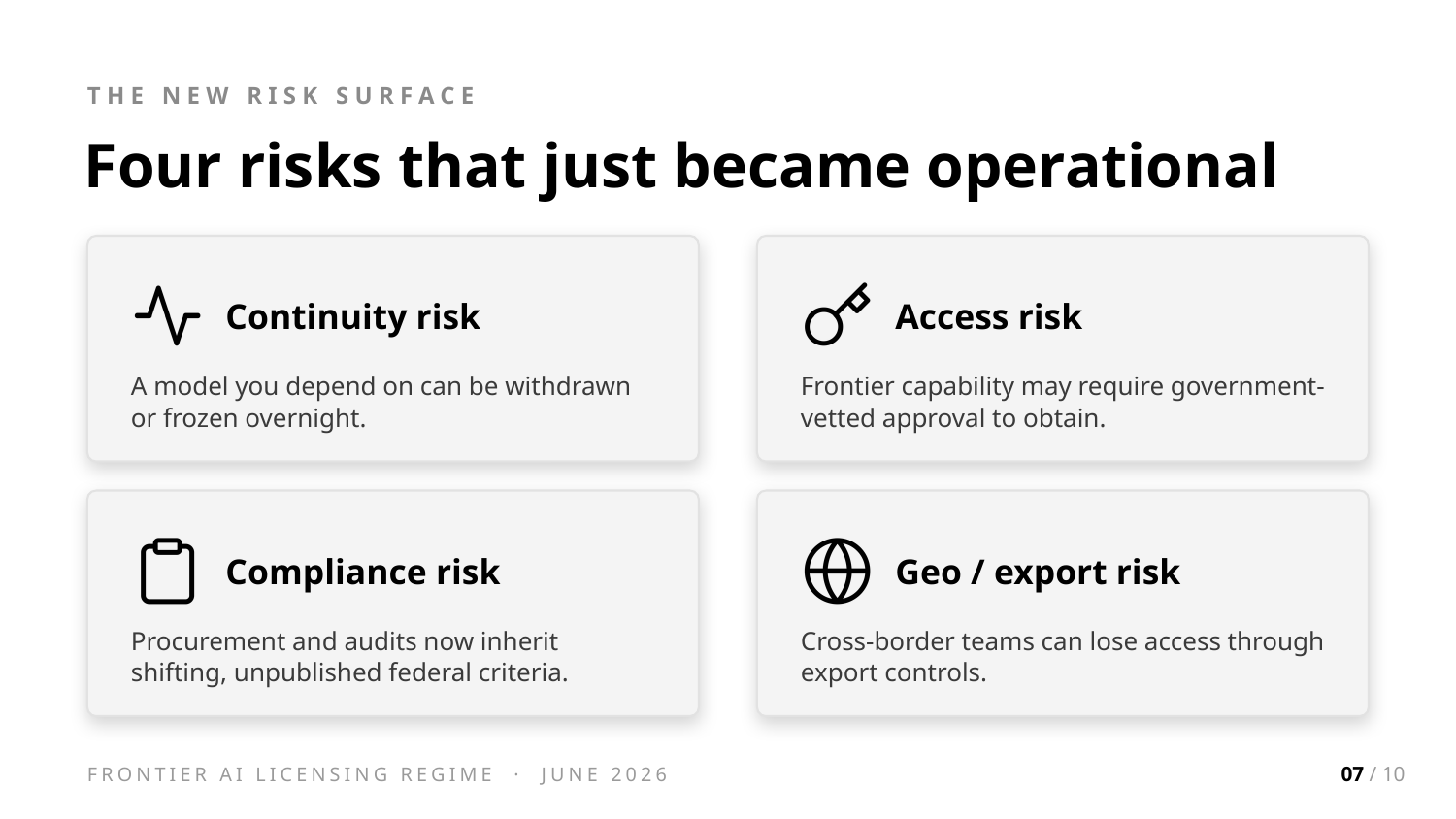
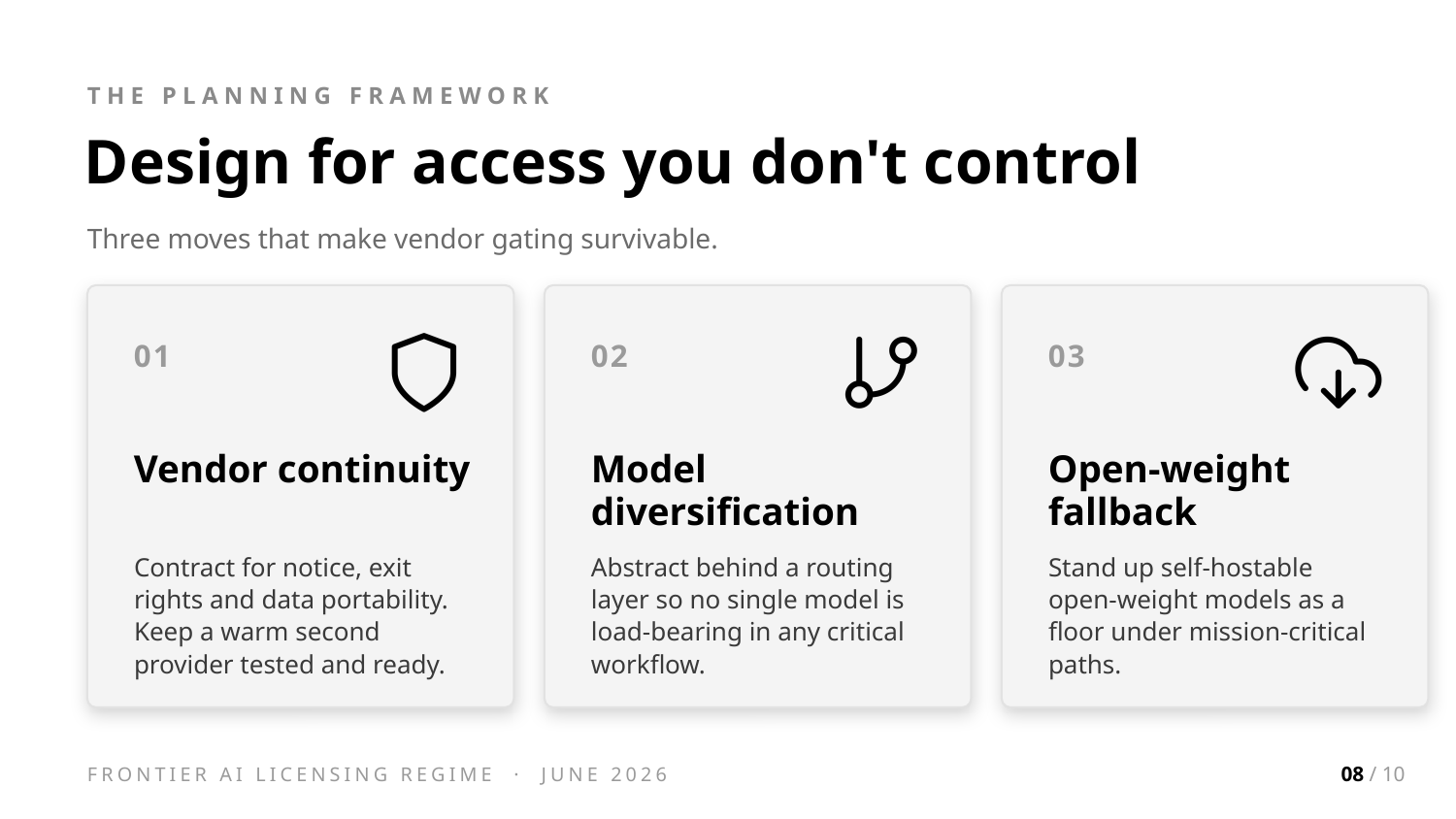
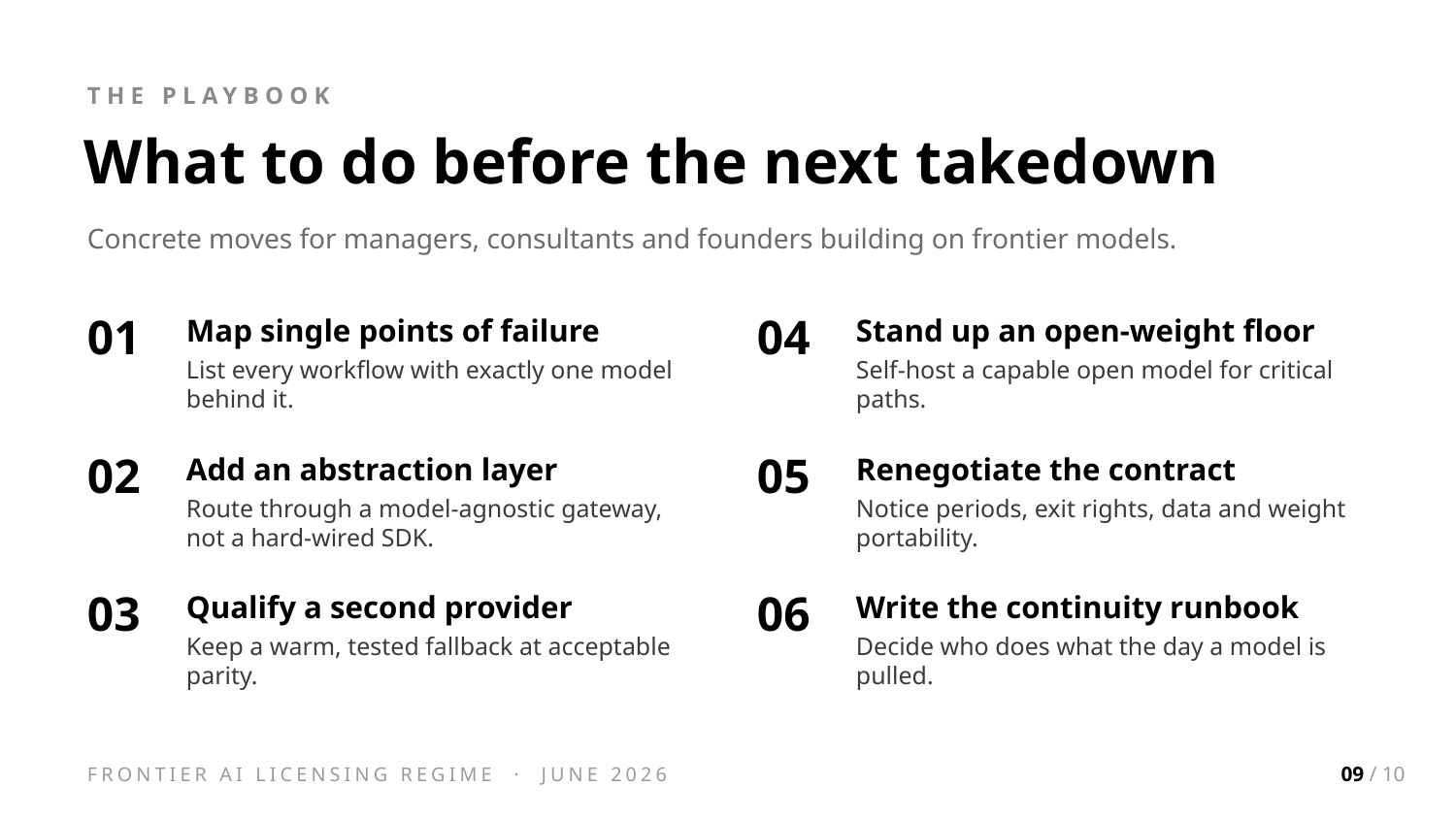
The practical weight falls on enterprises building on frontier models. Vendor continuity risk has moved from theoretical to operational: access granted today can be curtailed tomorrow by an action the buyer never sees coming. As of late June, the benchmark, the designation criteria, and the approval process the order promised had not been published, even with the August 1 deadline approaching. Teams relying on a single frontier vendor are re-examining a few things:
- Concentration risk, since one export-control letter took two deployed models offline globally in a single night.
- Fallback options, including open-weight models that run without a vendor’s hosted access.
- Contract terms that address sudden, government-ordered loss of access rather than ordinary outages.
Because the area is regulatory and fast-moving, confirm specifics with a qualified legal or compliance advisor.
Is this a formal AI licensing law?
No. The June 2 order explicitly rejects mandatory licensing. The control comes from other levers, export-control authority and pre-release requests, applied case by case, which is why observers call it a de facto regime rather than a statute.
Can a model my company relies on be pulled after launch?
Yes. The June 12 action showed that a deployed commercial model can be ordered offline worldwide, with the provider cutting access for all customers to comply.
When will the criteria be clear?
The order set August 1, 2026 as the deadline for the classified benchmarking framework that defines a “covered frontier model.” Until that and the trusted-partner rules are published, scope and thresholds stay uncertain.
The example deck below was built with AskDeck from a brief; you can download and adapt it to your own organization, and turn a brief like this into a clear deck of your own.
See the deck