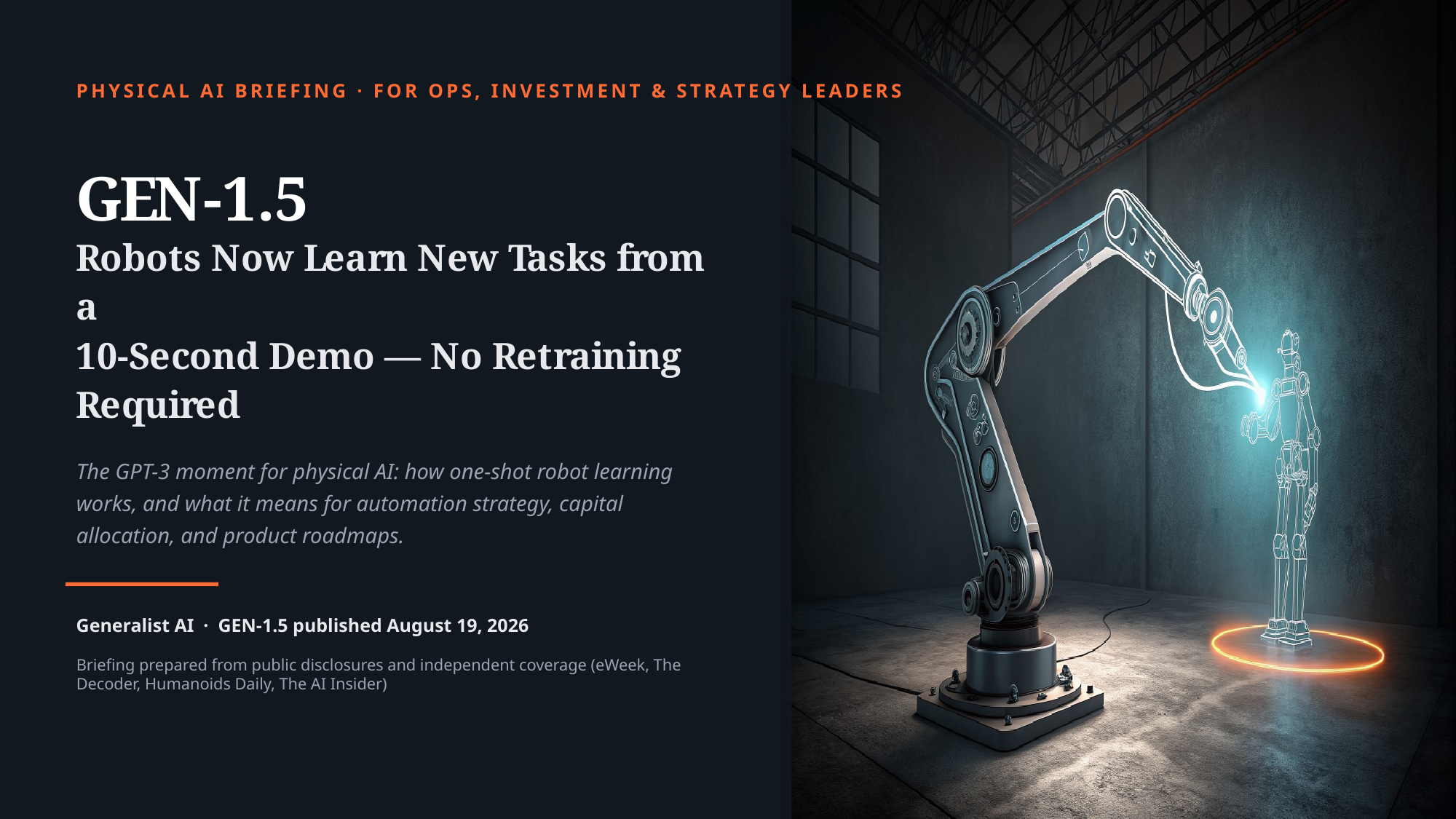
A robotic arm watches a person unzip a pencil pouch for about ten seconds, then does it itself, no retraining, no extra instructions. That single demo is the entire lesson.
Key Takeaways
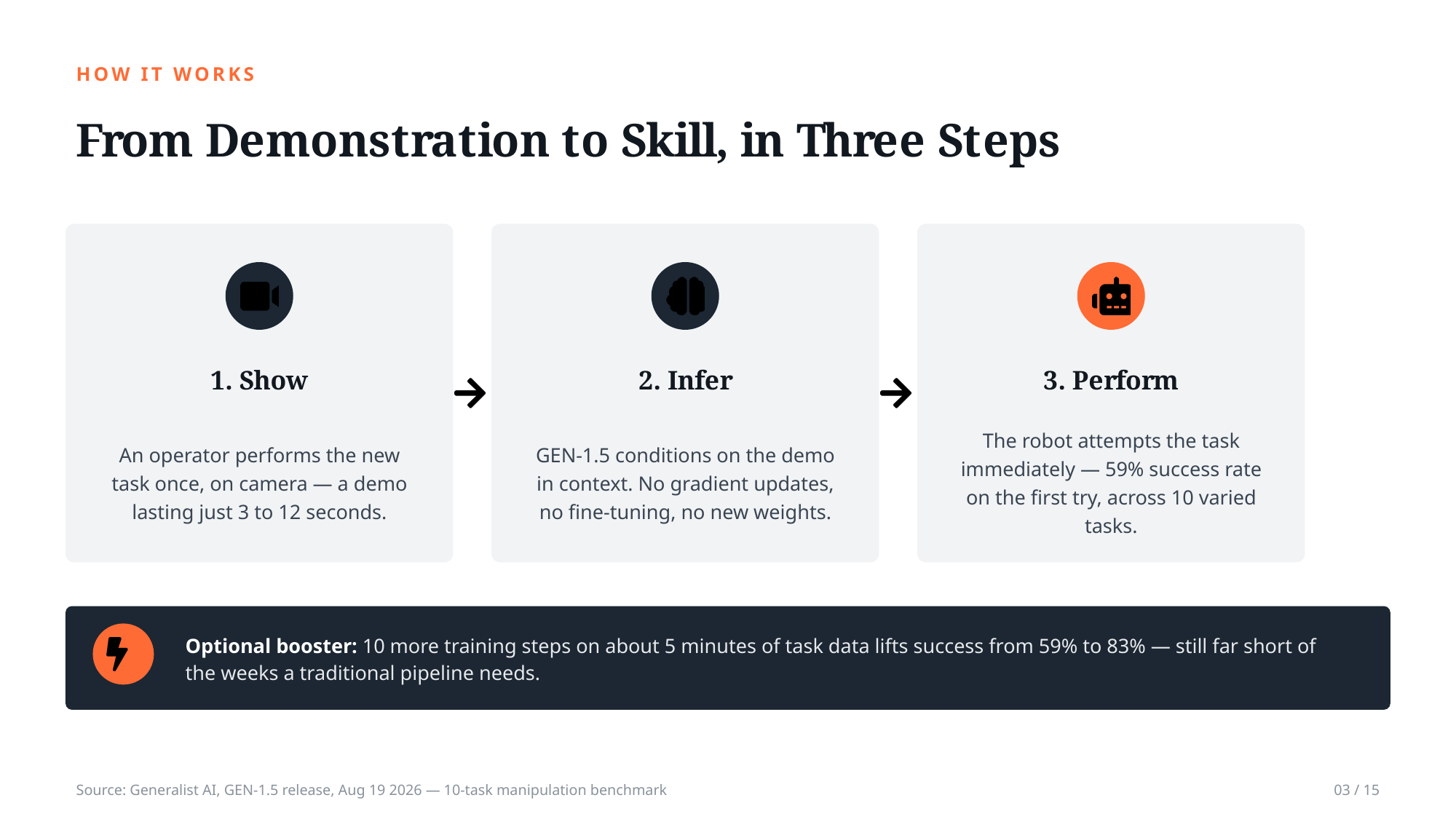
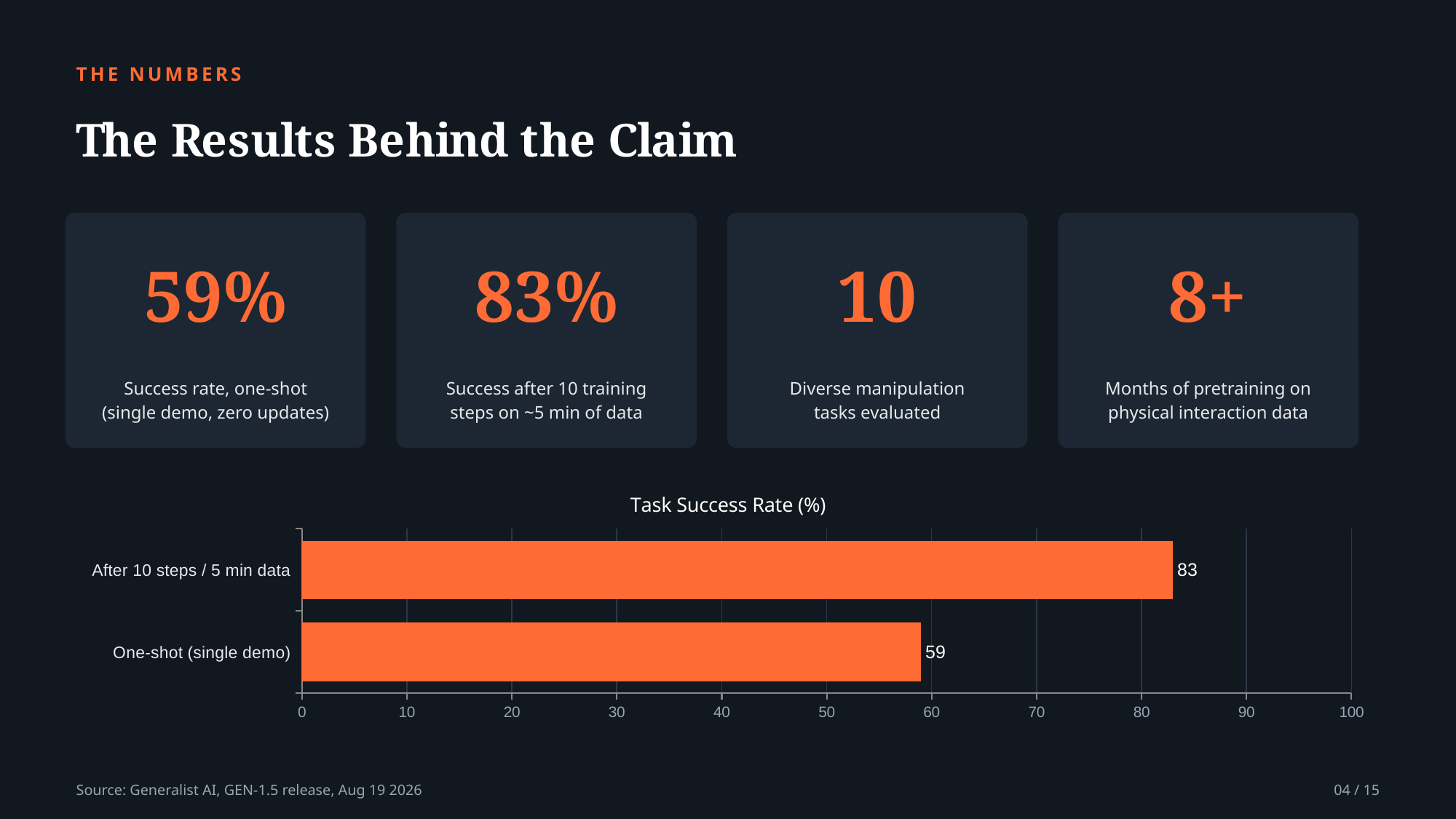
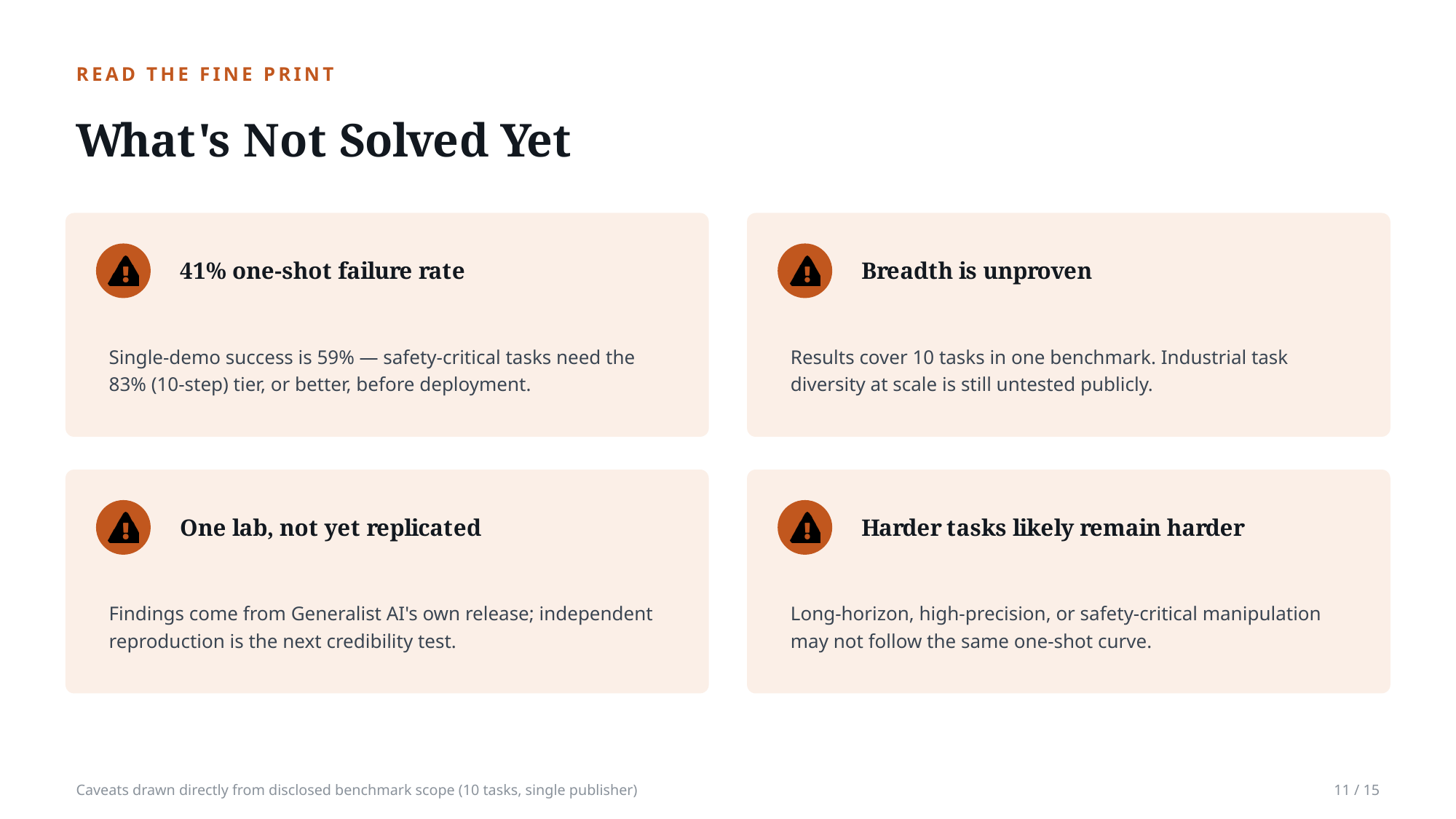
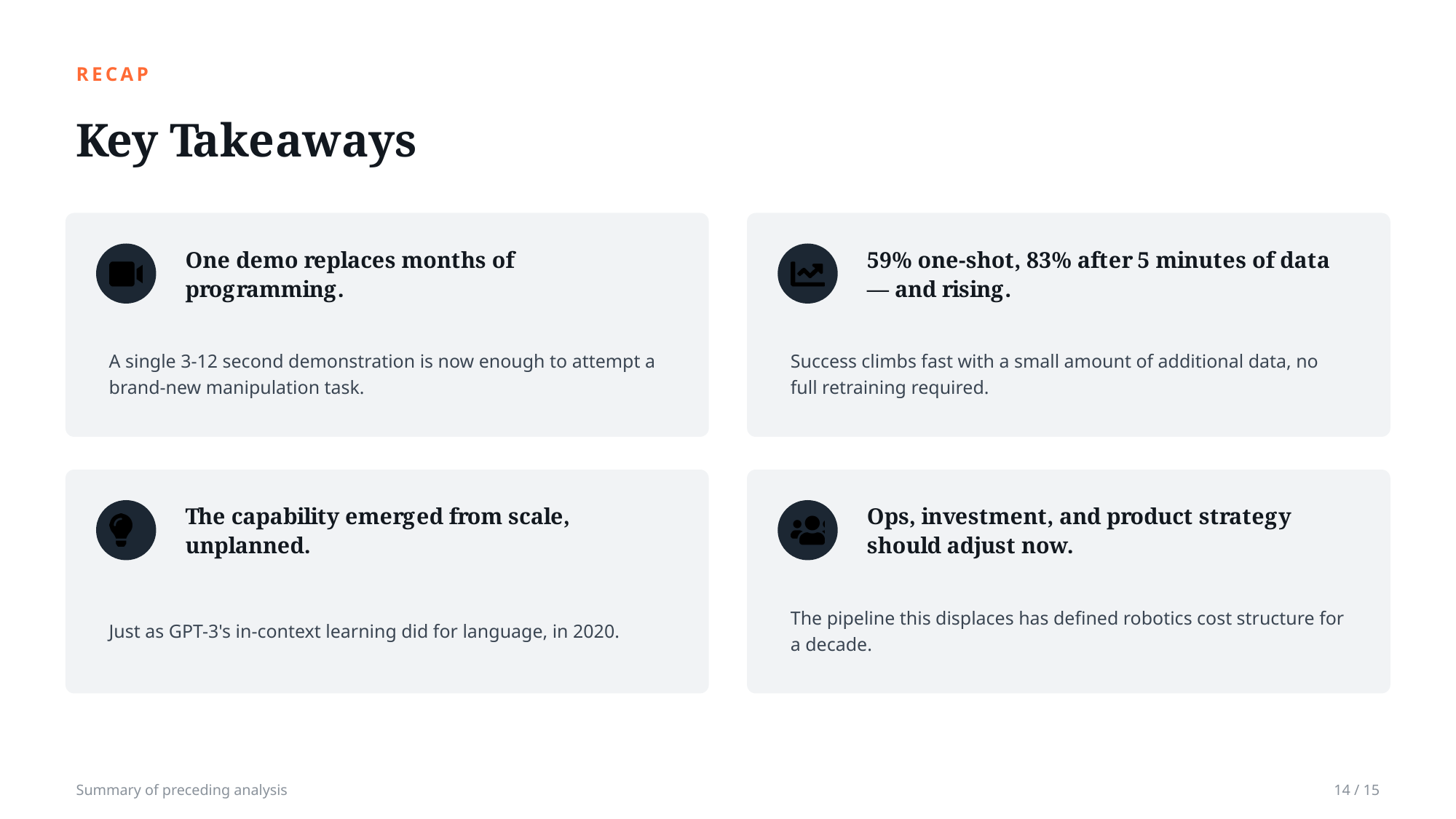
- GEN-1.5 hit 59% one-shot success across 10 tasks from a single 3-to-12-second demo with zero gradient updates, rising to 83% after 10 training steps on five minutes of data.
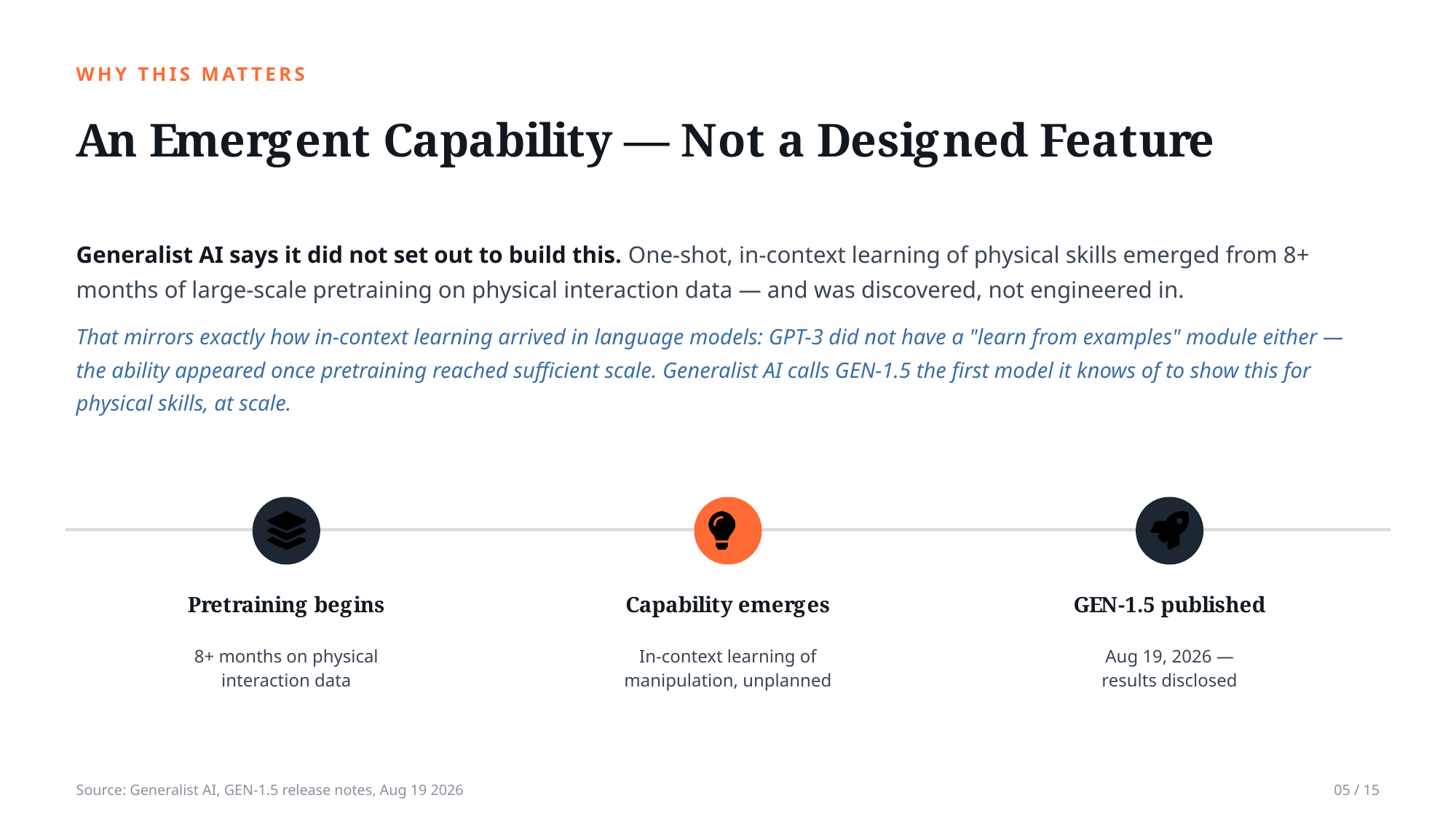
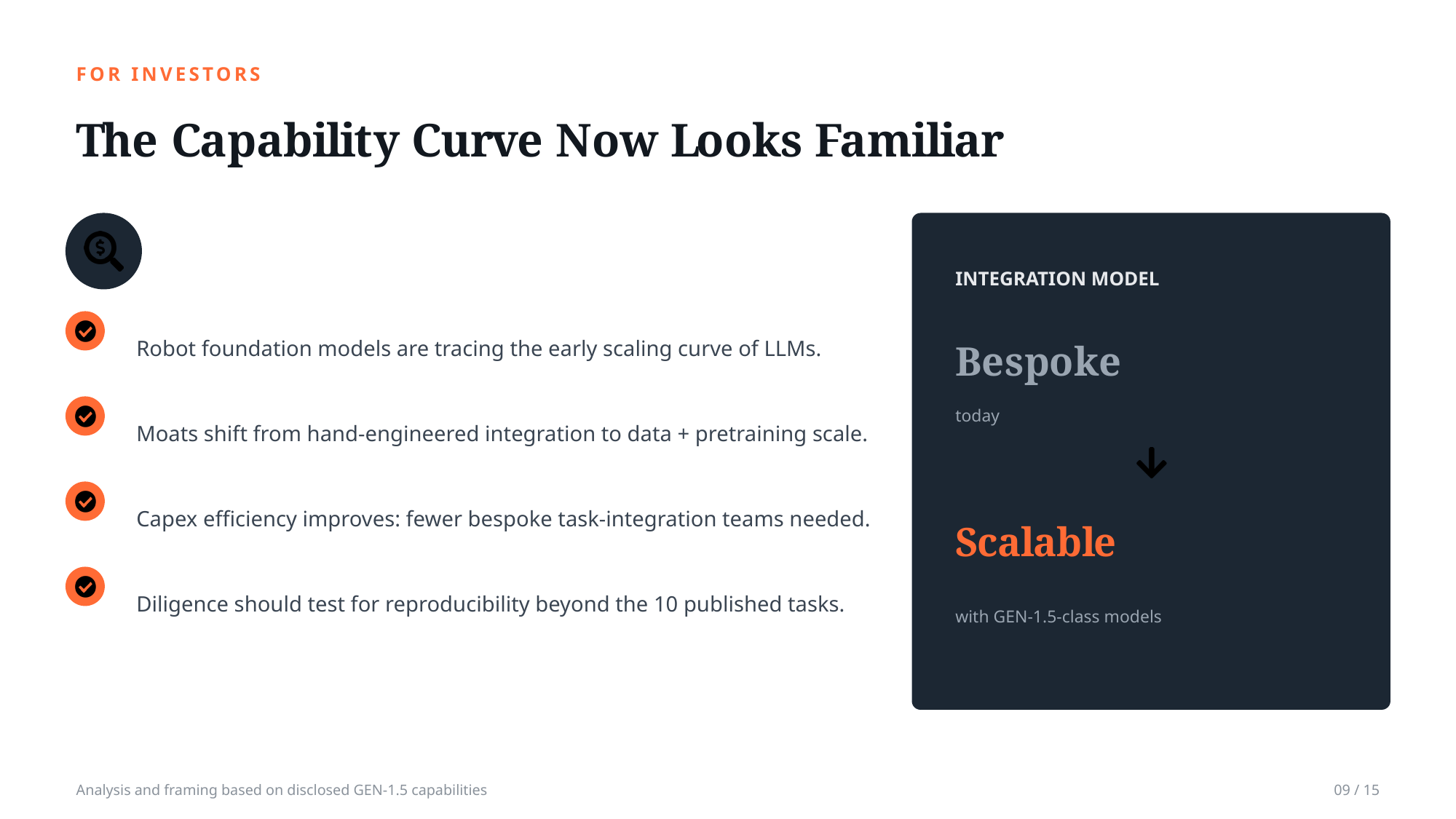
- The skill emerged unplanned from over 8 months of pretraining, echoing how GPT-3 first showed in-context learning in language.
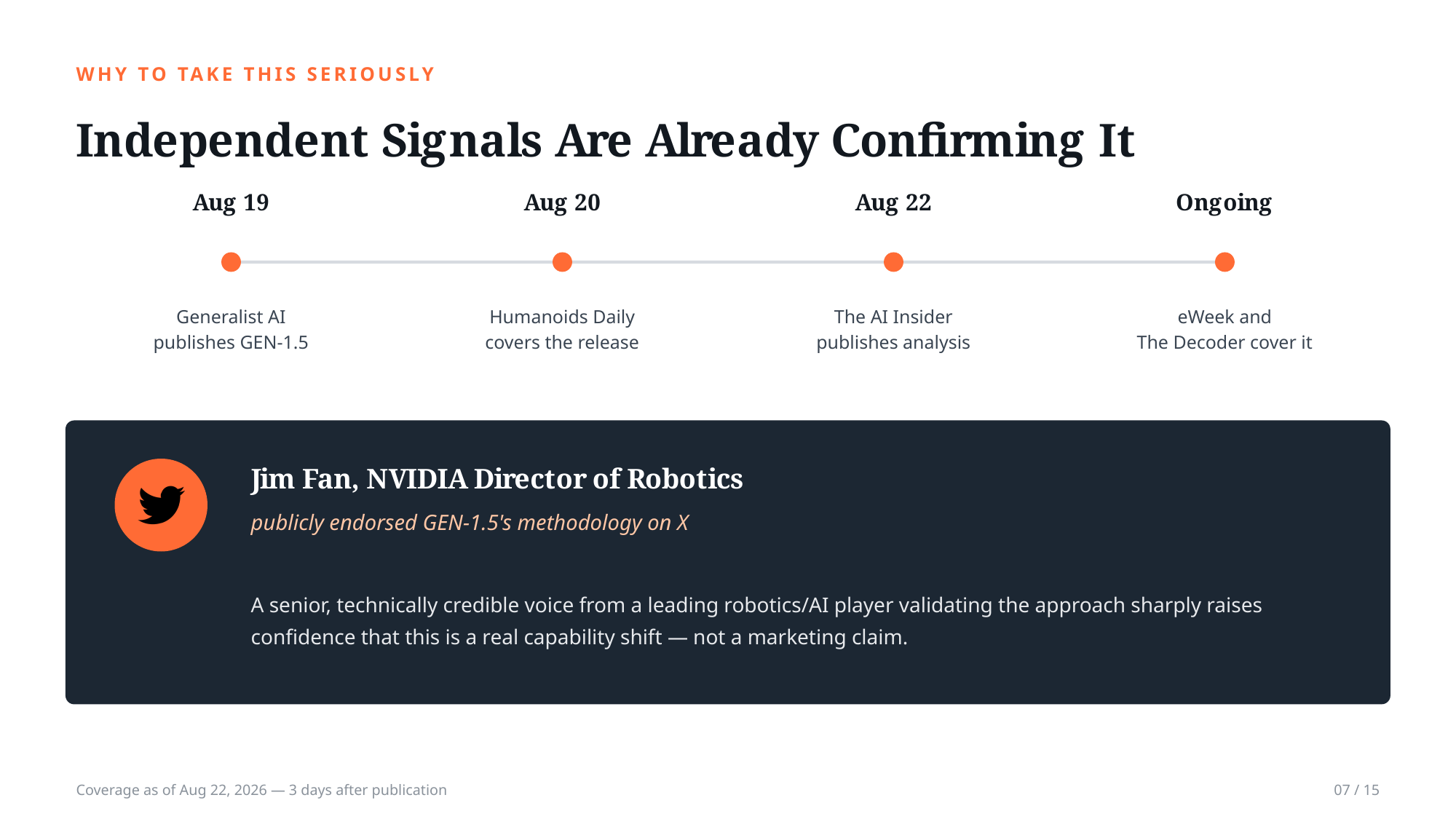
- Nvidia robotics director Jim Fan publicly endorsed the mechanism, tying it to how the training data was collected.
- Results are self-reported by the company and not yet independently verified; the tested tasks stay short and simple.
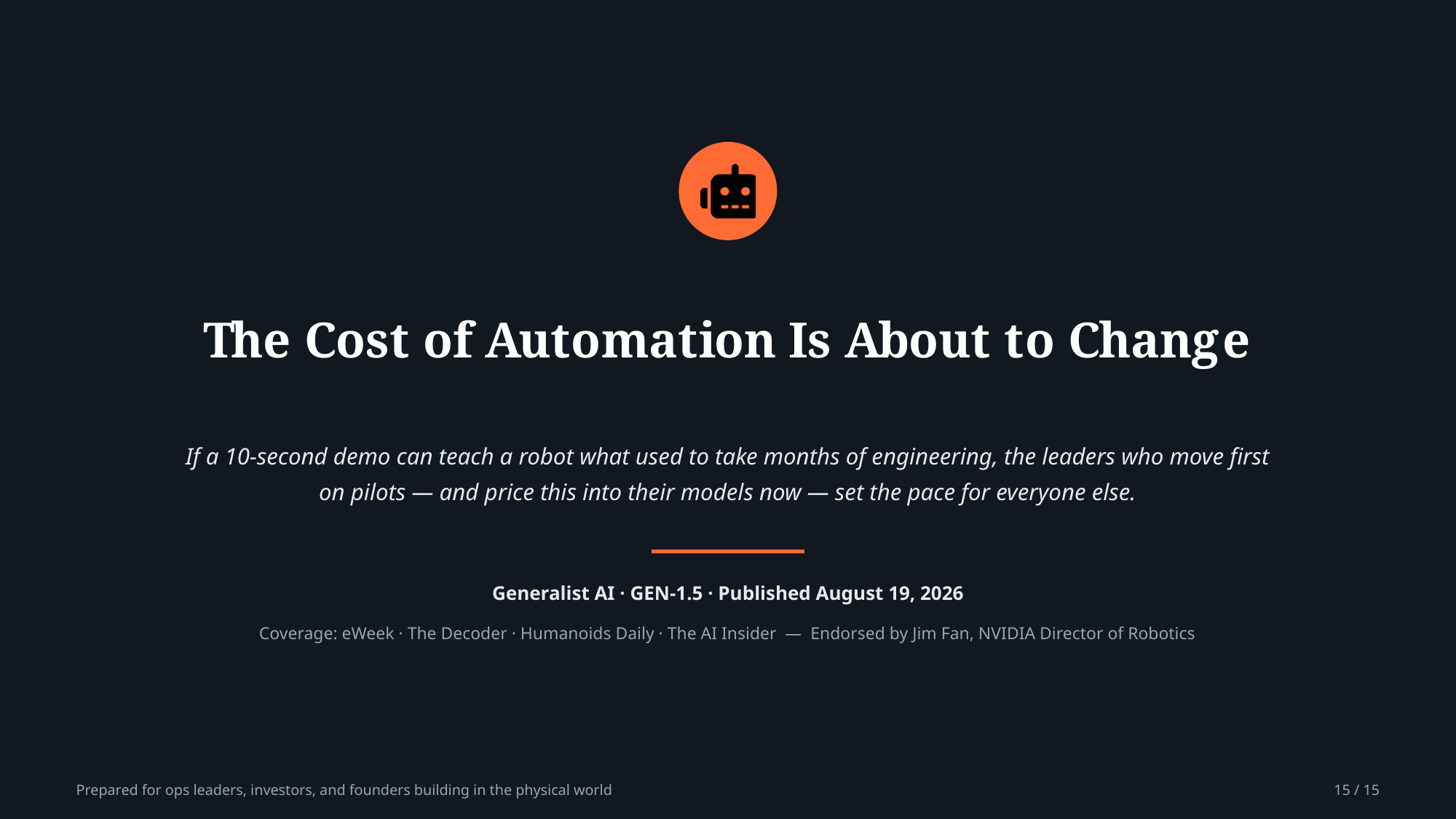
The slides embedded below walk through this same story as a ready-made deck, generated by AskDeck from a short brief. Back to the substance: what this model actually demonstrated, and why robotics researchers are treating it as a milestone rather than a marketing claim.
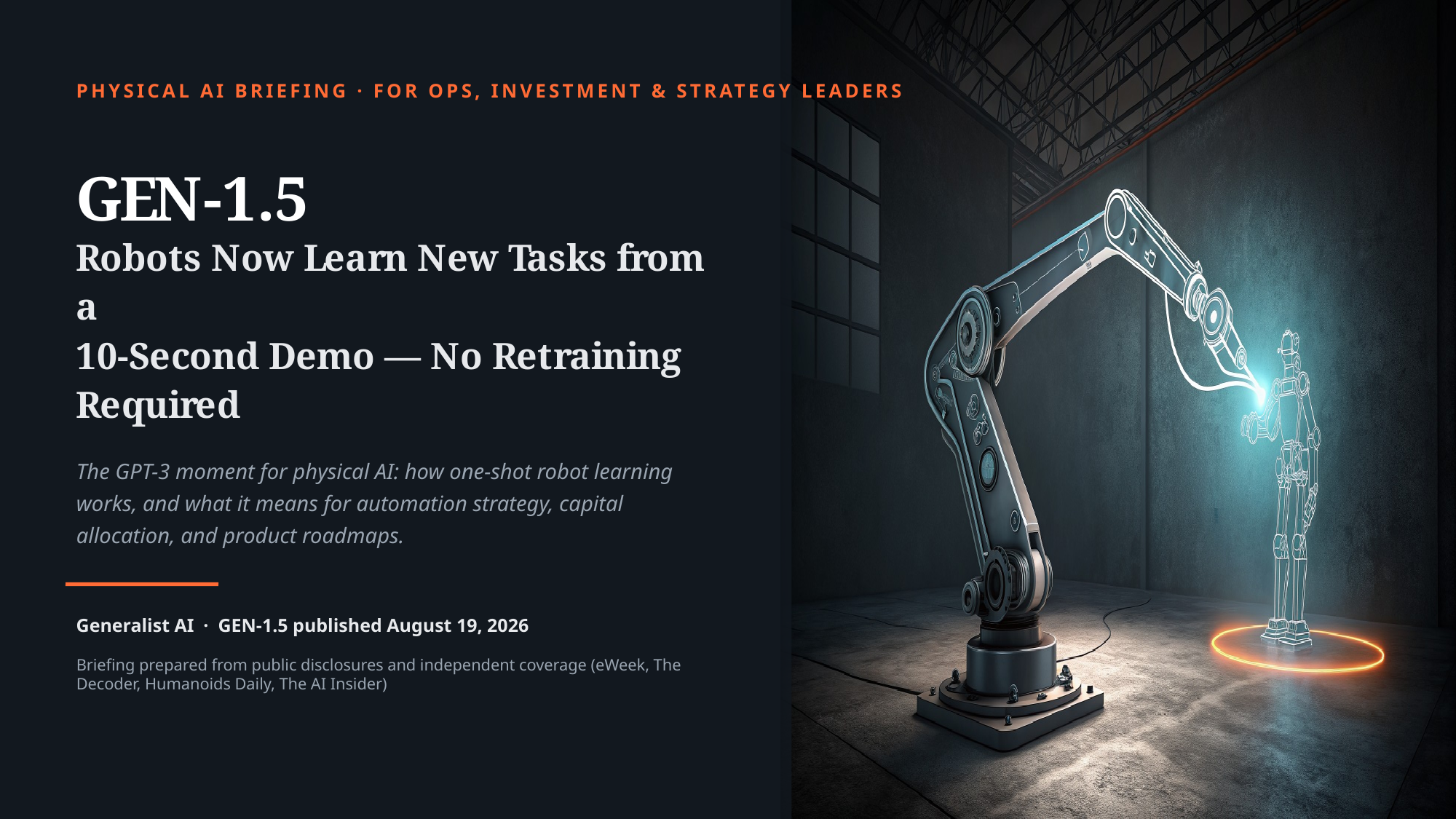
Swipe or scroll sideways to flip through the 15-slide deck →
What did Generalist AI actually build?
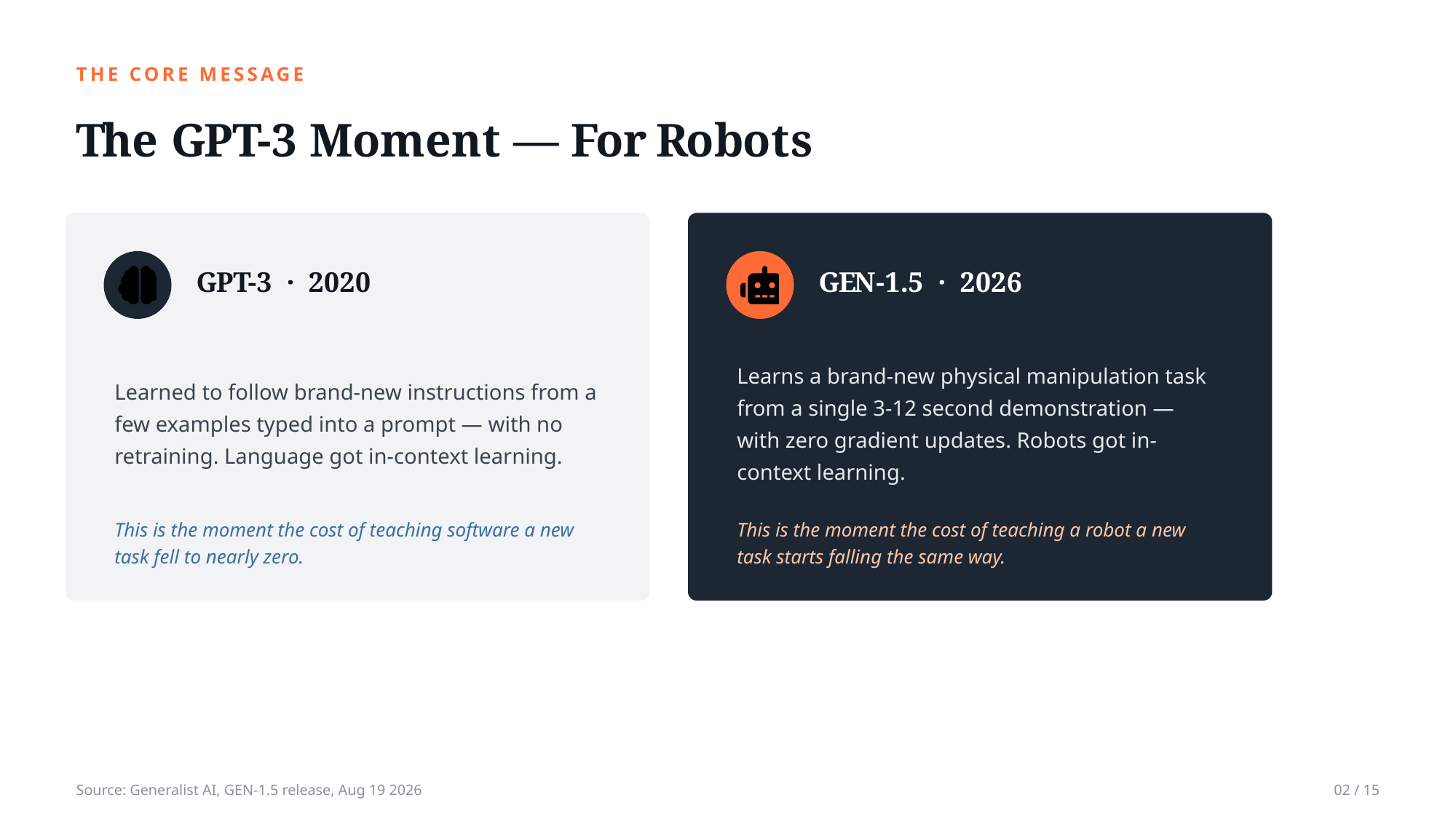
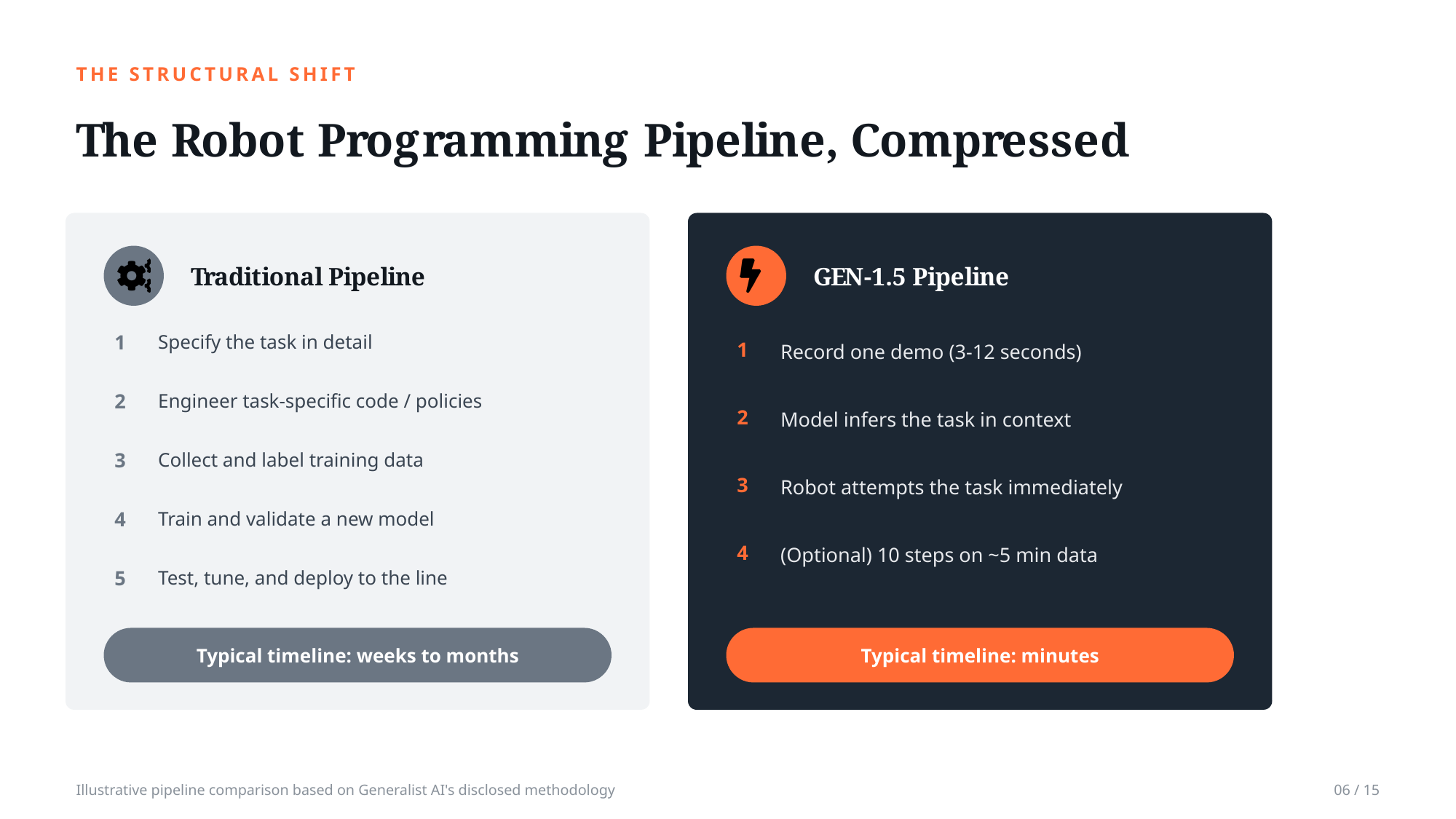
GEN-1.5 is a robot foundation model, published August 19, 2026 by Generalist AI, that learns a new physical task from a single 3-to-12-second demonstration with no gradient updates or fine-tuning. It is a large multimodal system taking in roughly 30 seconds of video, sensor, language, and proprioceptive data, and outputs robot movement at 100 times per second. The company calls the trick “physical prompting,” a nod to how a language model takes instructions in a text prompt instead of through retraining.
How does “physical prompting” actually work?
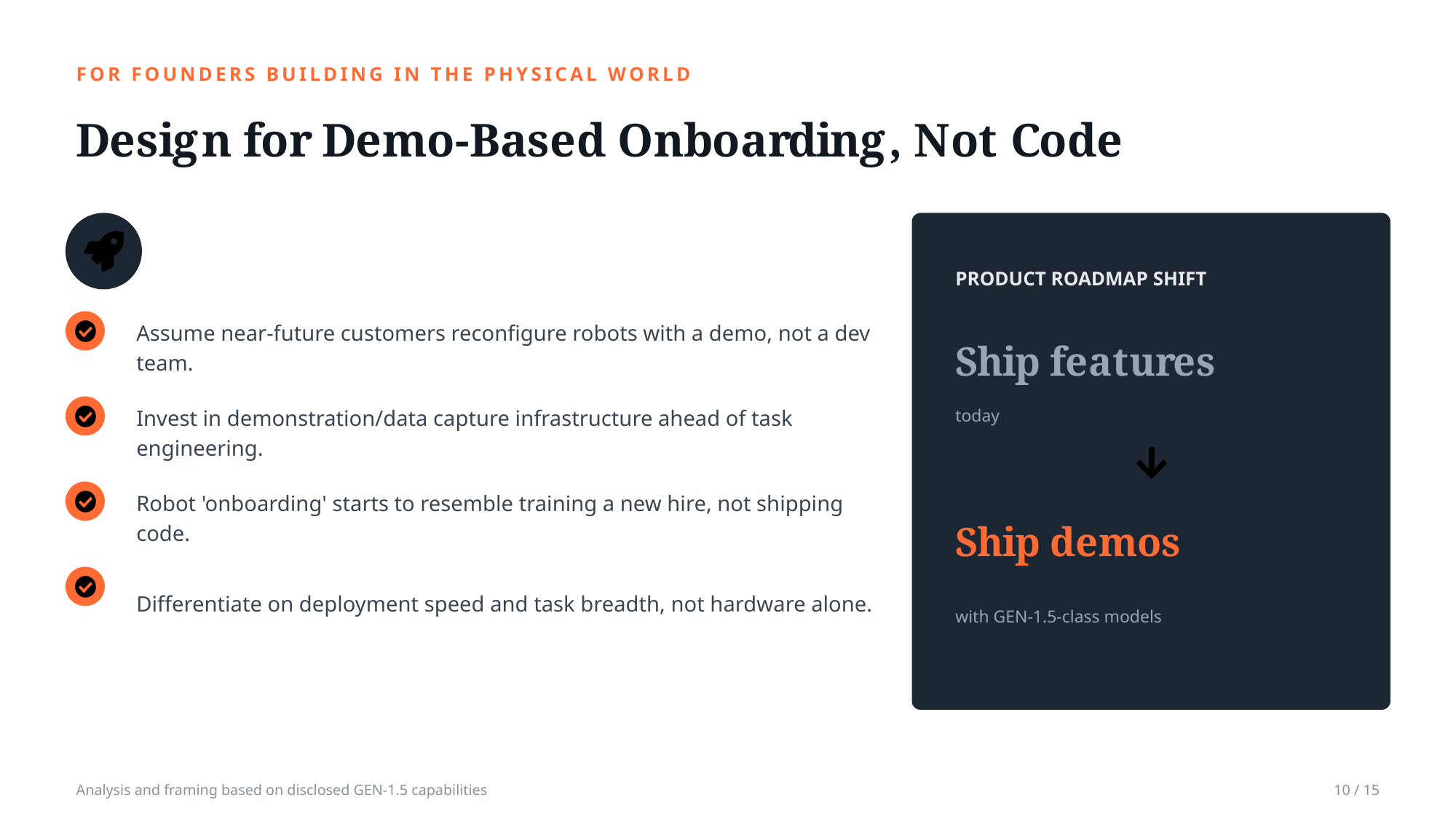
A short recording of someone performing a task, either a person wearing handheld gripper devices or the robot’s own earlier attempt, gets inserted into the model’s memory window, and the robot copies the behavior immediately, with no training step in between. The trick generalizes further than a simple copy: placing two separately recorded demonstrations into the same context window made the model chain them into one continuous behavior, inventing the motions needed to bridge them on its own. It also worked with demonstrations that never touched a real robot, since a task recorded entirely inside a simulator was enough to prompt a working real-world behavior, even though the training data held no simulation footage.
What do the success numbers actually show?
The headline figures are modest by design, and the company says so plainly: 59% success from zero training, climbing sharply with a little practice. Across ten diverse manipulation tasks, one-shot in-context prompting run straight from the pretrained model averaged 59% success, and ten gradient steps on five minutes of task data, roughly 50 demonstrations, pushed that average to 83%. A single gradient step on one minute of data still reached 66.5% success on a task the model had never seen, and those ten adaptation steps changed the model’s underlying weights by less than 0.15%.
Why is everyone comparing this to GPT-3?
The comparison is deliberate, and the numbers land in a similar band. Brown et al.'s original GPT-3 paper reported roughly 45% average accuracy on language tasks with one-shot prompting and up to about 65% with dozens of examples, without parameter updates, the result that first made in-context learning a hallmark of large pretrained models. GEN-1.5’s 59% figure sits between those two numbers. What makes the robotics result notable is that nobody engineered the trick in: Generalist added no architectural changes, no meta-learning loop, and no auxiliary objective to encourage improvisation. It simply appeared after the model trained continuously on physical interaction data for more than eight months.
Who backs this claim, and should it be trusted yet?
The strongest outside validation so far comes from a rival lab’s researcher, not an independent study. Nvidia robotics director Jim Fan argued, in comments covered by Humanoids Daily, that ordinary physical work is naturally repetitive, giving the model free contextual training signal, and that keeping human “fumbles” in the data rather than trimming them out taught it to recover from mistakes on its own. He also linked the result to how Generalist gathers data: handheld grippers worn by a human rather than remote teleoperation, which he argues preserves physical intuition that teleoperation strips away. Caution is still warranted. As The Decoder noted, other teams have shown similar in-context learning before, but only for a narrow set of task types, and every result behind GEN-1.5 is self-reported.
What does this mean for manufacturing and automation planning?
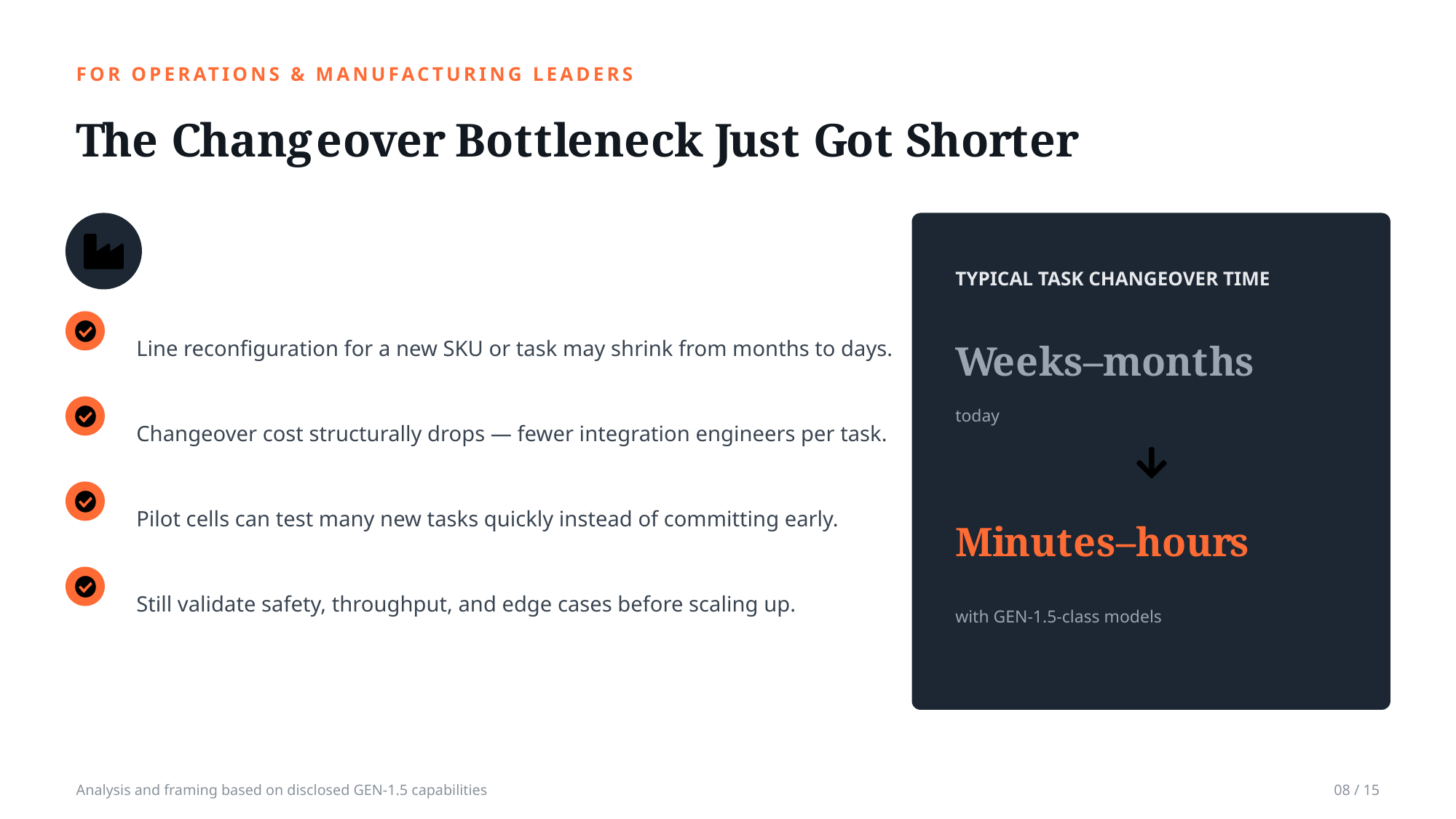
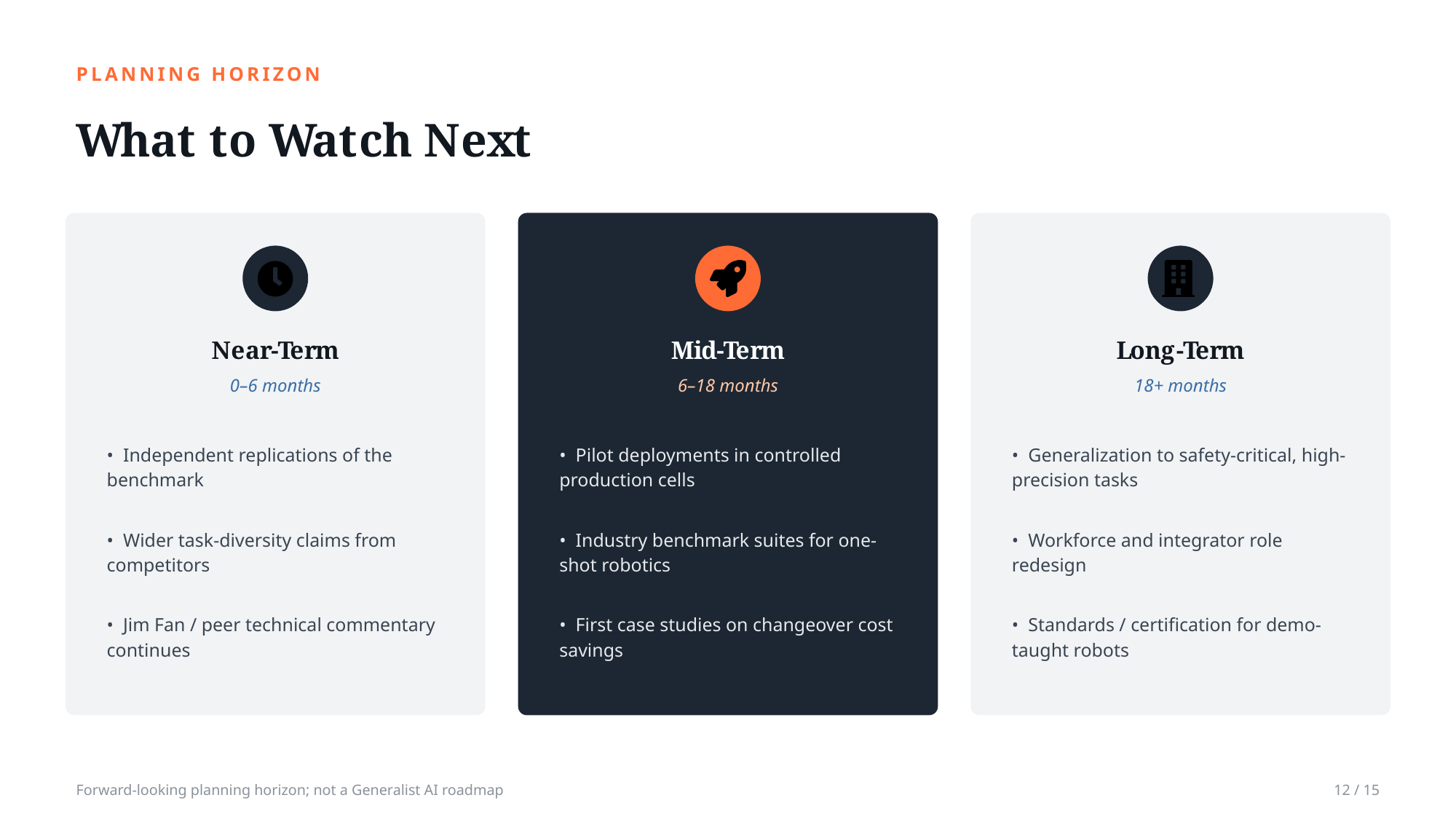
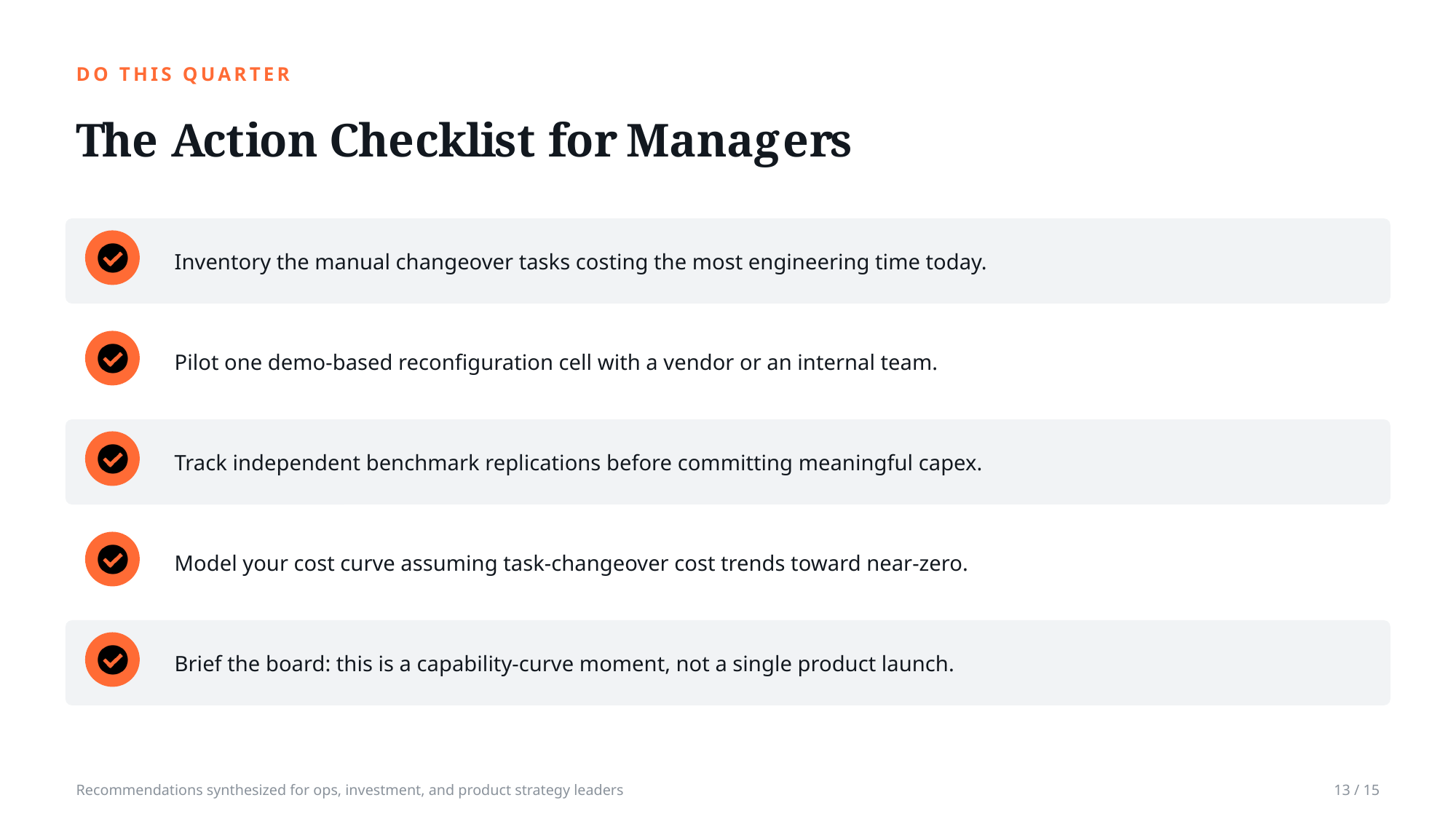
If the pattern holds up outside the lab, the cost of teaching a robot a new task shifts from months of engineering to a demonstration lasting seconds. Tech Times framed the stakes directly: the pipeline industrial robot deployments require today, expert teleoperation, thousands of demonstrations, validation, custom software, may end up competing with a library of ten-second video clips. That matters for planning now, even with results unverified, because it changes what to pilot first: not a fully engineered workflow, but a small, clean library of demonstrations a model might reuse. Generalist is not alone chasing this outcome. Google DeepMind’s Gemini Robotics line, Nvidia’s GR00T models, Physical Intelligence, and Skild AI are pursuing general-purpose robot control from different angles, but Generalist is currently the only one claiming this in-context ability appeared on its own, without being deliberately designed in.
The example deck paired with this post was built with AskDeck from a short brief, and it’s free to download and adapt if you need a quick way to walk a team through the concept.