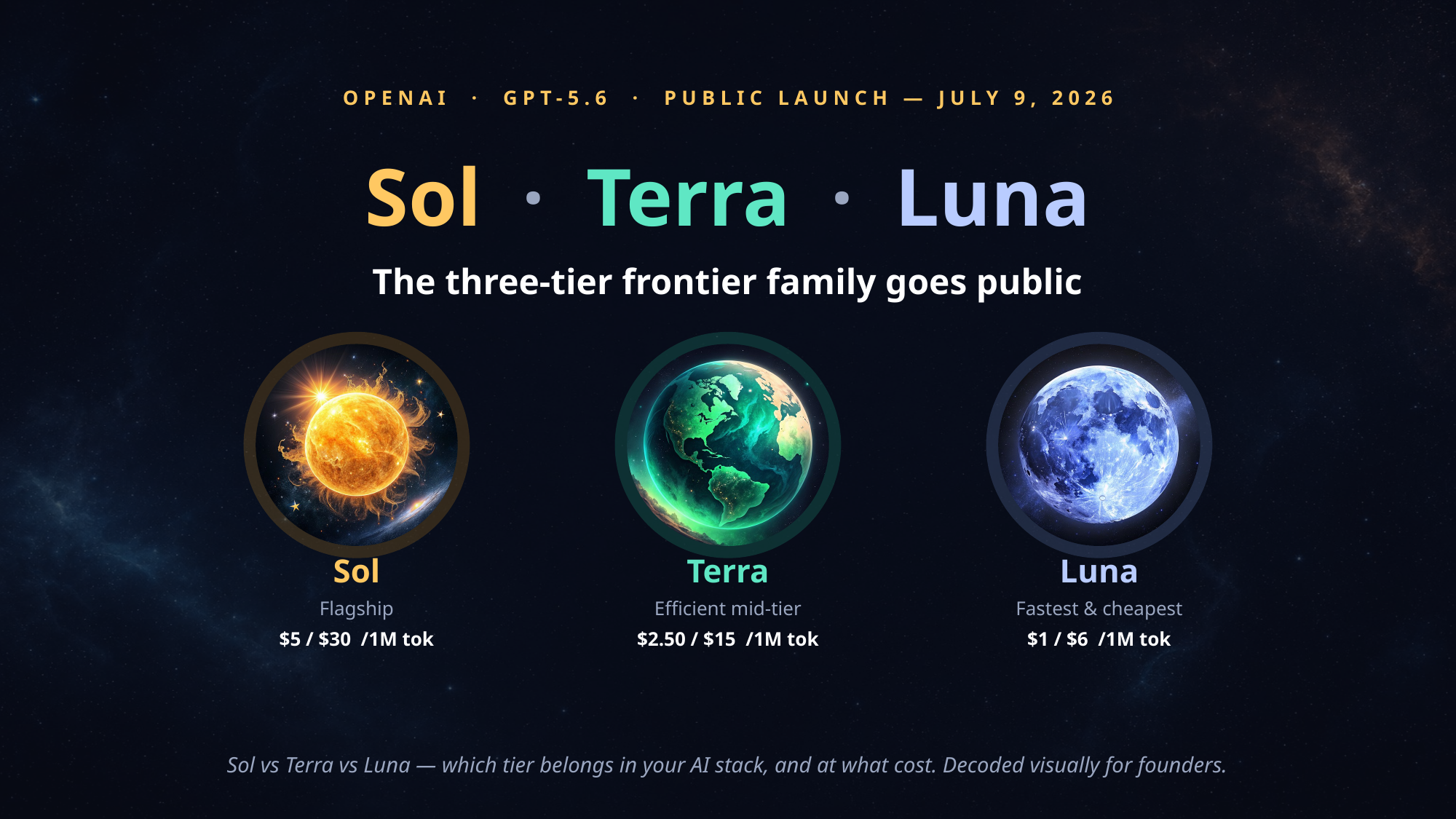
OpenAI’s newest frontier model has no single price. It has three: $5, $2.50, or $1 per million input tokens, depending on the tier.
Key Takeaways
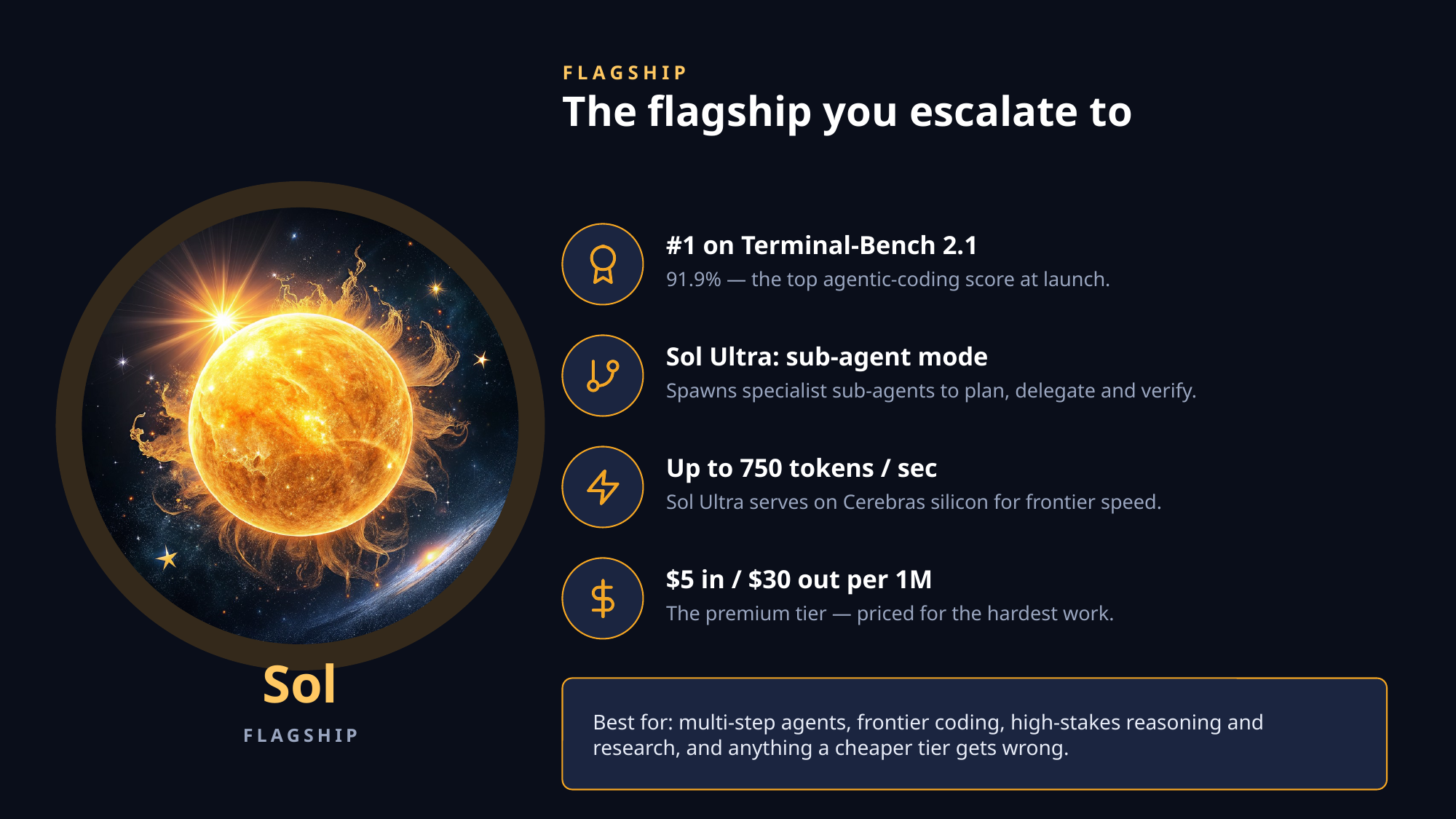
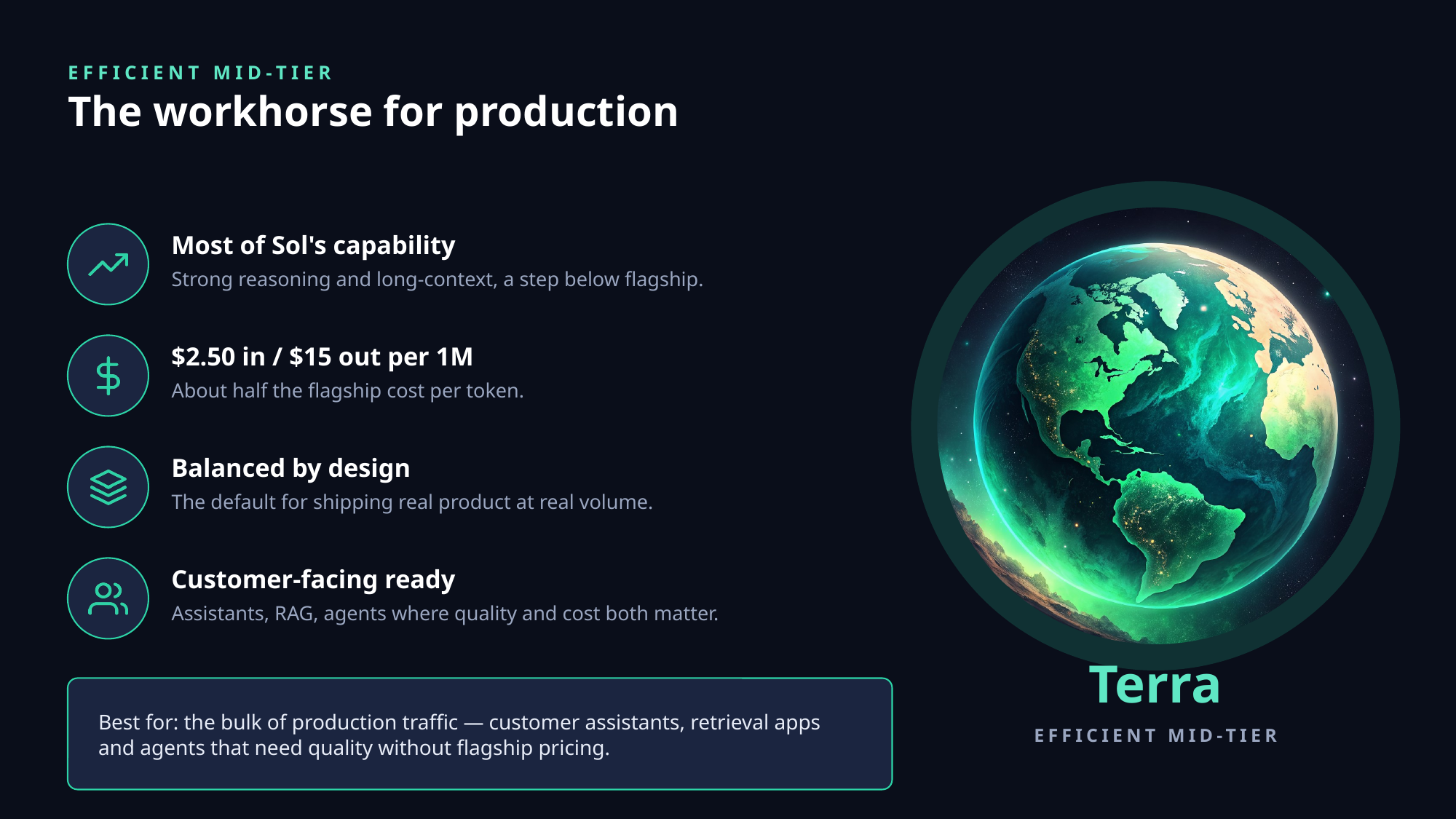
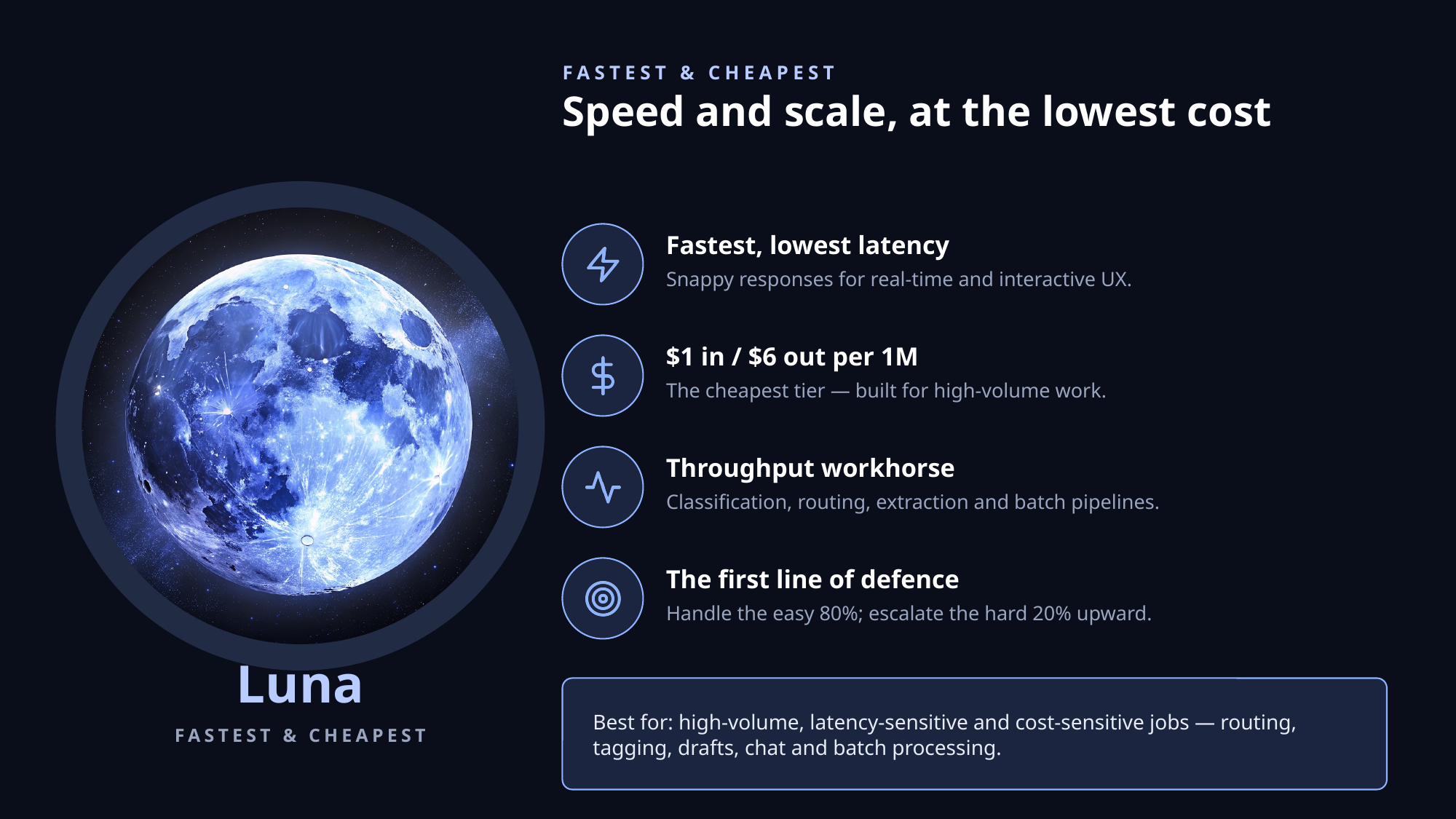
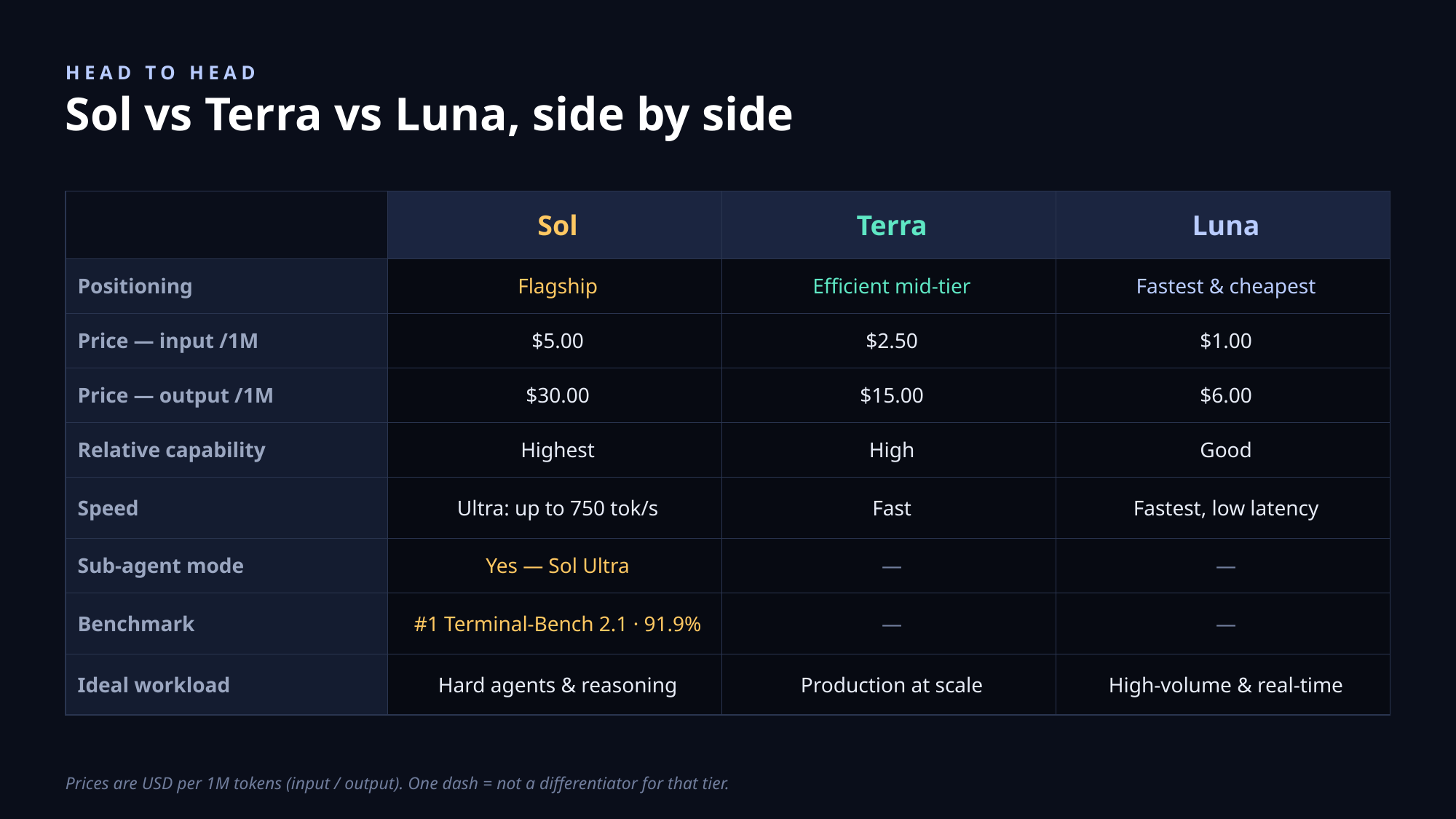
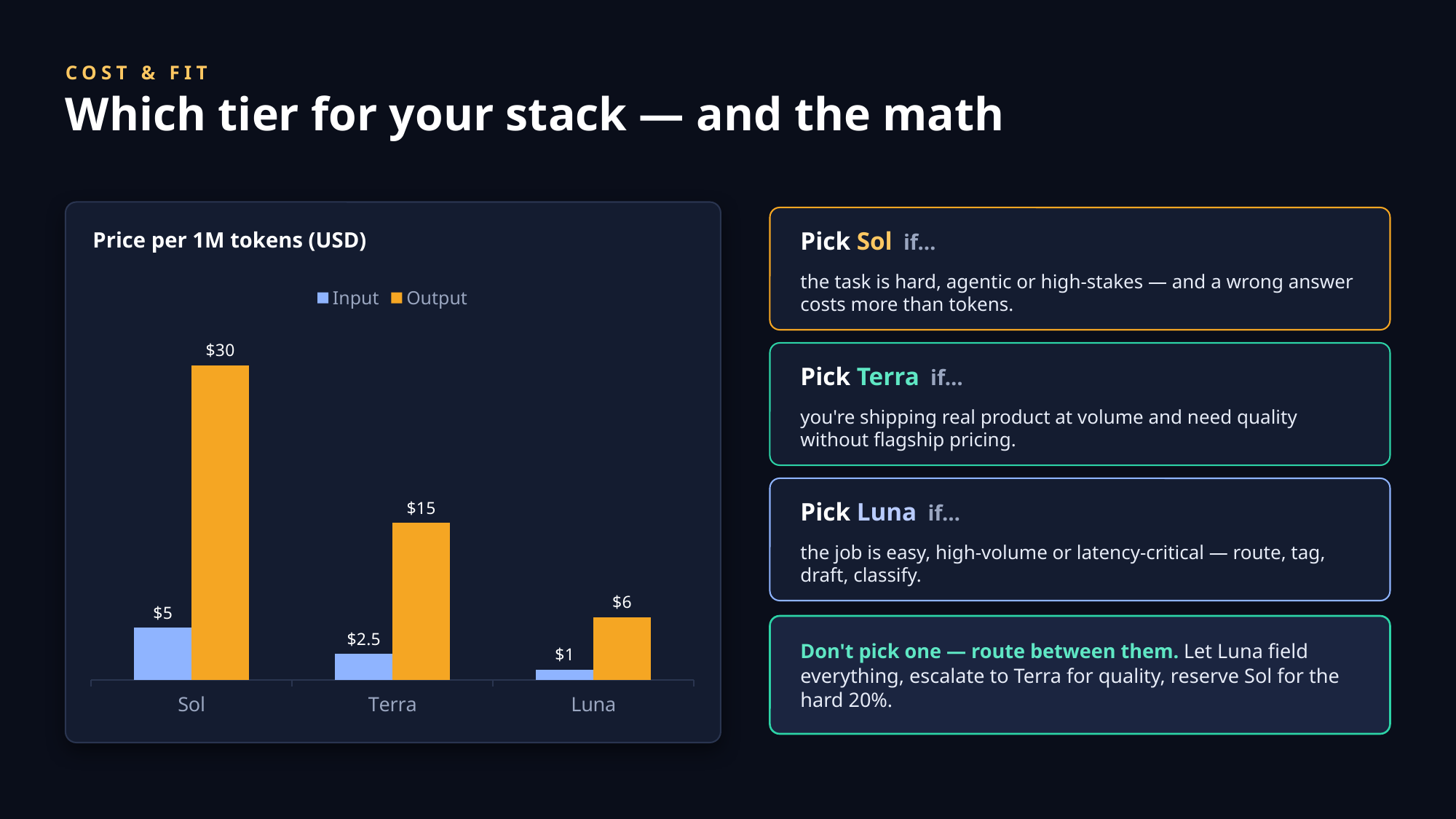
- GPT-5.6 ships as three tiers: Sol ($5/$30 per million tokens), Terra ($2.50/$15), and Luna ($1/$6).
- Sol Ultra hits 91.9% on Terminal-Bench 2.1 using four parallel agents, yet Sol still trails Claude’s coding leader by roughly 15 points on SWE-Bench Pro.
- Open-weight rivals GLM-5.2 and DeepSeek V4 Pro undercut every GPT-5.6 tier on price by a wide margin.
The slides embedded below walk through that three-tier decision visually, a ready-to-use example generated by AskDeck from a short brief. Back to the model itself, since the pricing split reflects a bigger shift in how frontier labs sell intelligence.
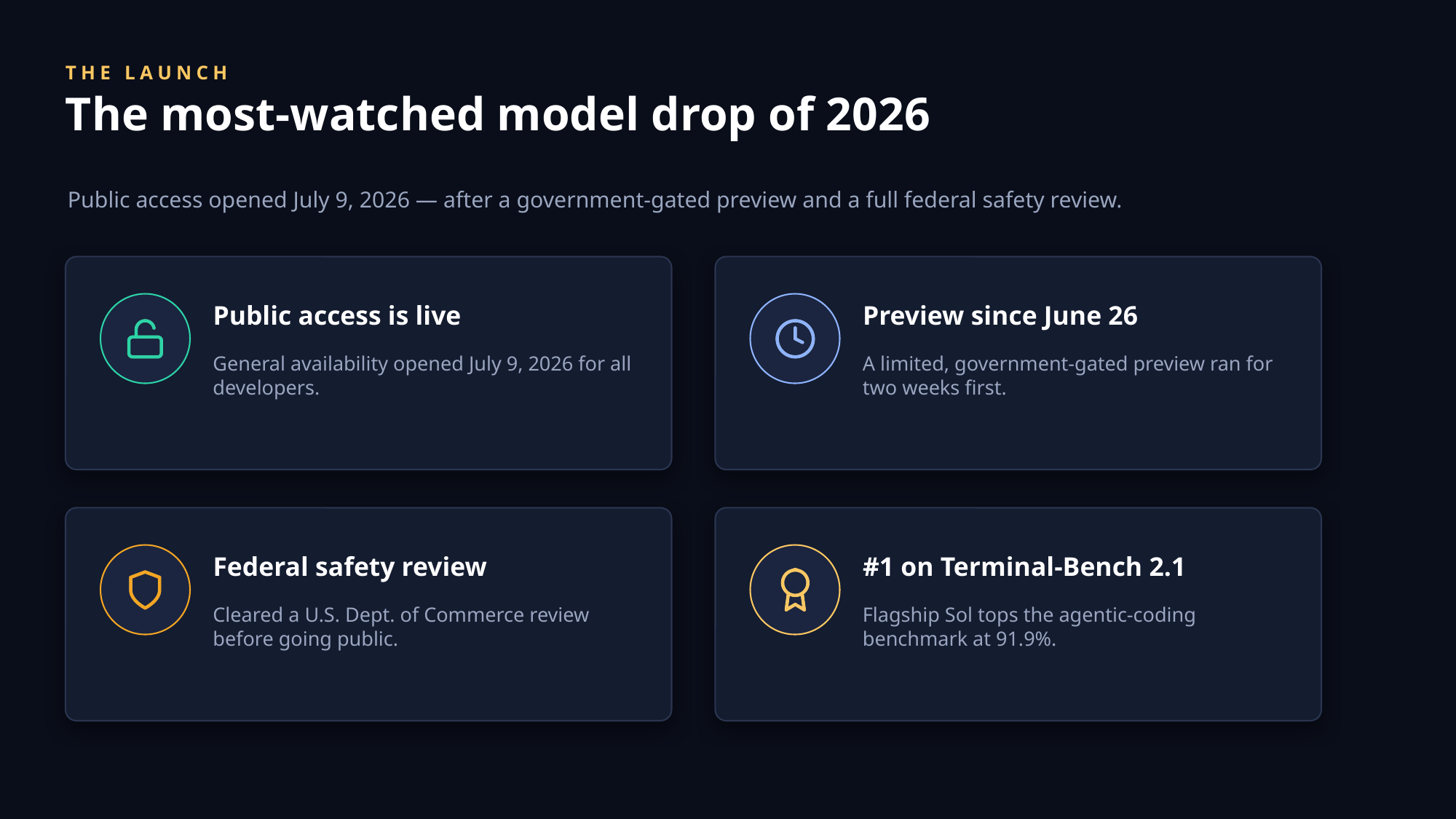
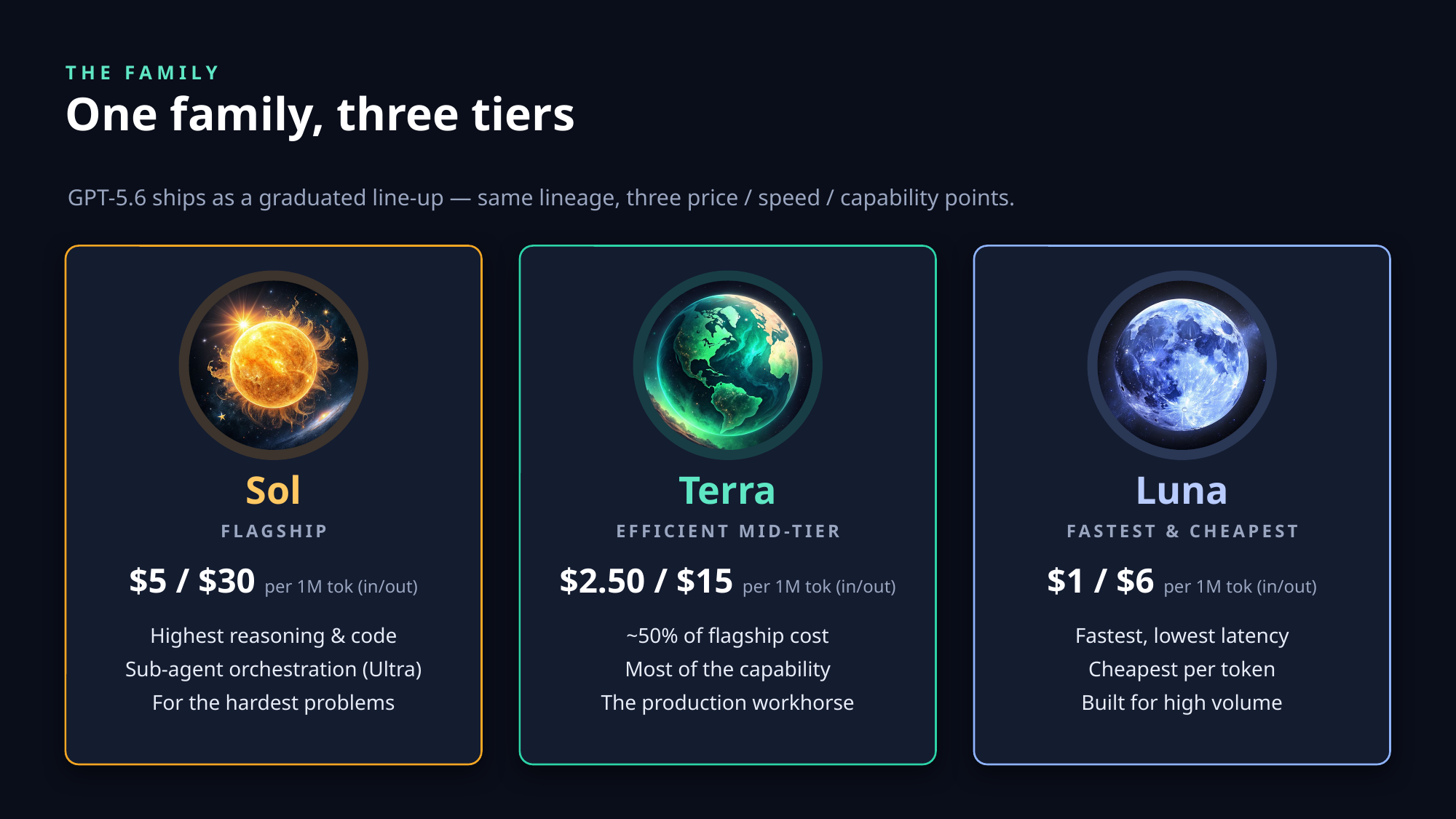
Swipe or scroll sideways to flip through the 11-slide deck →
What is GPT-5.6, and why does it come in three tiers?
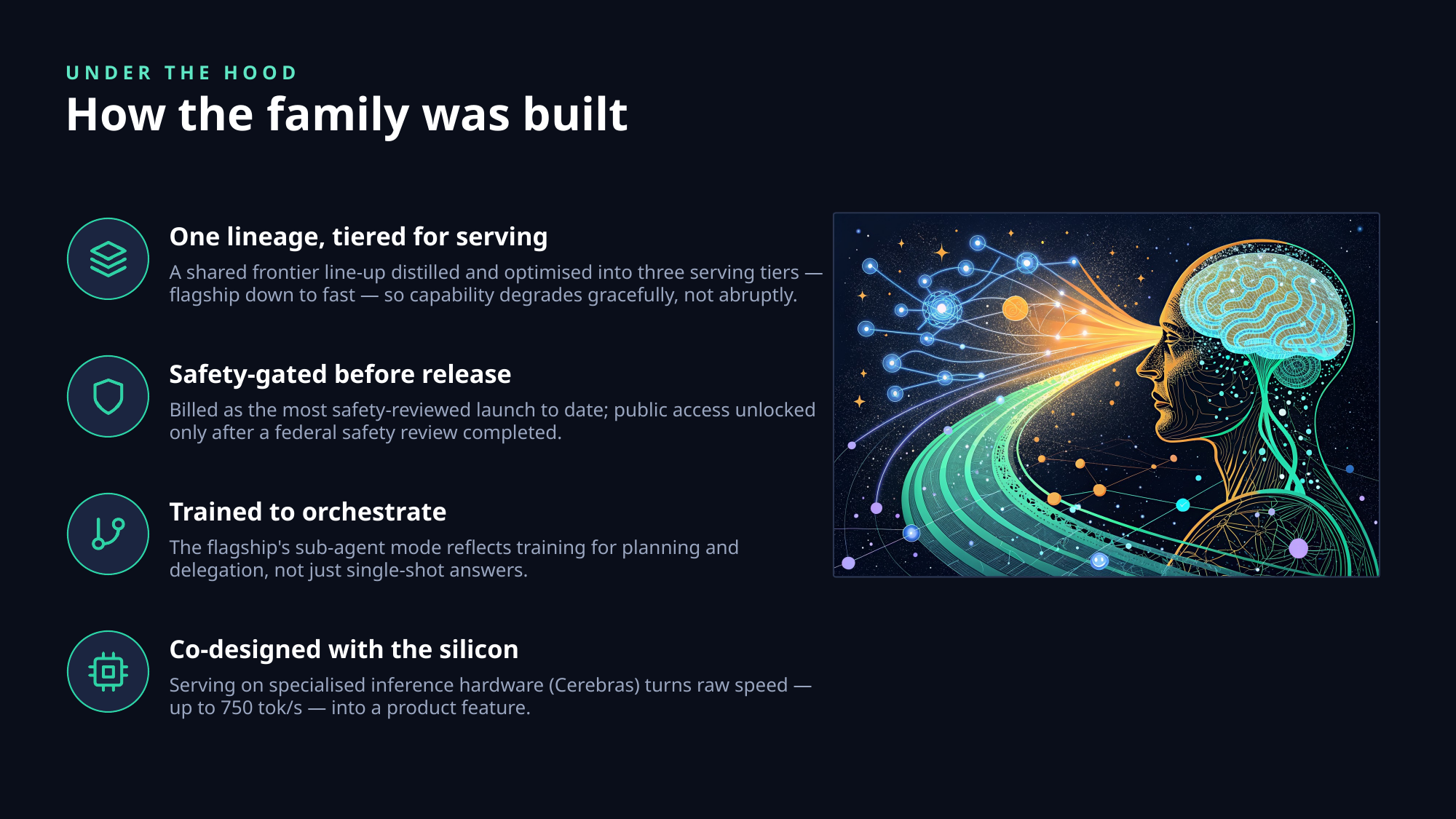
GPT-5.6 replaces OpenAI’s single-model naming with durable tiers. <cite index=“7-1”>Rather than a single model, it ships as a family of three: Sol (the flagship), Terra (a balanced everyday model), and Luna (a fast, low-cost model). They’re capability tiers.</cite> <cite index=“6-1”>The number identifies the generation, while Sol, Terra, and Luna are durable capability tiers that can advance on their own cadence.</cite> That lets Luna update without touching Sol’s release schedule.
How much do the tiers cost, and who should use each?
| Model | Input / Output (per 1M tokens) |
|---|---|
| GPT-5.6 Sol | $5.00 / $30.00 |
| GPT-5.6 Terra | $2.50 / $15.00 |
| GPT-5.6 Luna | $1.00 / $6.00 |
| Claude Fable 5 | $10.00 / $50.00 |
| Grok 4.5 | $2.00 / $6.00 |
| GLM-5.2 | ~$1.40 / $4.40 |
| DeepSeek V4 Pro | $1.74 / $3.48 |
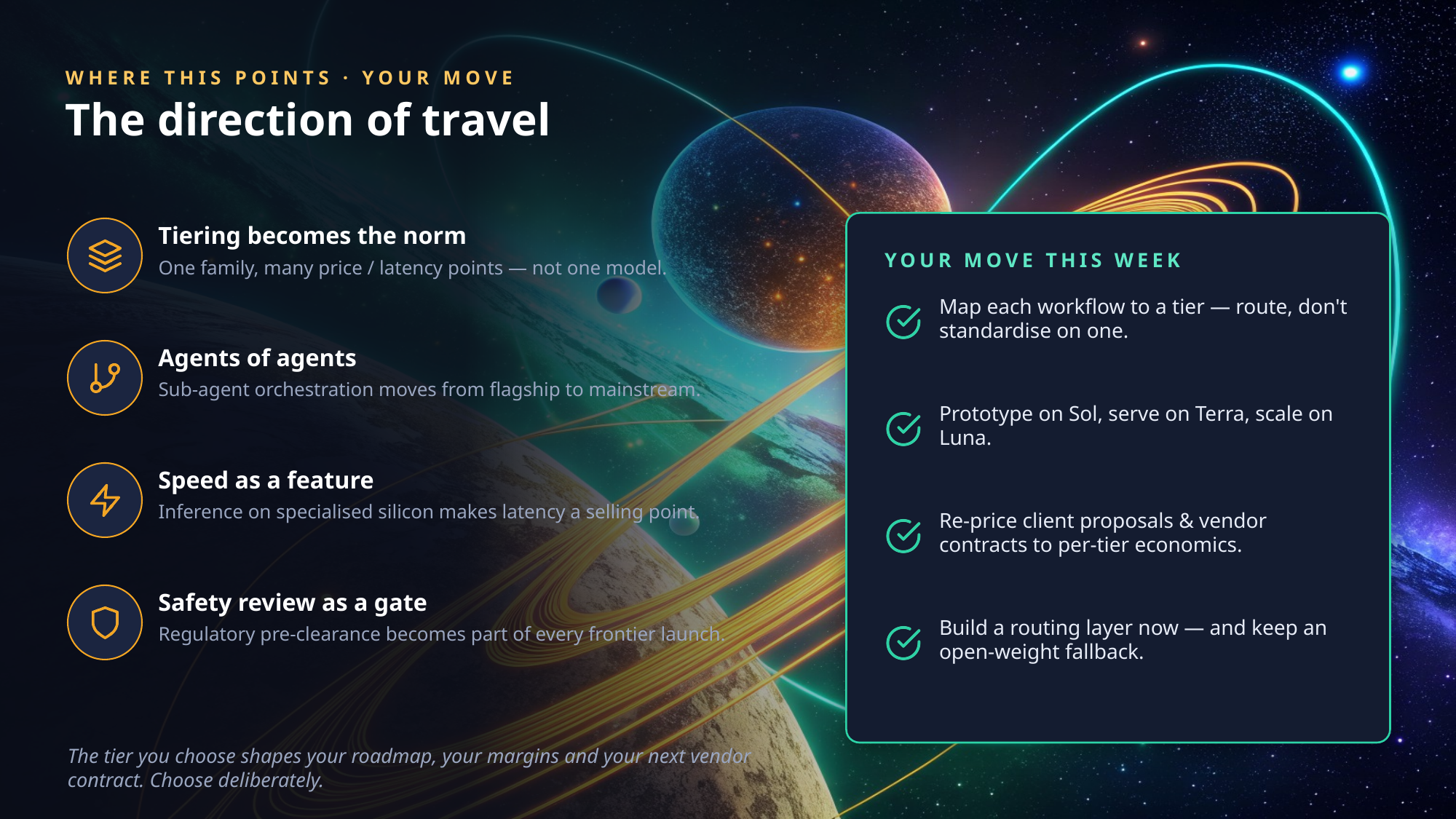
The split works as a routing guide. <cite index=“8-3”>Switch to Sol for coding agents if you are on GPT-5.5 or a previous model: it stays oriented longer and follows more requirements. Terra is worth testing for scoped coding tasks and first-pass review where escalation to Sol is available.</cite> <cite index=“8-4”>Luna suits top-of-funnel agent work, where a cheap first pass reduces load before a Terra or Sol escalation.</cite>
What changed under the hood: max, ultra, and tool calling?
Sol adds two reasoning controls plus a way to cut tool-call overhead. <cite index=“5-2”>Ultra mode runs four agents in parallel, lifting Terminal-Bench 2.1 from 88.8% to 91.9%.</cite> Programmatic Tool Calling changes orchestration itself: <cite index=“4-5”>it lets the model “compose and run JavaScript that orchestrates tool calls,” bridging simple tool APIs and full terminal sessions.</cite> Caching also got more predictable, with explicit breakpoints and a 30-minute minimum cache life.
Where does Sol win, and where does it fall behind?
<cite index=“6-2”>On Agents’ Last Exam, a long-running professional-workflow evaluation, Sol sets a new high of 53.6, eclipsing Claude Fable 5 by 13.1 points, and even at medium reasoning it beats Fable 5 by 11.4 points at roughly one-quarter the estimated cost.</cite> <cite index=“6-3”>On the Artificial Analysis Coding Agent Index, Sol with max reasoning sets a new state of the art at 80, 2.8 points above Fable 5, using less than half the output tokens.</cite> It doesn’t sweep everything: <cite index=“5-2”>on SWE-Bench Pro, Sol’s 64.6% trails Claude Mythos 5’s 80.3%, roughly 15 points behind.</cite>
Why the government-gated rollout, and how was it trained for safety?
Sol’s cyber and biology gains triggered an unusual launch process. <cite index=“2-2”>At the government’s request, OpenAI began with a limited preview for a small group of trusted partners whose participation had been shared with the government, before releasing more broadly.</cite> <cite index=“10-3,10-4”>All three models, not just Sol, are classified at OpenAI’s “High” risk level for cyber and biological capability, so Terra and Luna may carry new governance obligations too.</cite> OpenAI says far more about that safety layering than its pretraining recipe: <cite index=“2-3”>it built layered safeguards matched to each model’s capability, aiming to make prohibited activity harder without limiting legitimate work like code review and defensive testing.</cite>
How does it compare to open-weight models like GLM-5.2 and DeepSeek?
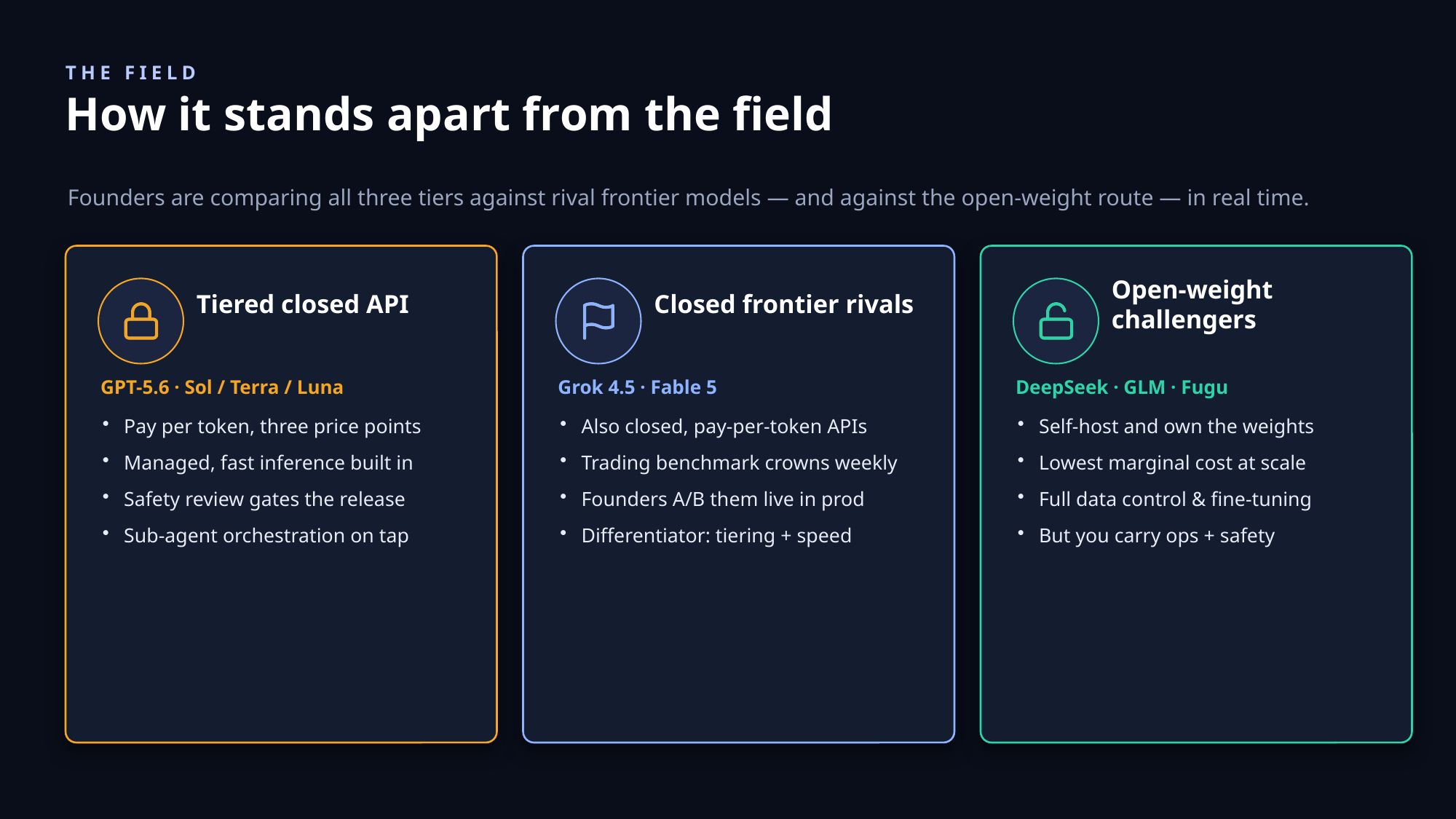
This is where OpenAI’s direction gets tested by cheaper, more transparent rivals. <cite index=“17-4”>GLM-5.2 is a 753-billion-parameter open-weights model whose Mixture-of-Experts design activates only about 40 billion parameters per token, delivering the depth of a massive model at a fraction of inference cost.</cite> <cite index=“14-1”>DeepSeek pre-trained V4 Pro on over 32 trillion tokens, more than double V3’s total,</cite> in <cite index=“14-5”>a 1.6-trillion-parameter MoE architecture with 49 billion active parameters.</cite> Both publish parameter and token counts OpenAI doesn’t for GPT-5.6. Sakana Fugu makes a different “open” claim: <cite index=“26-1”>it is itself a language model trained to call a pool of other LLMs, and instances of itself, behind one API,</cite> yet <cite index=“28-4”>it hasn’t disclosed what share of that pool is open versus closed,</cite> making it closed, not transparent. Grok 4.5 competes on price instead, <cite index=“34-1”>launching at $2/$6 per million tokens, roughly 75% below Opus 4.8.</cite> <cite index=“16-3”>GLM 5.2 landed days after a U.S. export-control directive forced Anthropic to disable Fable 5 and Mythos 5 broadly,</cite> making open weights look like insurance against vendor risk, not just a discount.
Common questions
Is GPT-5.6 available in ChatGPT yet? <cite index=“6-5”>Yes, starting today across ChatGPT, Codex, and the API, rolling out globally over roughly 24 hours.</cite> For regulated cyber or life-science use cases, confirm current access rules with your OpenAI account team rather than relying on any single article.
The example deck below was built with AskDeck from a short brief and can be downloaded and edited for your own team’s model-selection conversation.