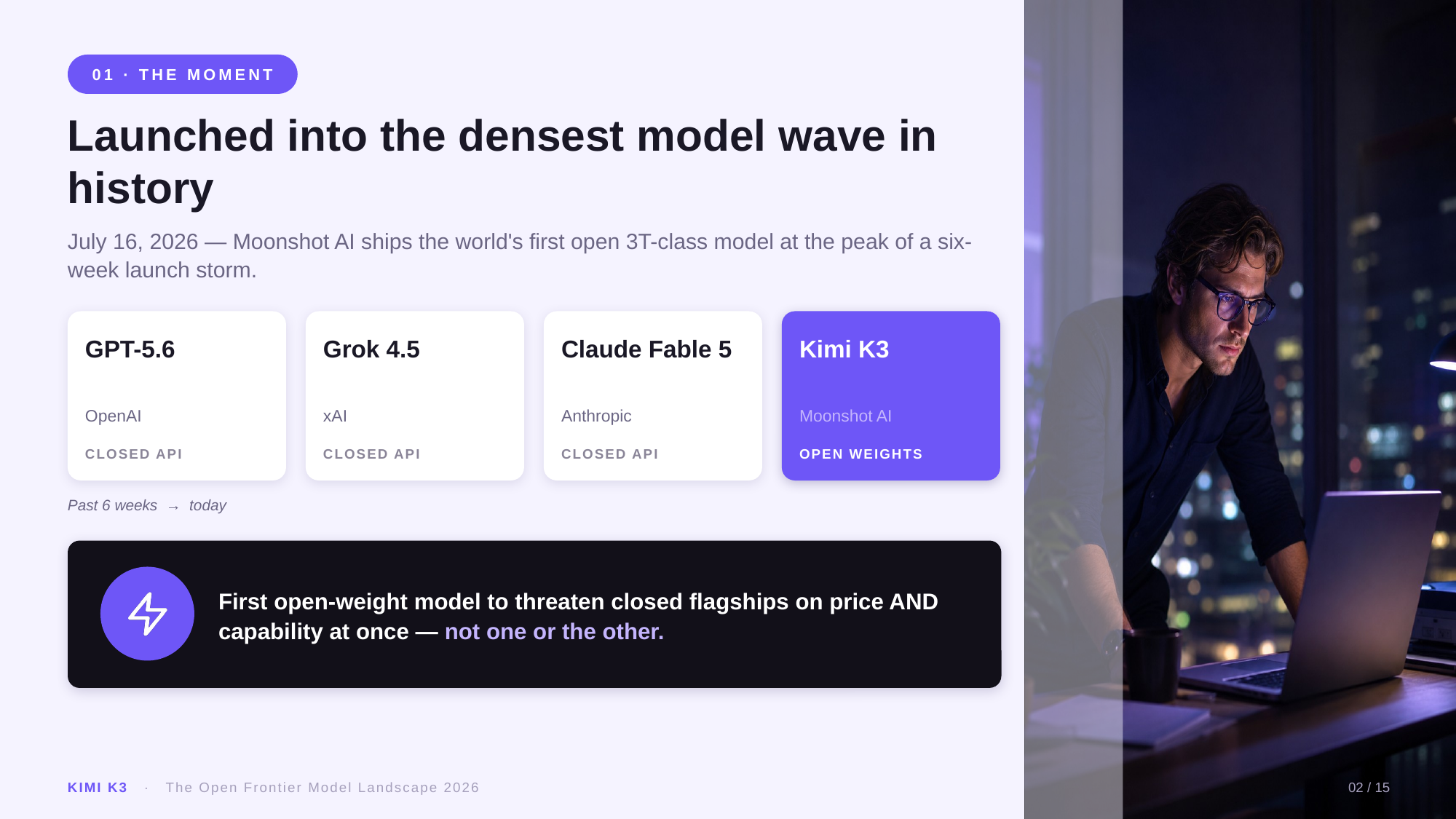
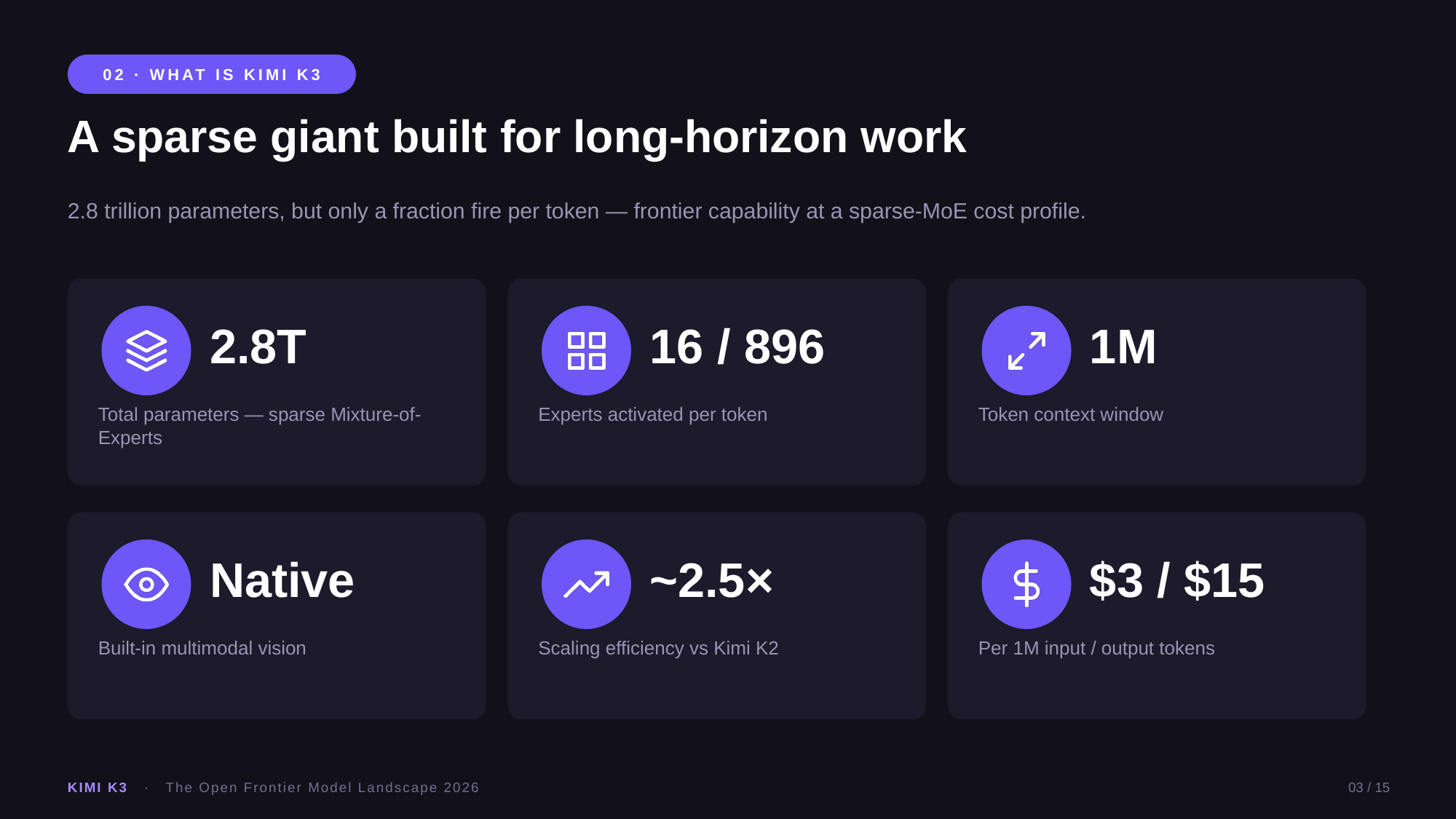
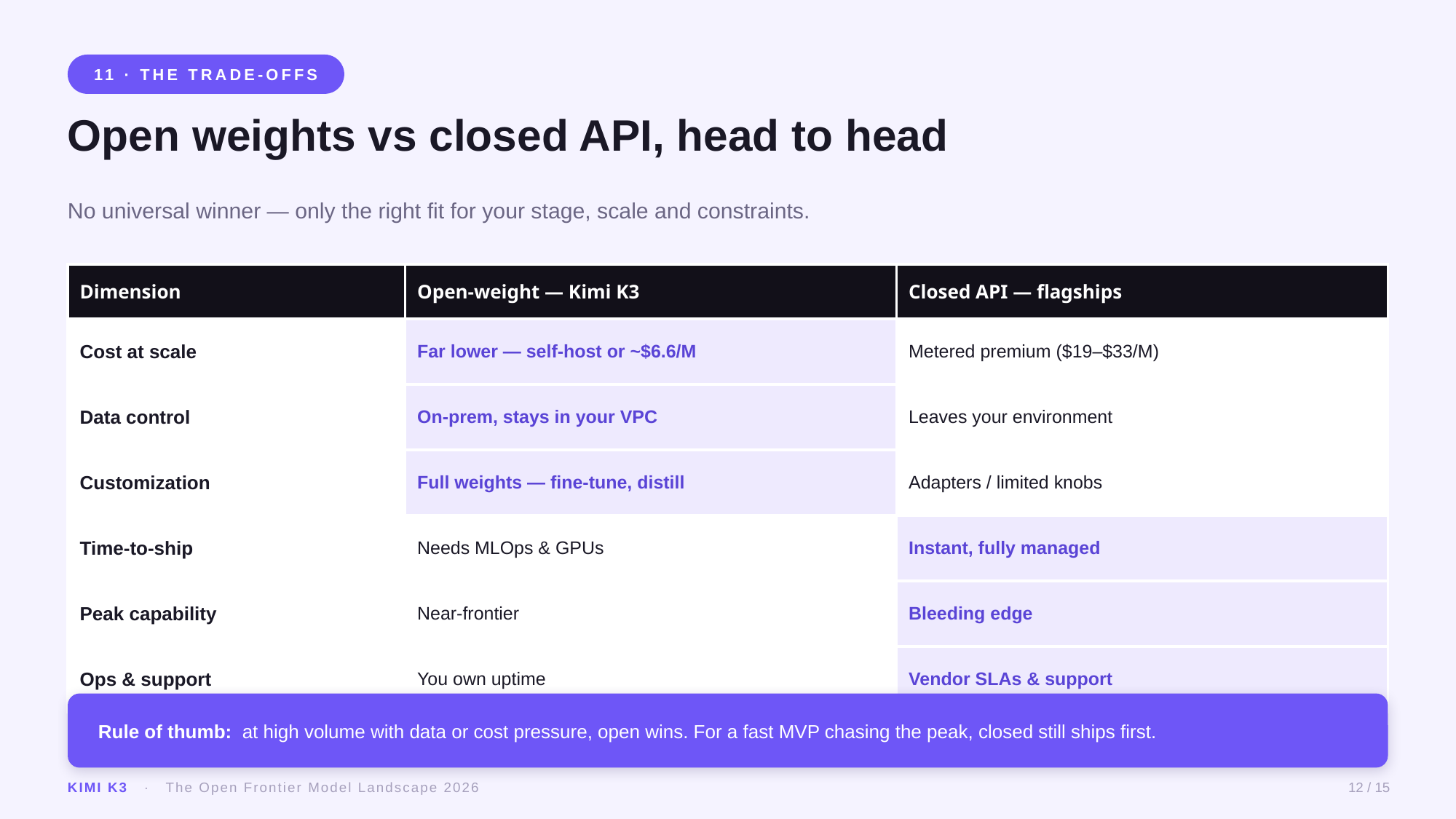
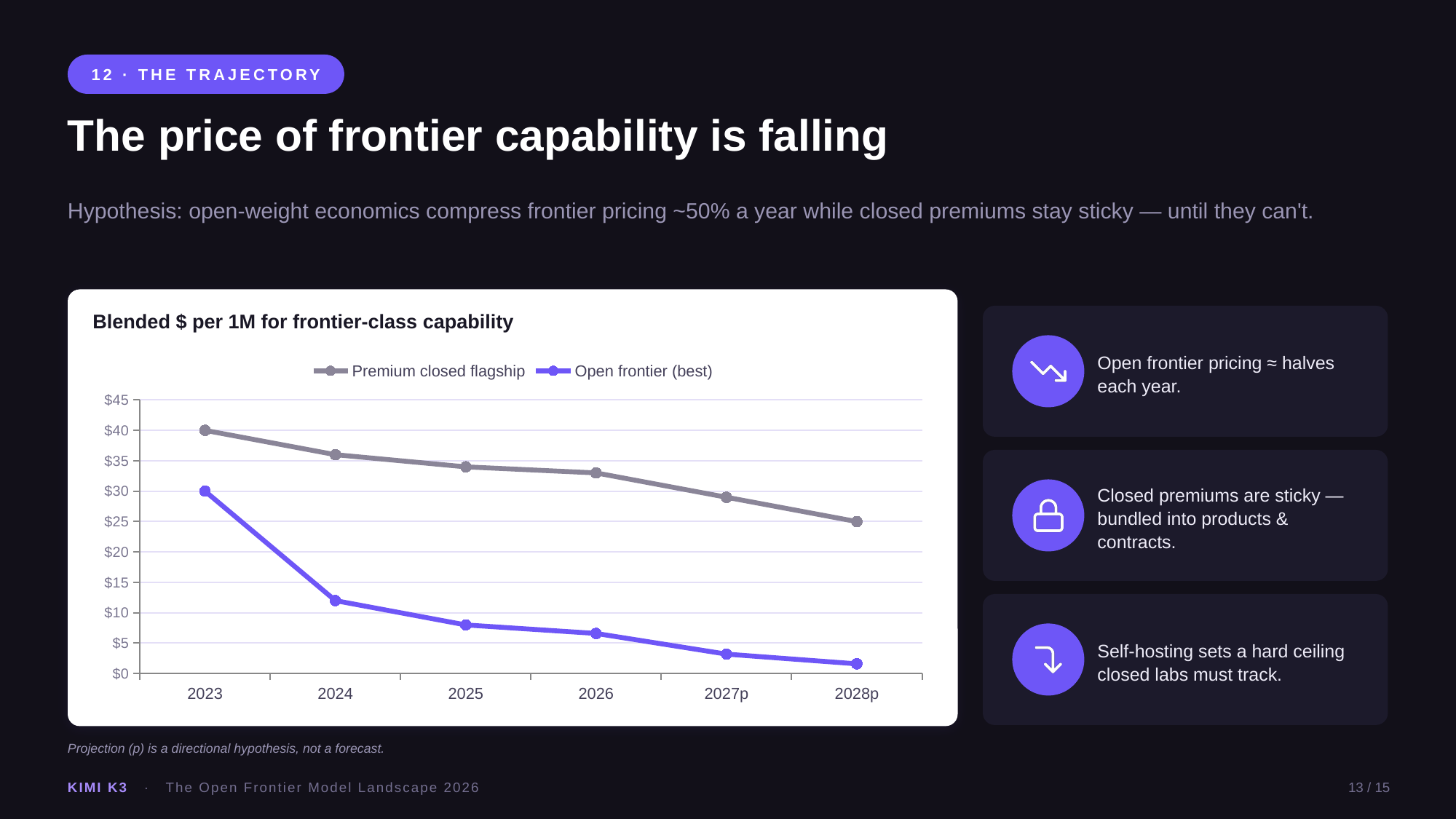
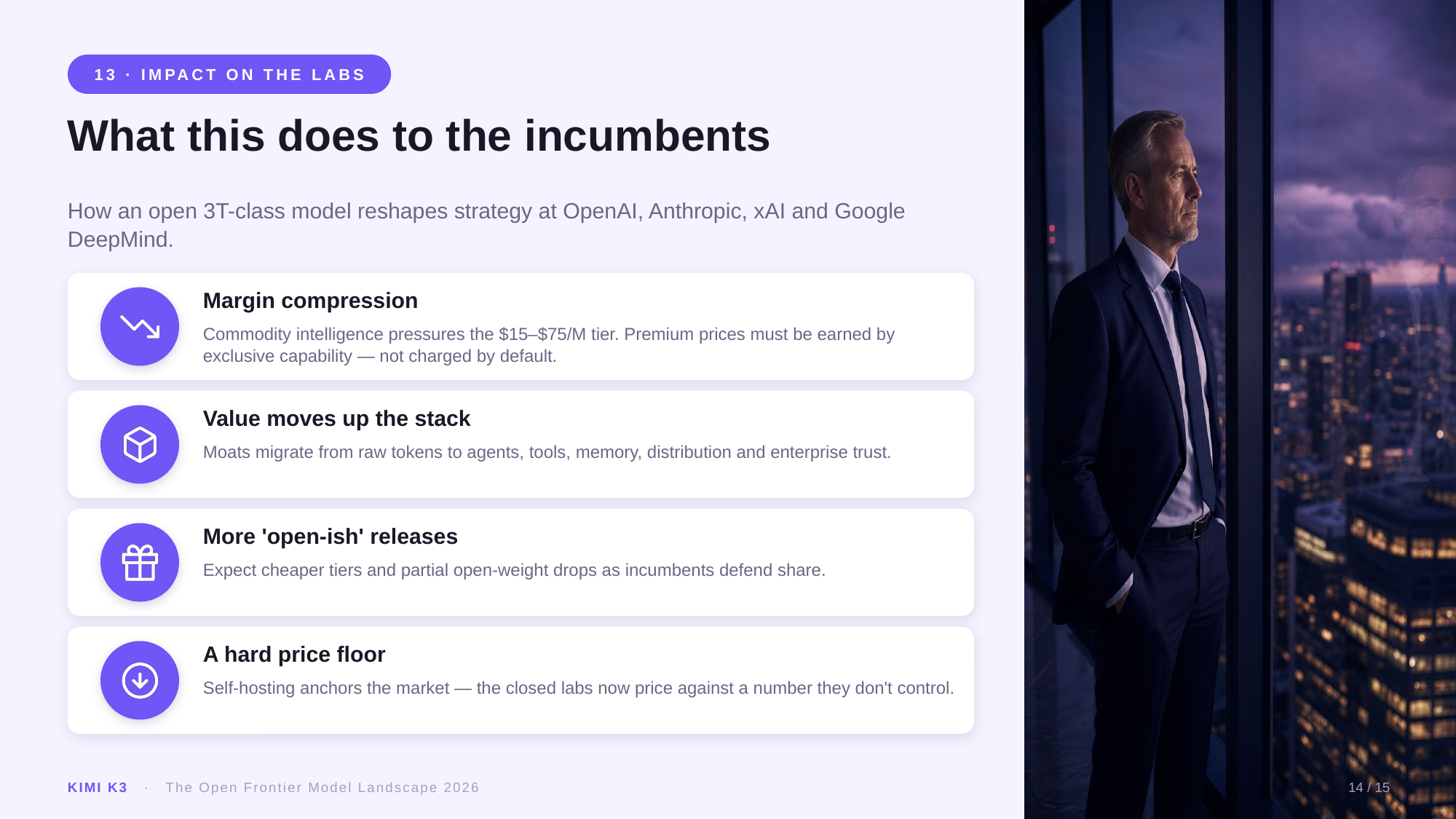
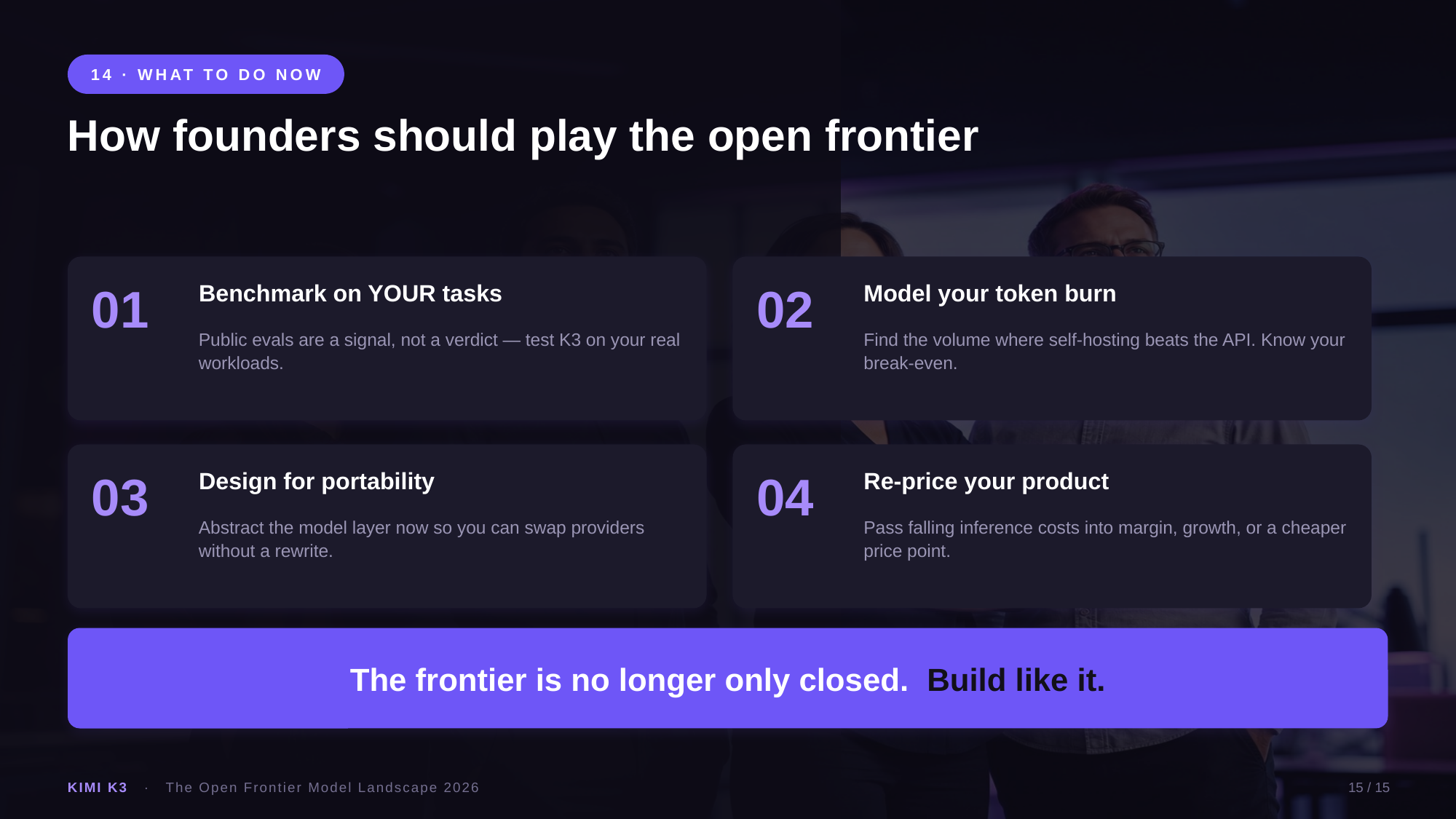
Swipe or scroll sideways to flip through the 15-slide deck →
What is Kimi K3, and why is it a big deal?
Kimi K3 is a 2.8-trillion-parameter open-weight language model that Moonshot AI released on July 16, 2026, with native vision and a 1-million-token context window, and the company calls it the world’s first open 3T-class model. It targets long-horizon coding, agent workloads, and knowledge work rather than casual chat.
Key Takeaways
- Kimi K3 is a 2.8T-parameter open MoE model that activates just 16 of 896 experts per token.
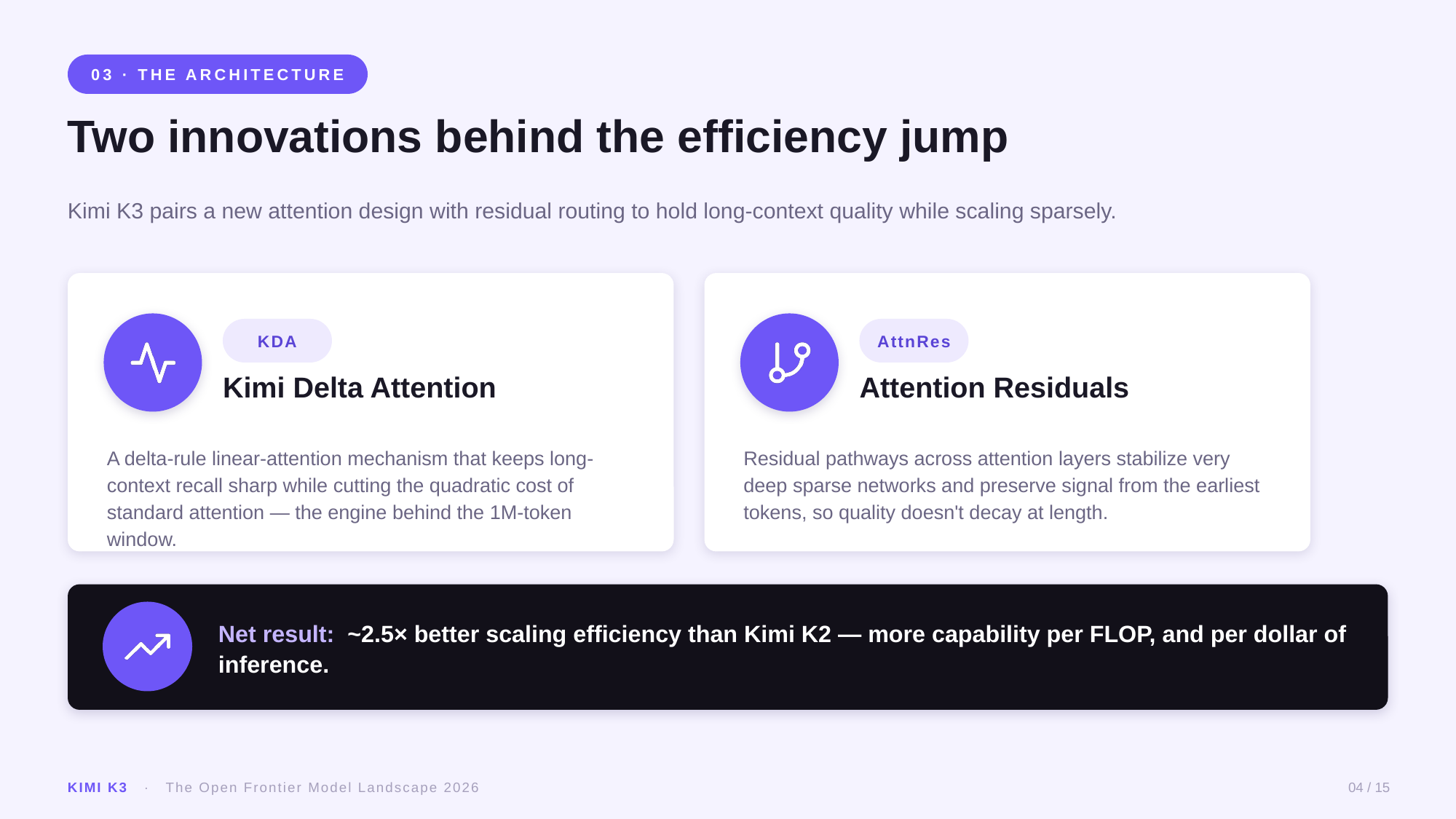
- Kimi Delta Attention and Attention Residuals give it roughly 2.5x better scaling efficiency than its predecessor, Kimi K2.
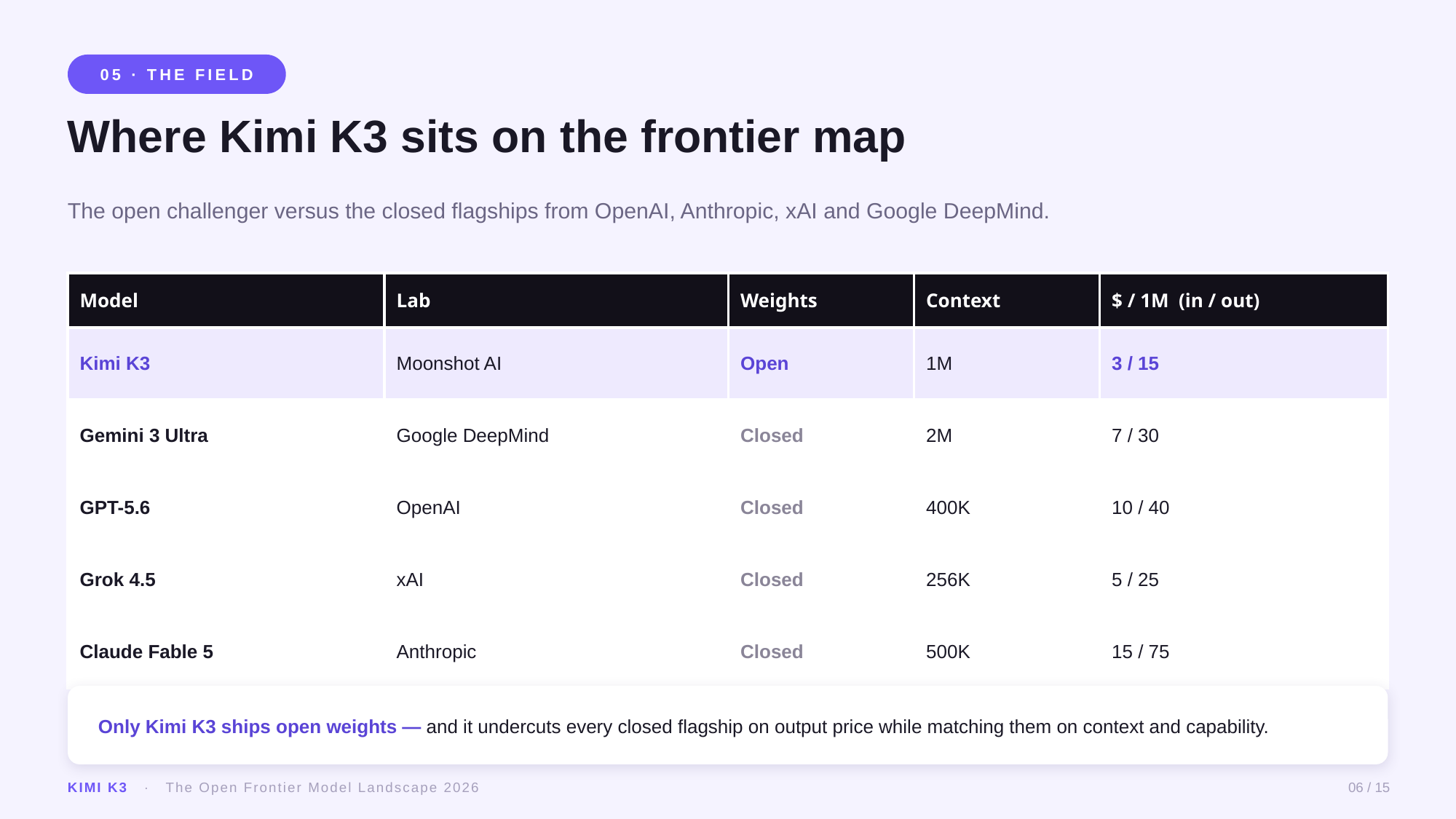
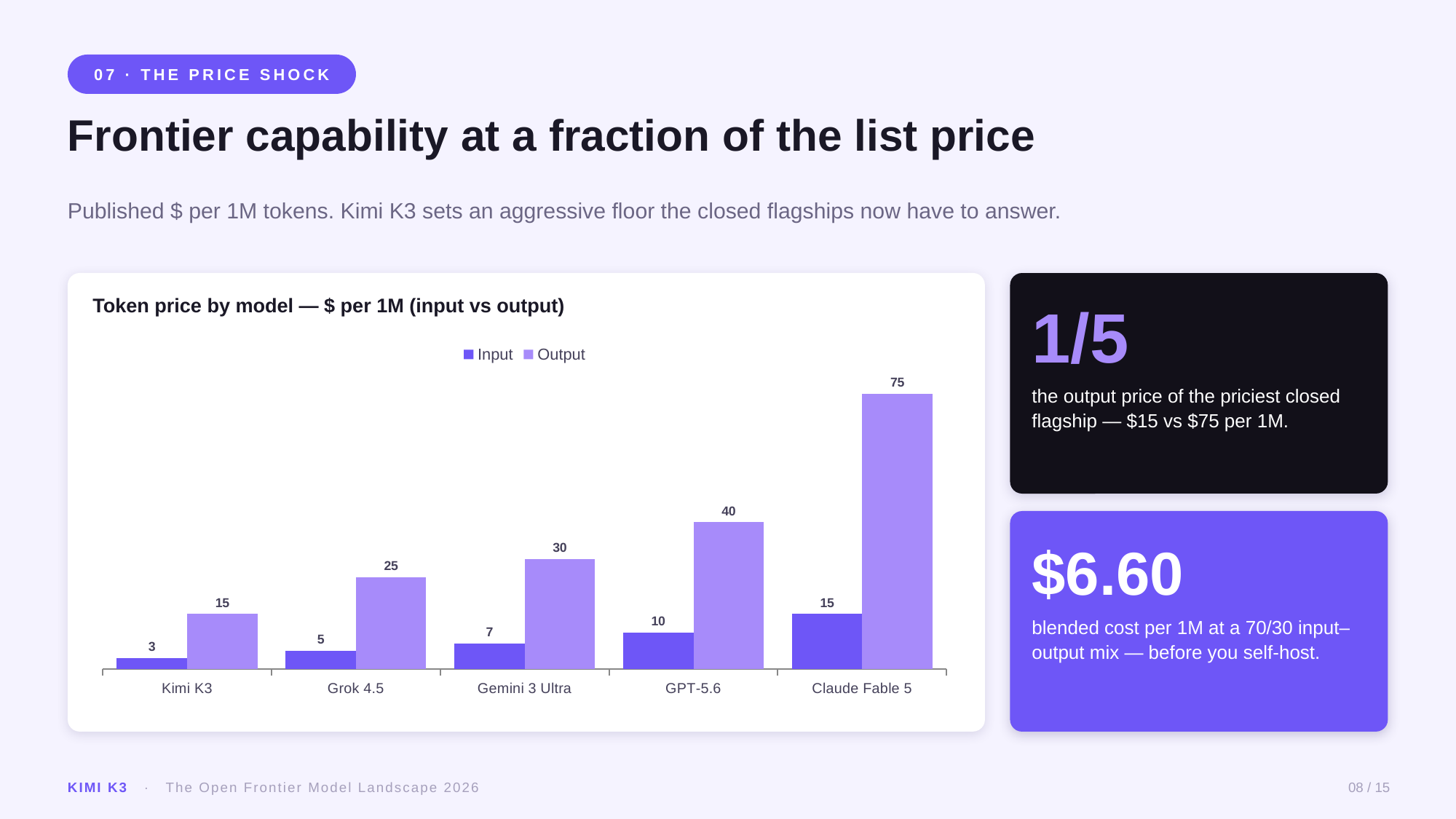
- It runs a 1-million-token context window and prices at $0.30 to $3.00 per million input tokens and $15.00 per million output tokens.
- It trails closed frontier models Claude Fable 5 and GPT 5.6 Sol overall but leads on several agentic and coding benchmarks.
The slides embedded below cover this same open-versus-closed model comparison as a ready-made deck, built by AskDeck from a short brief, in case a visual version is useful for a team. Back to the model itself.
How does a 2.8-trillion-parameter model stay affordable to run?
Kimi K3 stays practical through extreme sparsity. It is a Mixture-of-Experts network that activates just 16 of its 896 experts per token, one of three levers, alongside two new attention mechanisms, that keep a model nearly three times larger than its predecessor usable in production.
The routing scheme is called Stable LatentMoE, and at this level of sparsity, routing becomes a central engineering problem rather than a footnote. Moonshot addressed it with Quantile Balancing, which derives expert allocation directly from router-score quantiles, removing a sensitive balancing hyperparameter that earlier MoE systems needed. A second technique, Per-Head Muon, extends the Muon optimizer that Kimi K2 used to stabilize trillion-parameter training, tuning each attention head independently. Sigmoid Tanh Unit activations and Gated MLA round out the list.
What do Kimi Delta Attention and Attention Residuals do?
Kimi Delta Attention (KDA) is a hybrid linear attention mechanism that Moonshot says enables up to 6.3x faster decoding in million-token contexts, which is what makes the 1-million-token window workable at real-world speed. Attention Residuals (AttnRes) tackles a different axis of the same problem.
Where KDA changes how information moves across a long sequence, AttnRes changes how it moves across depth, selectively retrieving representations across layers instead of accumulating them uniformly. Moonshot states this delivers roughly 25% higher training efficiency at under 2% additional cost. Combined with refined training and data recipes, these changes give K3 about 2.5x better scaling efficiency than Kimi K2, the prior flagship that launched in July 2025 as a 1-trillion-parameter model with 32 billion parameters activated per token.
How does Kimi K3 perform against closed models like GPT-5.6 Sol and Claude Fable 5?
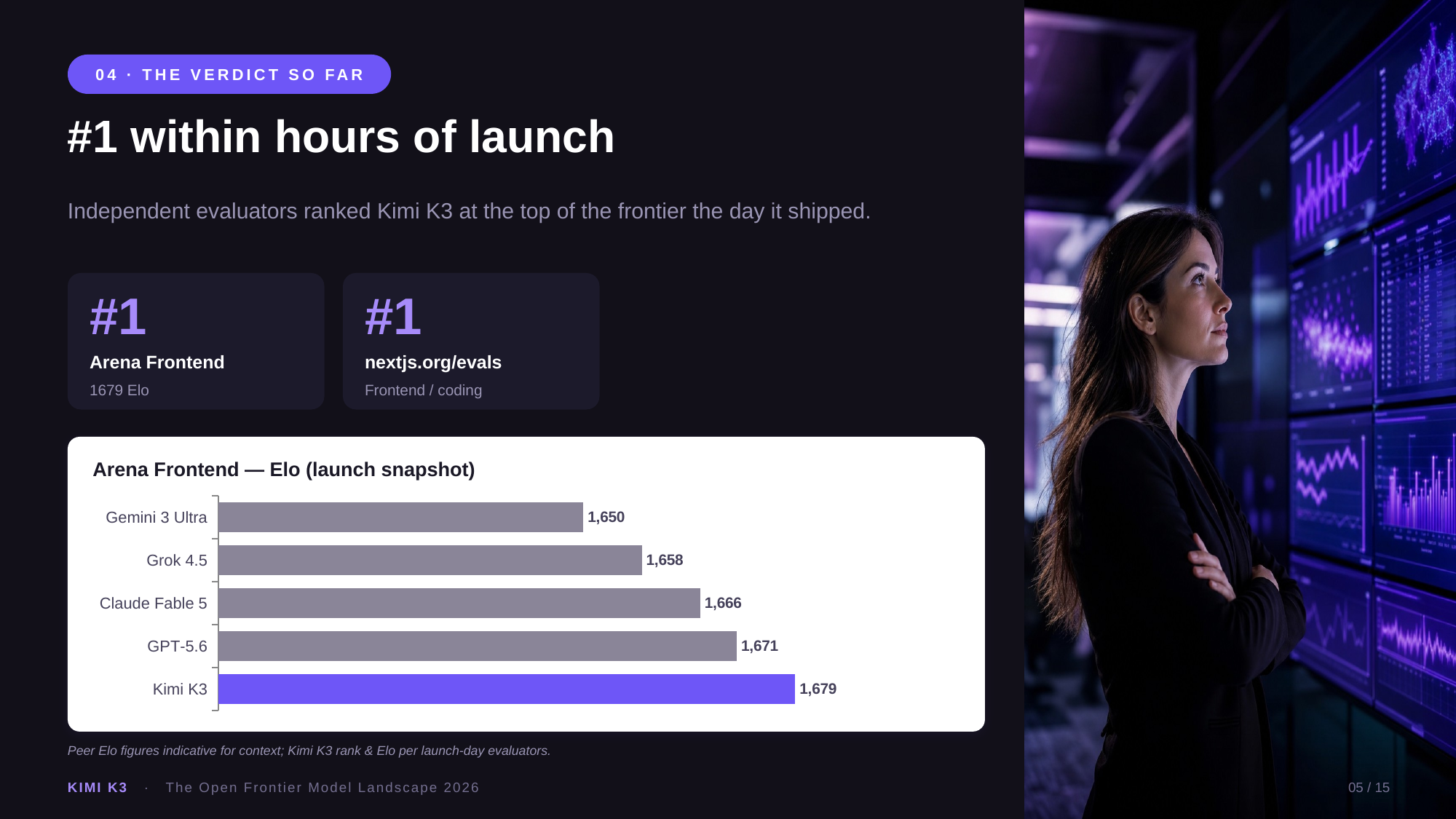
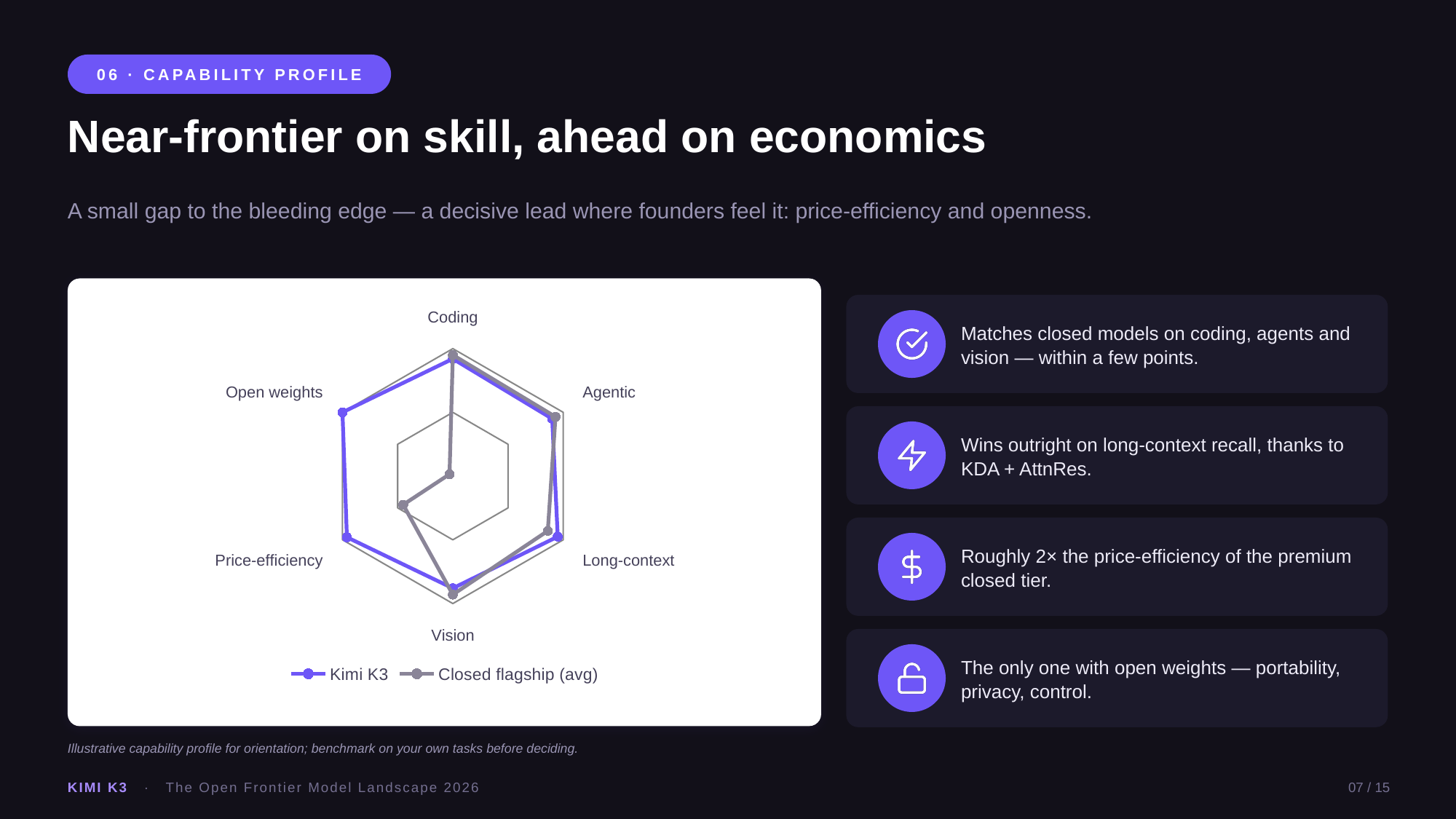
Kimi K3 does not claim outright superiority. Moonshot is direct that overall performance still trails the most powerful proprietary models, Claude Fable 5 and GPT 5.6 Sol, though K3 outperformed every other model in Moonshot’s own evaluation suite. On individual benchmarks, K3 leads Program Bench, SWE Marathon, BrowseComp, Automation Bench, and OmniDocBench, while trailing Fable 5 on FrontierSWE and HLE-Full, and GPT 5.6 Sol on the DeepSWE coding benchmark.
That split matters for deciding where to route work. A model that wins on long-running agent tasks and document parsing but loses ground on frontier reasoning fits coding pipelines and research agents better than every reasoning-heavy use case. Moonshot also notes that Kimi models have set the upper bound of open-model sizes for nine of the past twelve months, a streak that started with K2’s 1-trillion-parameter debut in mid-2025.
What does Kimi K3 cost, and how do you access it?
Kimi K3 is available through Kimi.com, Kimi Work, Kimi Code, and the API, using an OpenAI SDK-compatible interface pointed at a Moonshot base URL. Pricing is flat regardless of context length: cache-hit input costs $0.30 per million tokens, cache-miss input costs $3.00 per million tokens, and output costs $15.00 per million tokens.
Because pricing splits sharply between cache hits and misses, the cache-hit rate determines real-world cost, and Moonshot reports above 90% cache hits in coding workloads. A few API details matter before integrating: reasoning_effort only accepts max, temperature and top_p are fixed, and max_completion_tokens defaults to 131,072 but can reach the full 1,048,576-token window.
Common questions
Is Kimi K3 fully open-source? Moonshot describes it as an open model, meaning weights and architecture details are shared publicly rather than gated behind a closed API, continuing the approach of K2, released under a Modified MIT license in July 2025.
Who is Moonshot AI? Moonshot AI is a Beijing-based AI startup founded in 2023 by Tsinghua University alumnus Zhilin Yang and backed by major tech investors including Alibaba, and its Kimi model line is now one of the most closely watched open-weight families competing with Western labs.
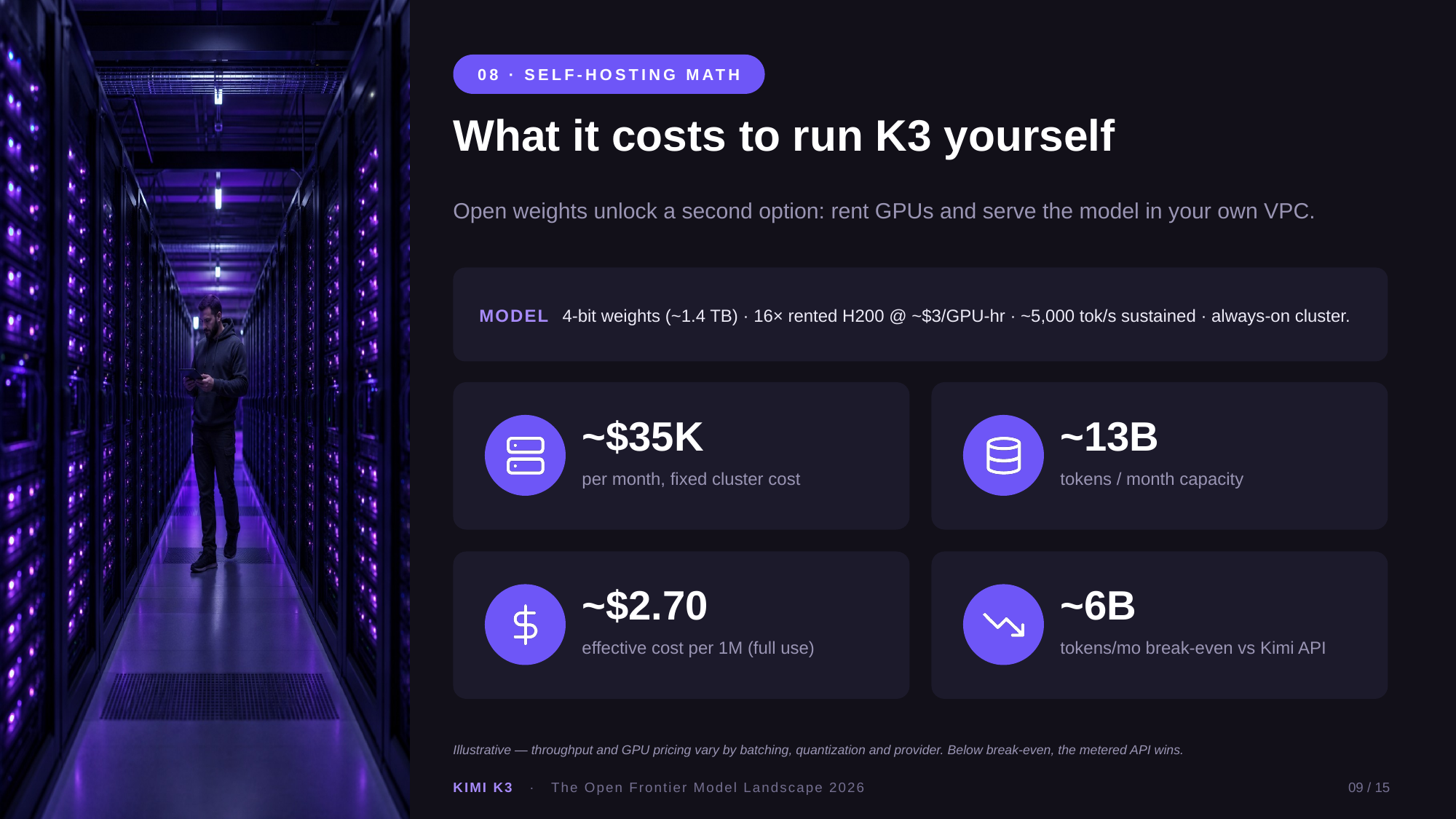
Does K3 replace K2 for existing deployments? Not automatically. K3 uses new attention mechanisms and quantization choices, including MXFP4 weights with MXFP8 activations and vLLM support Moonshot contributed for prefix caching, so teams running K2 should test K3 against their own workloads first.
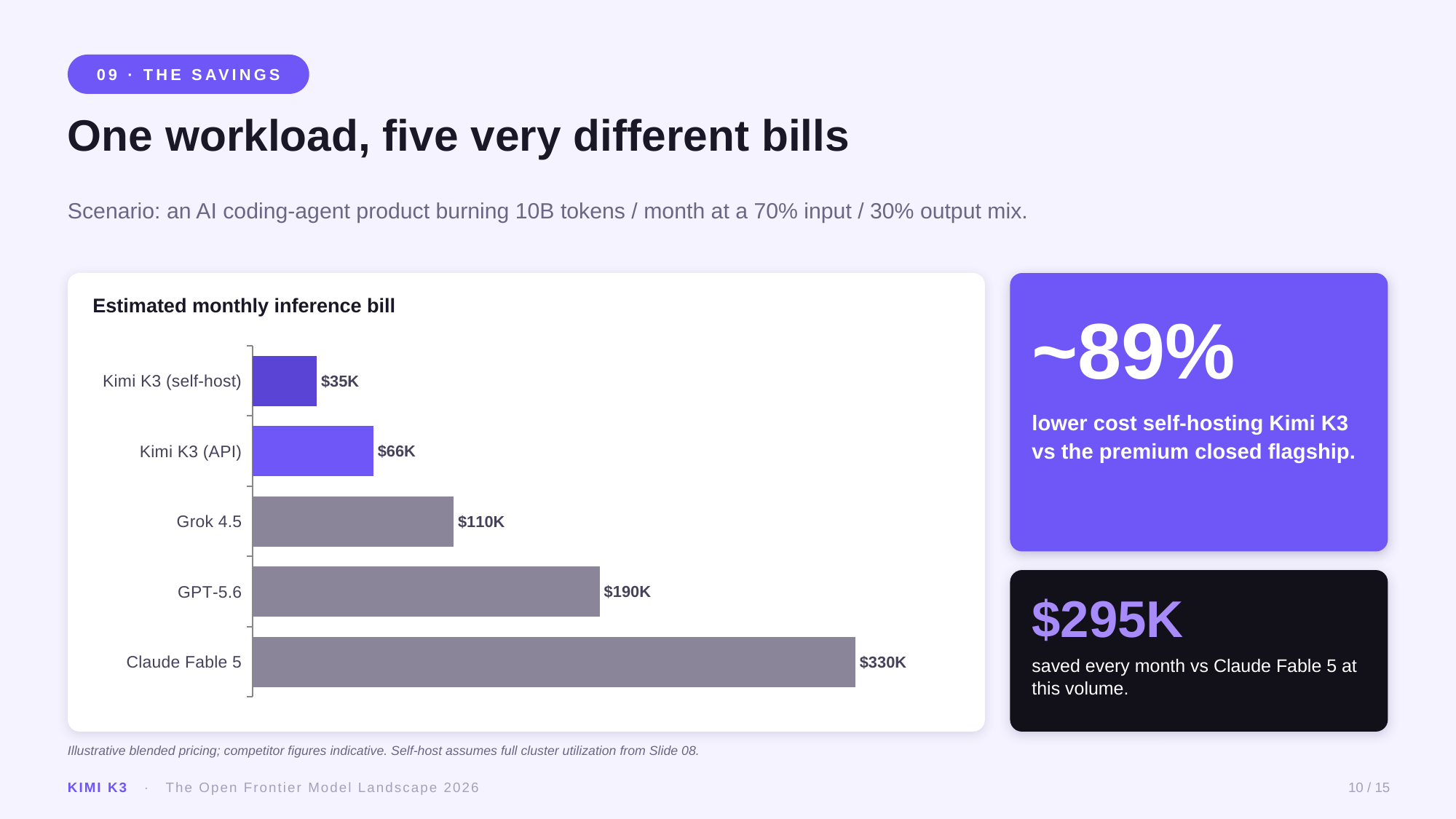
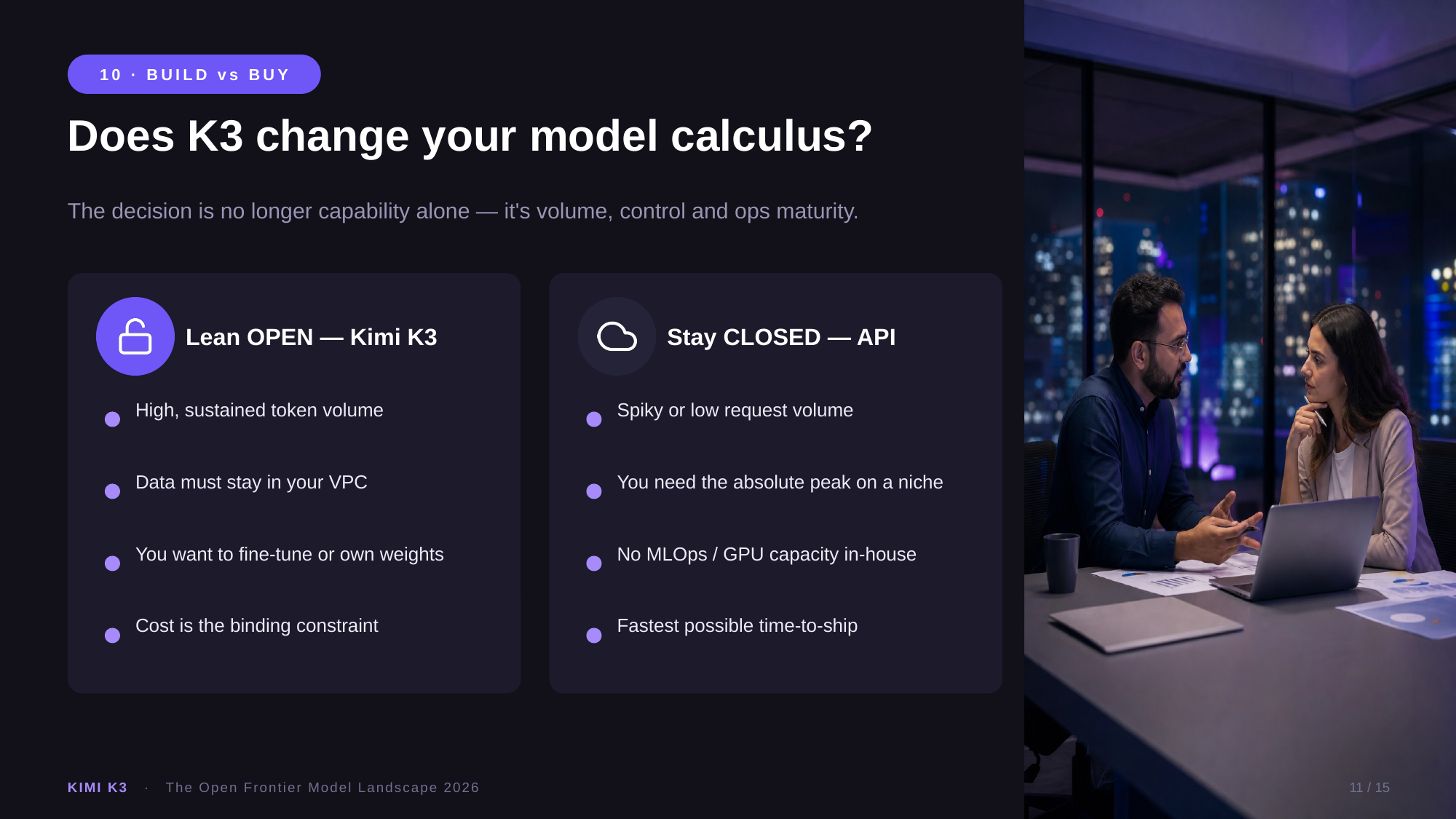
Kimi K3 will not settle the open-versus-closed debate on its own, but it narrows the gap enough that the build-versus-buy conversation now has real numbers behind it. If a visual version of that comparison is useful, an example deck built with AskDeck from a short brief sits below, ready to download and adapt.