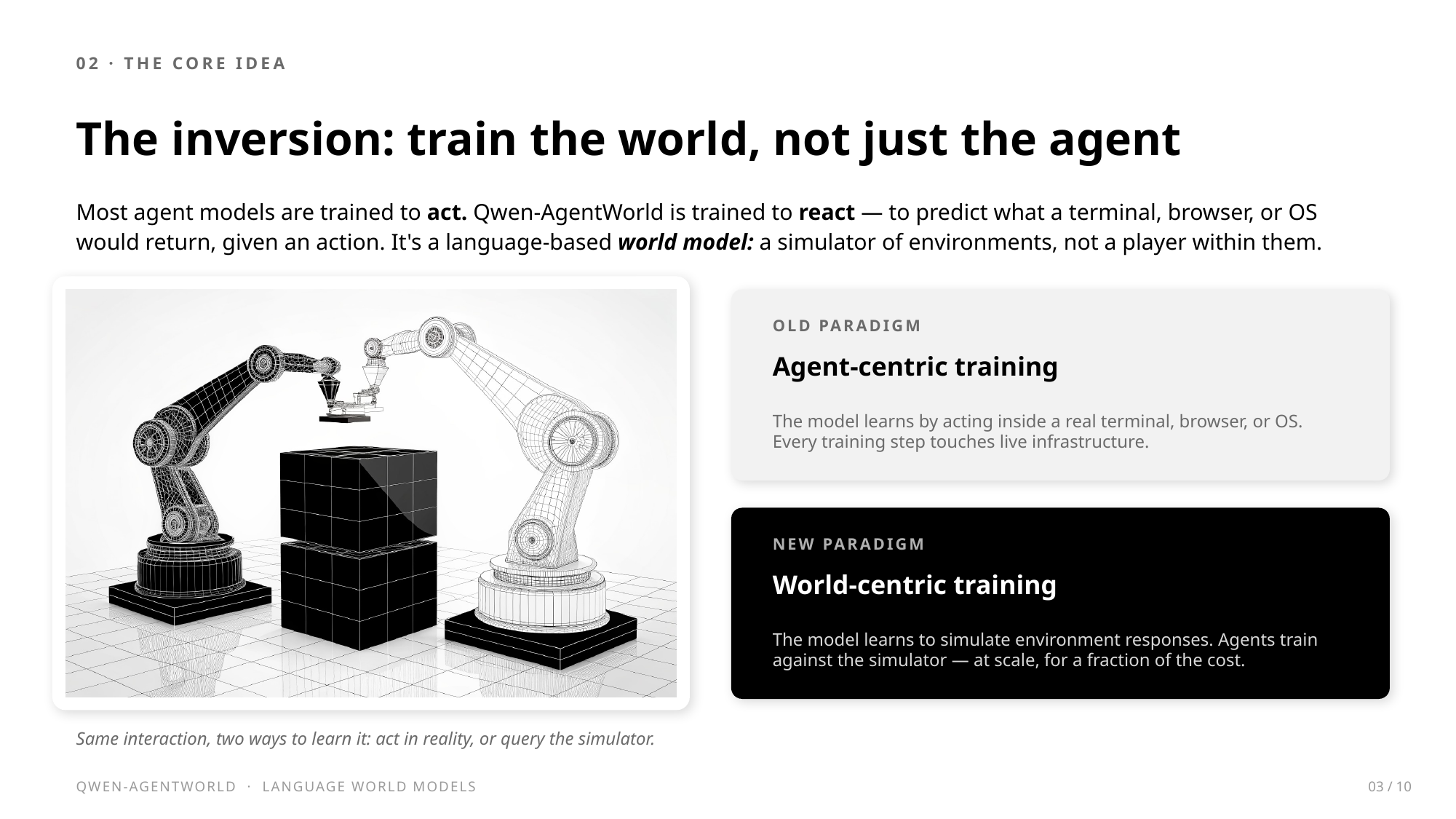
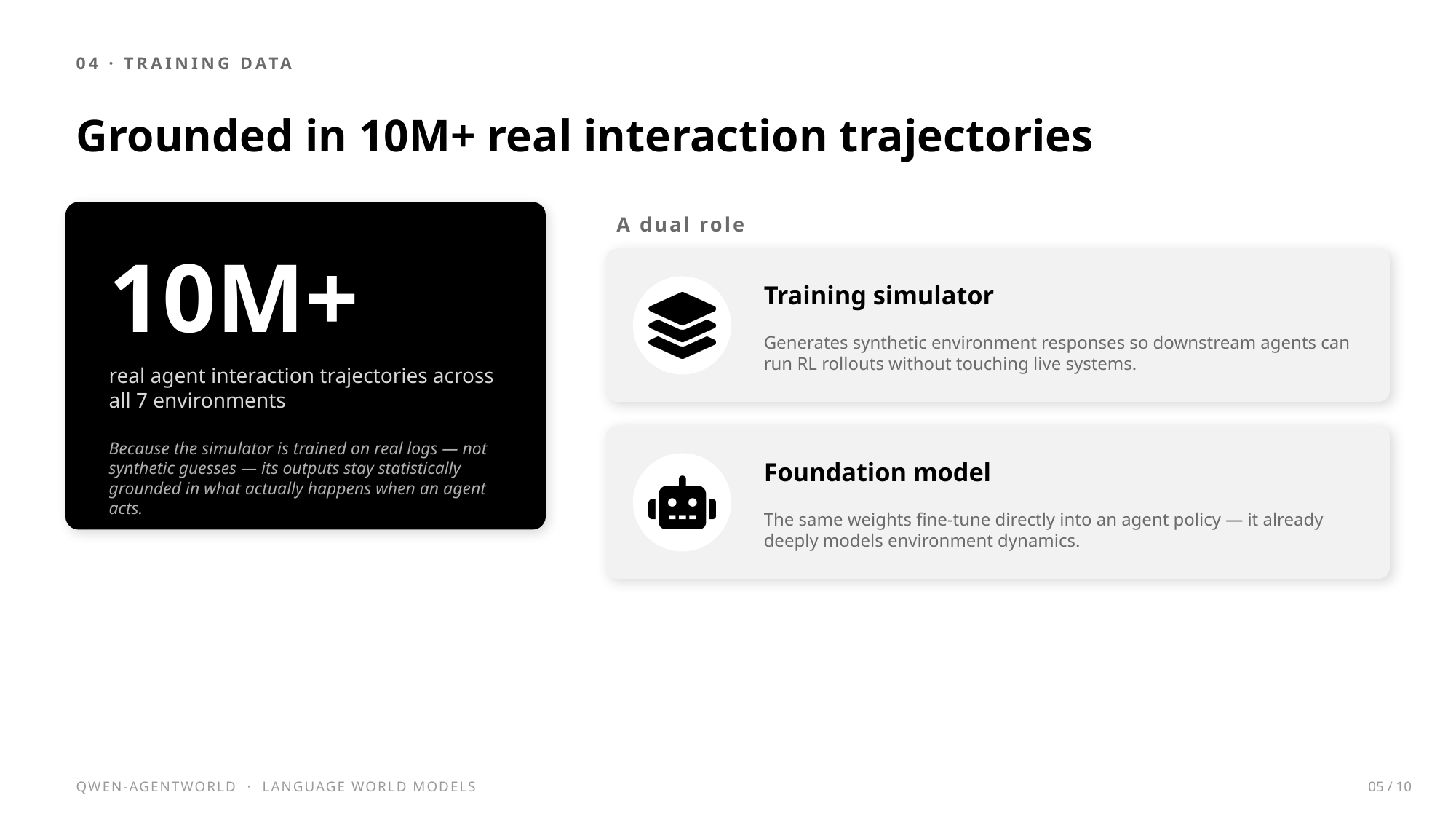
Most AI agents learn by doing: the agent takes an action, a real terminal, browser, or API returns a result, and a training loop scores whether that action helped. A language world model inverts that arrangement. Instead of training a model to act, you train it to be the environment — given the history of a session and the agent’s next action, it predicts the observation the environment would send back: the terminal output, the API response, the next screen of an app. A research team recently published the first such model to cover seven kinds of environment at once, trained on more than 10 million real interaction trajectories, and it targets one of the most expensive bottlenecks in building agents.
What a “world model” actually is
In reinforcement learning, two pieces drive the loop. The policy maps a situation to an action (state to action). The world model maps a situation and an action to what happens next (state and action to next state). Almost all recent agent work has poured effort into the policy, while treating the environment as something you simply run and observe.
The bet here is that the environment side is worth modeling directly. A recent theoretical result argues that any agent able to generalize across a wide range of tasks must have effectively learned a world model already, which reframes world modeling as necessary rather than optional. Predicting the next observation forces a model to reason about cause and effect, recall prior state, and respect a strict output format — the same skills a strong agent needs.
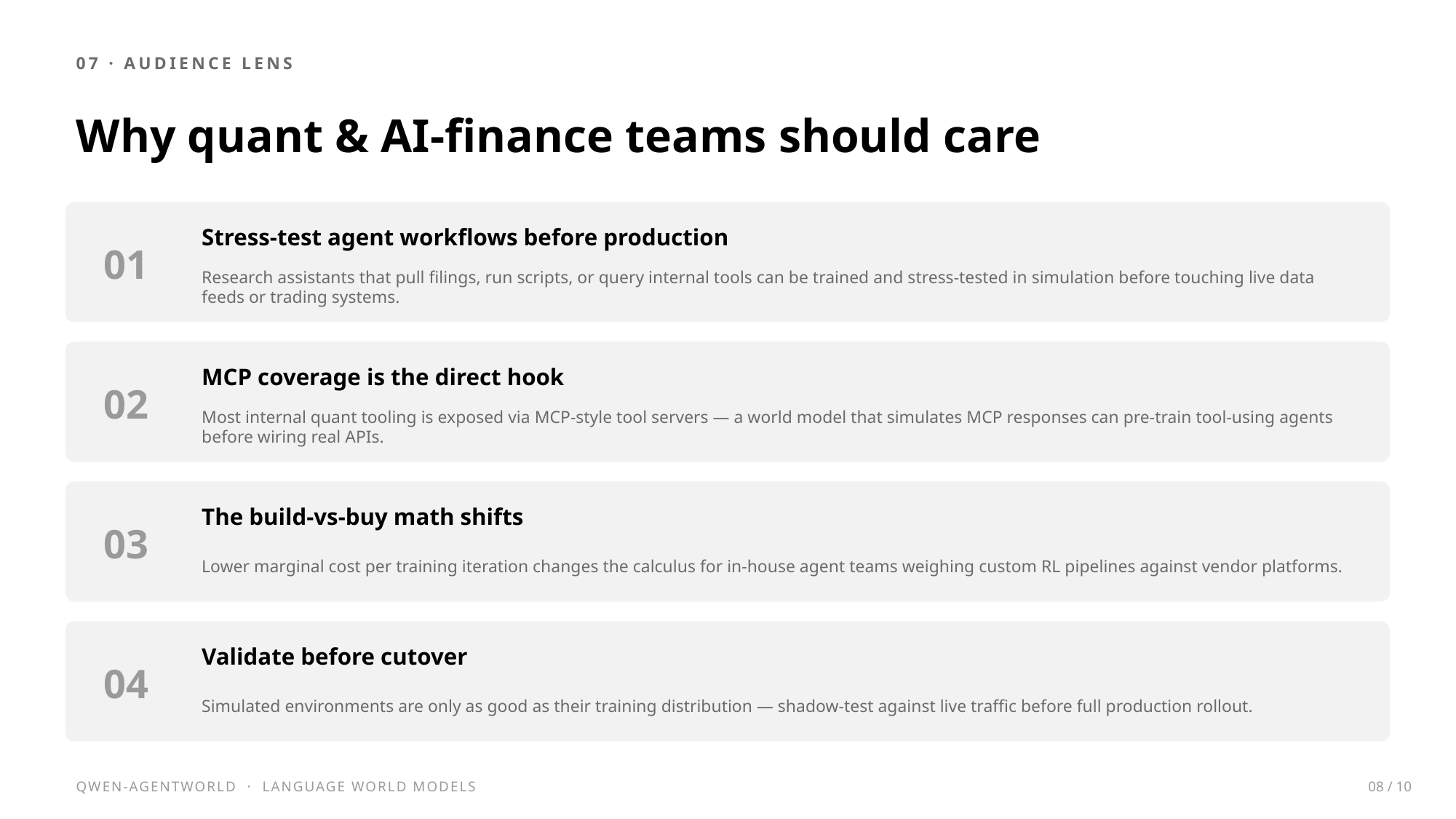
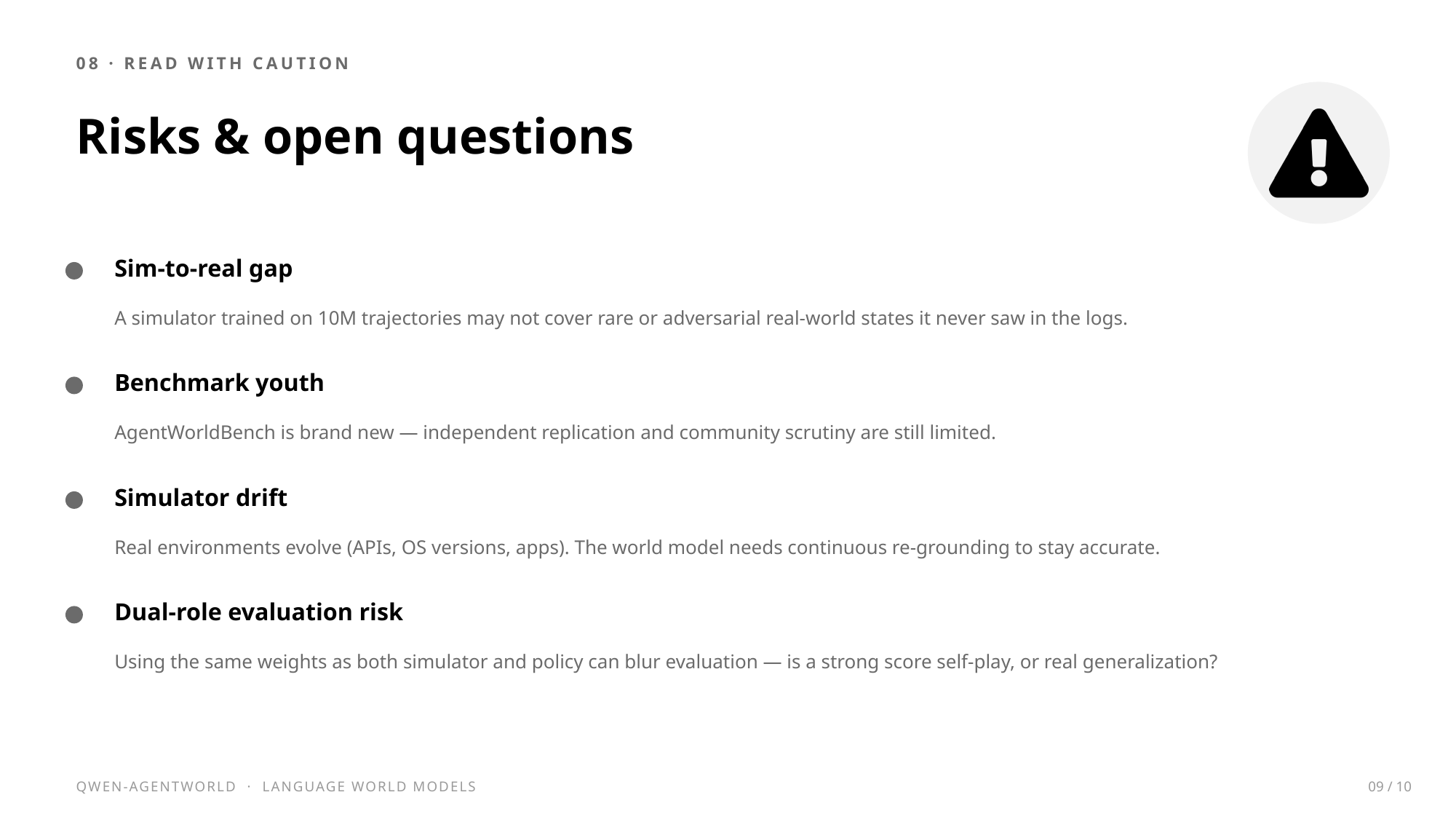
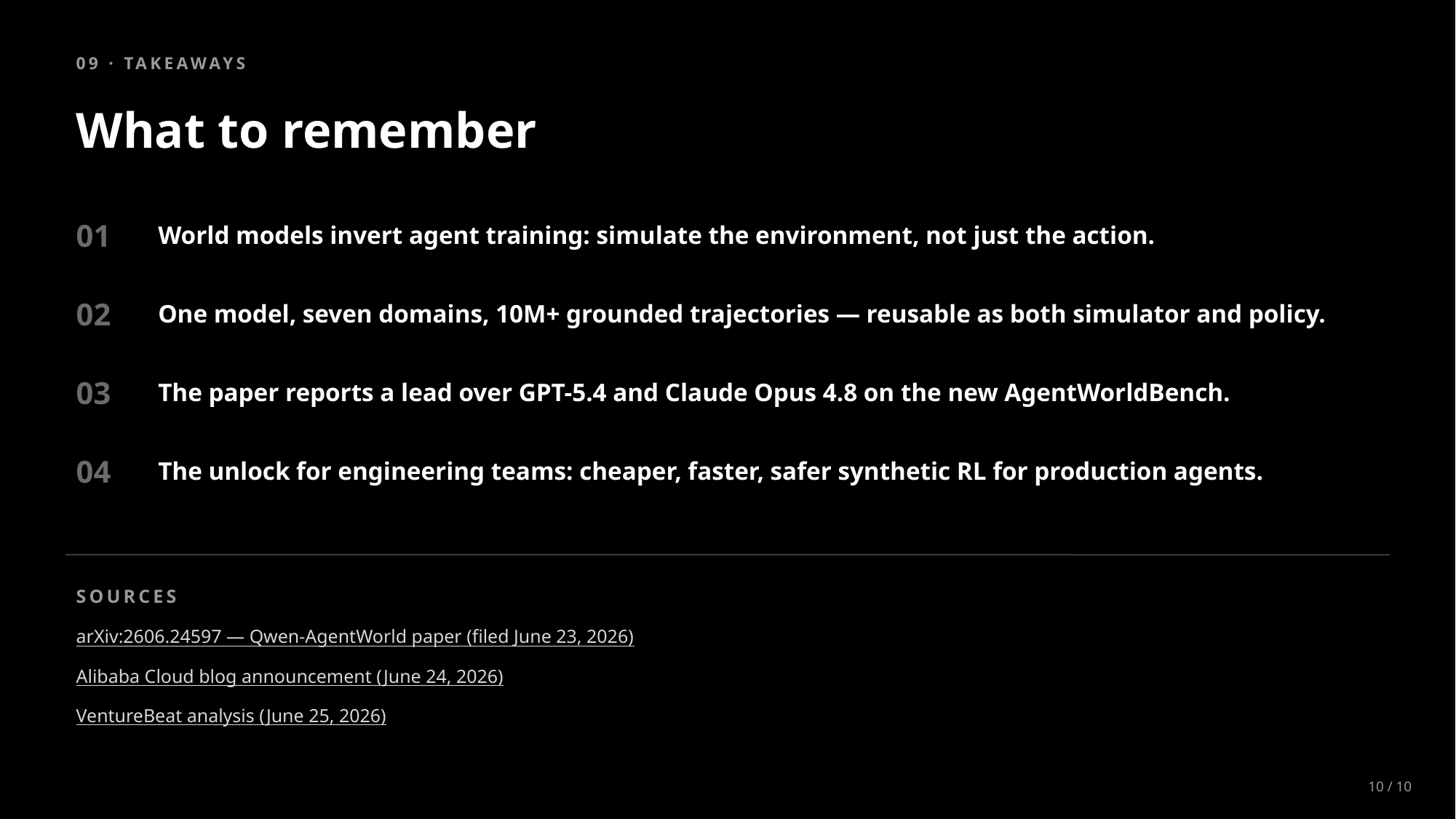
The slides embedded below are a ready-to-use deck on this subject, generated by AskDeck from a short brief.
The seven environments it simulates
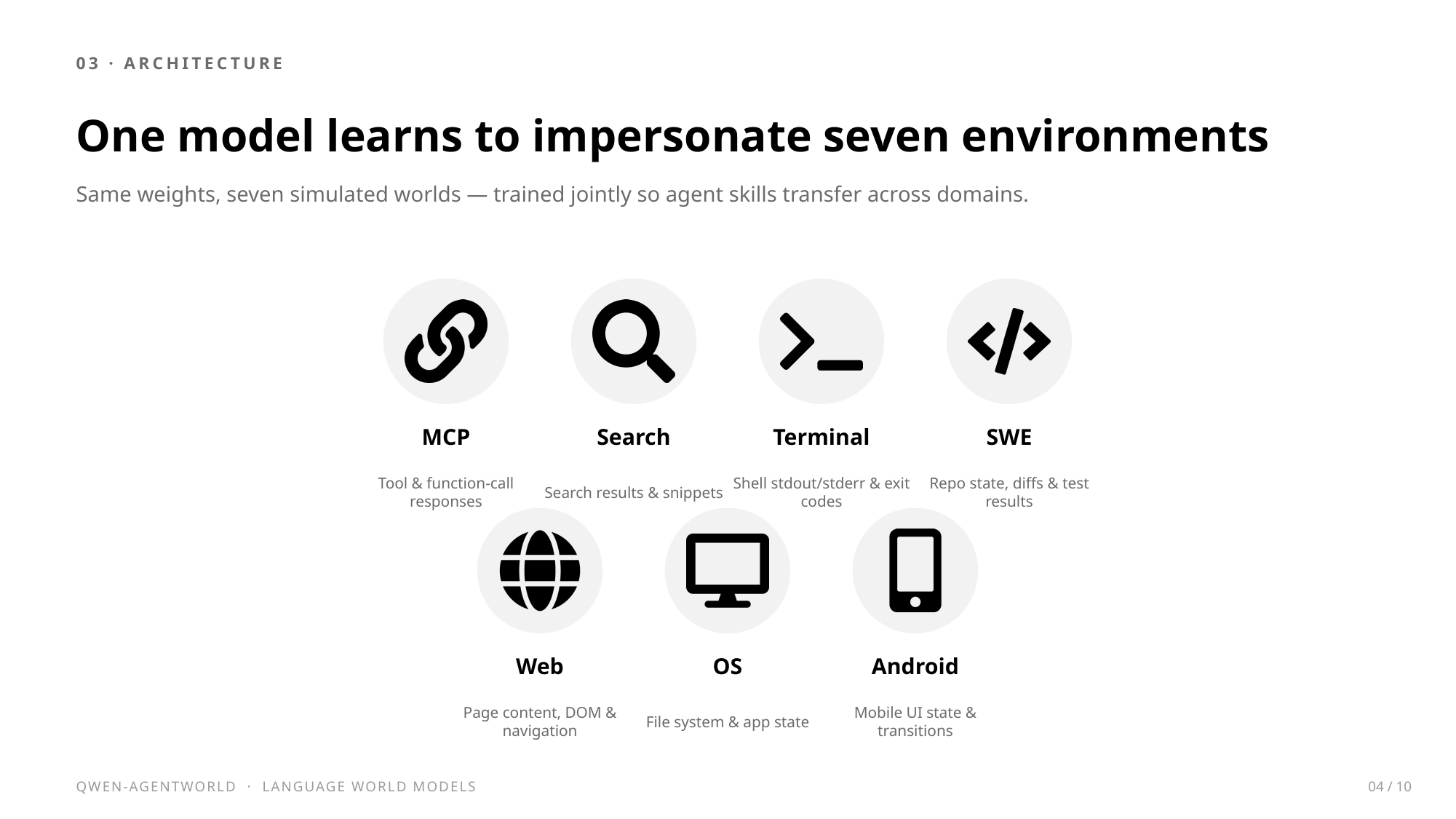
A single model handles seven very different domains, unified by representing every interaction as a stream of (action, observation) turns:
- Tool and API calls, where the model returns structured responses like file contents or database rows.
- Web search, returning plausible query results grounded in world knowledge.
- The command-line terminal, predicting exact output and shell state across many commands.
- Software-engineering sessions, predicting file diffs, test output, and error tracebacks.
- Mobile apps, web browsers, and desktop operating systems, where the “screen” is represented as a text accessibility tree rather than pixels.
That last choice matters: the model predicts the underlying interface structure as text, so graphical apps become a language-prediction problem one model can handle.
How it’s trained: inject, activate, sharpen
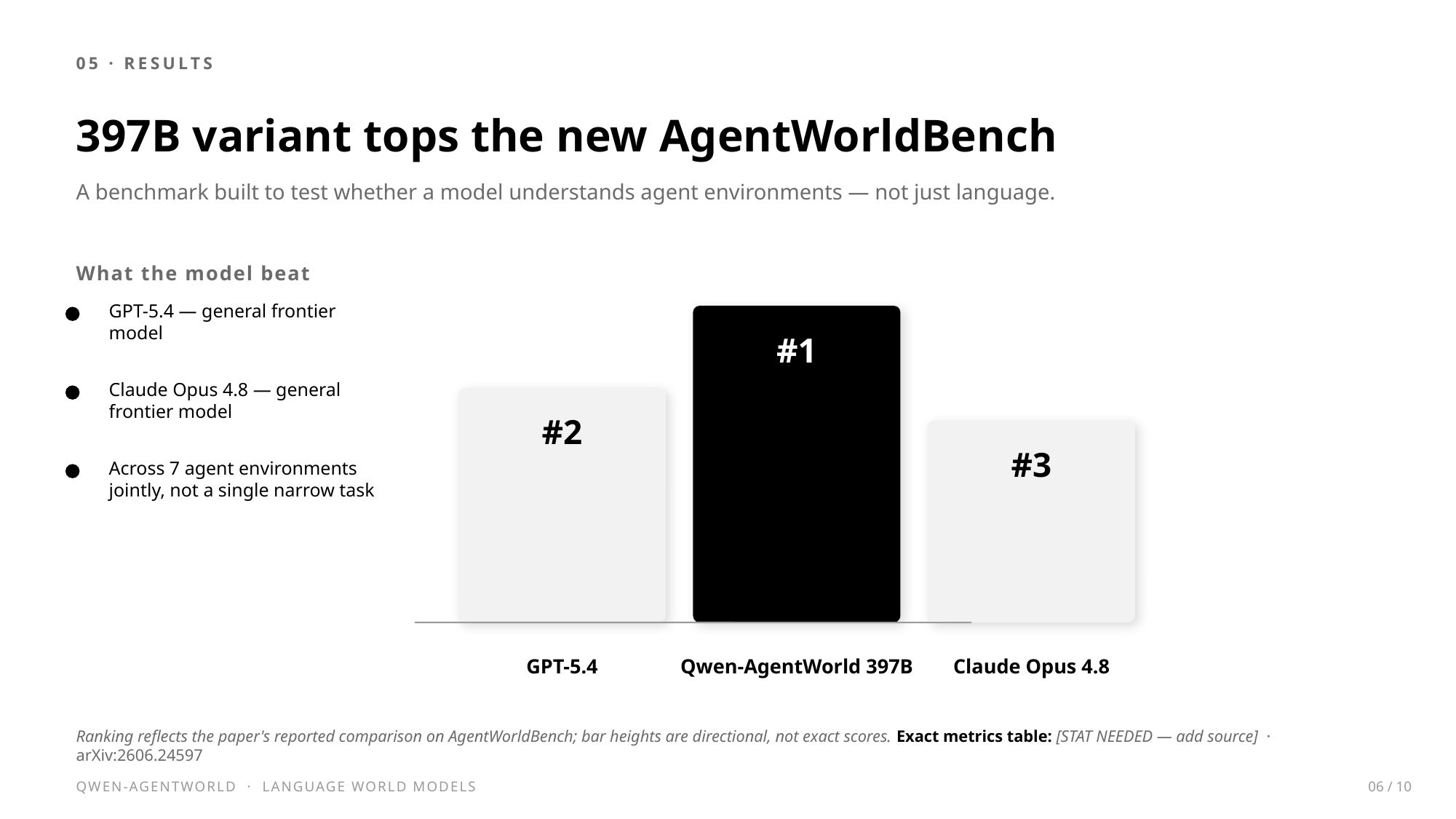
The team built two versions — a 35-billion-parameter model (3B active per token) and a 397-billion-parameter model (17B active) — through a three-stage recipe summarized as “inject, activate, sharpen.” Continual pre-training injects raw state-transition patterns plus broad professional knowledge in law, medicine, finance, and cybersecurity, so the model can mimic a regulatory portal or a hospital system convincingly. Supervised fine-tuning activates next-state prediction as an explicit chain of reasoning before the answer. Reinforcement learning then sharpens fidelity, rewarding predictions that match the ground-truth observation on both rubric-scored quality and hard rule checks. On a companion benchmark built from real sessions across nine established agent tests, the larger model scored higher on simulation quality than leading general-purpose frontier models.
Why this changes how agents get built
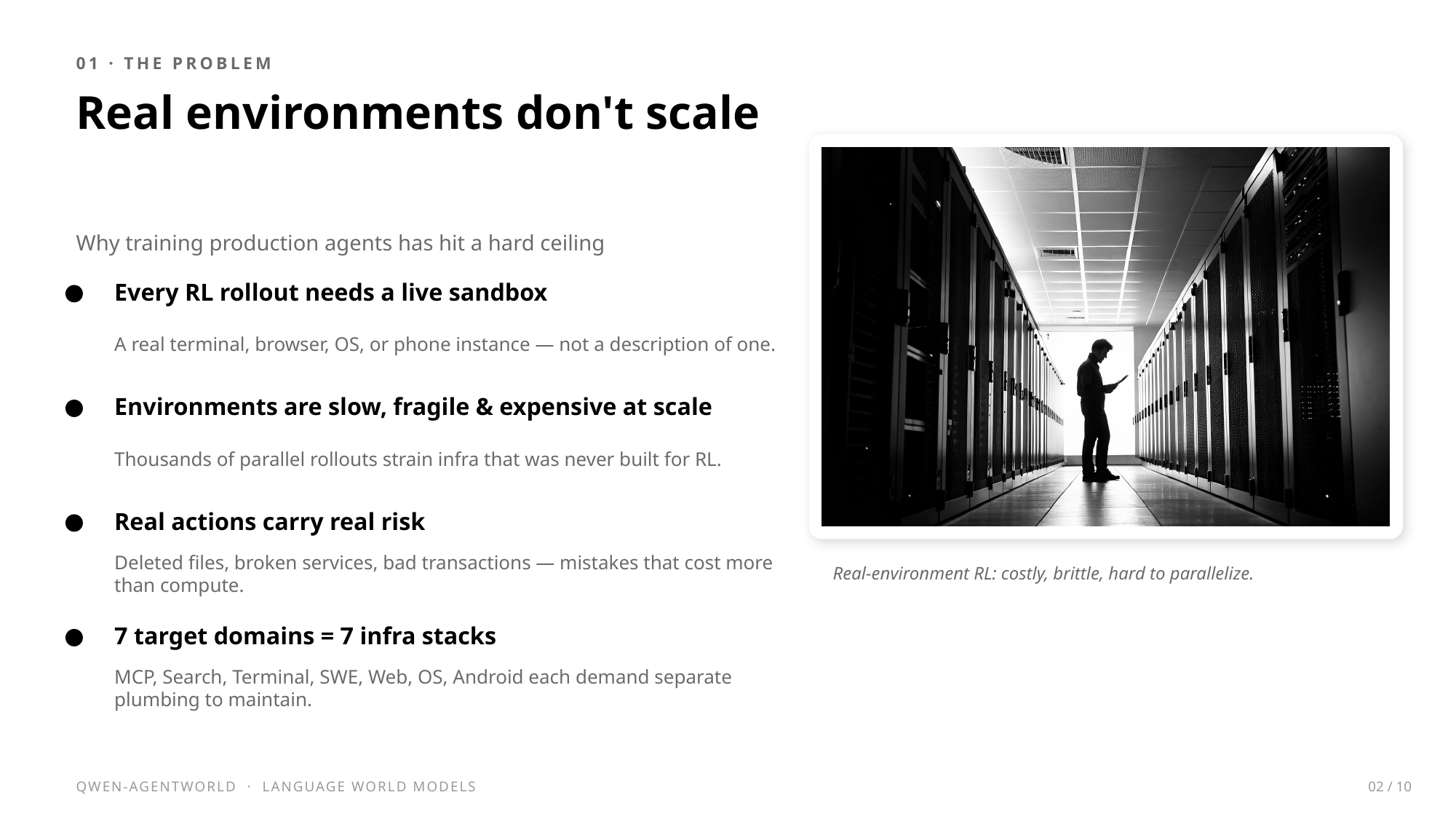
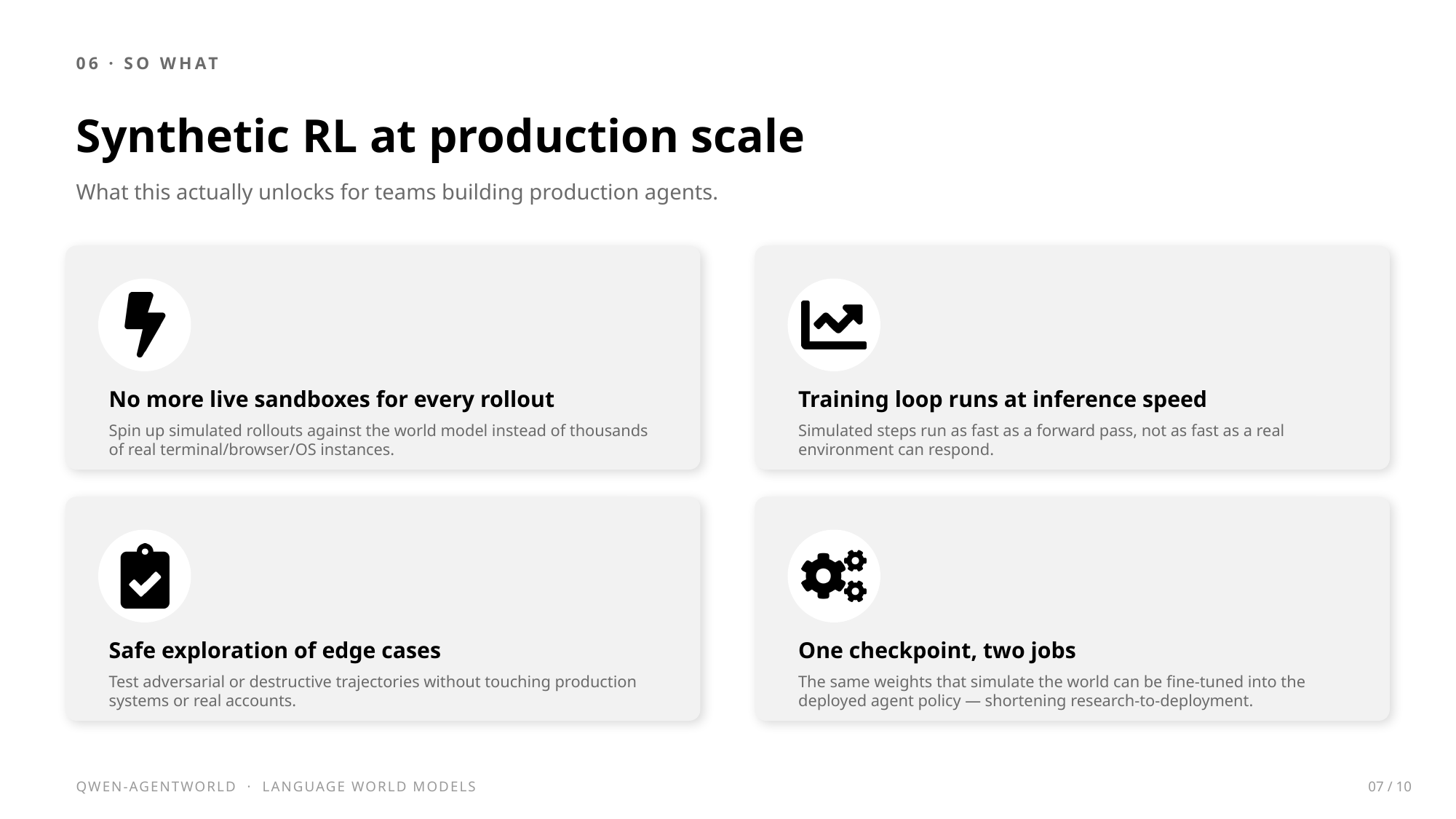
Training agents in real environments is slow and costly. Every rollout needs a live sandbox, a virtual machine, or a real API, and some environments can’t be used for training at all: the actions are irreversible, the system is proprietary, or no public version exists. A world model turns the environment into something you can generate. In the reported experiments, one model simulated roughly 4,000 real-world environments for agent training with no dedicated infrastructure.
The subtler gain is control. A simulator can be told to inject rare failures — a truncated result, a disk-full error, a partial API response — so an agent practices edge cases that almost never surface in normal runs. Agents trained partly this way beat agents trained only in the real environment. World-model training also works as a warm-up: an agent that first learns to predict environment feedback picks up downstream skills faster, because “what will happen if I do this?” becomes an internal check before it commits to an action.
Is this just an LLM predicting text?
Mechanically yes, but the objective is different. A chat model predicts a helpful reply; a language world model predicts the environment’s response, which must stay causally consistent with a long history and a precise format. That constraint is what turns text prediction into a usable simulator.
Can simulated training beat the real thing?
Not on its own, but as a complement. The reported results show the strongest agents come from mixing real interaction with controllable simulated environments, where the simulator supplies the hard, rare situations that real logs seldom contain.
What are the limits?
Fidelity is the open question. A simulator that drifts from real behavior can teach an agent the wrong lesson, which is why the reinforcement-learning stage focuses on matching ground truth exactly, down to byte-level terminal output and API schemas.
The deck embedded below was built with AskDeck from a short brief and lays out this same material as slides you can download and edit — a quick way to walk a team through language world models. If you have a topic of your own, it’s worth a try.