
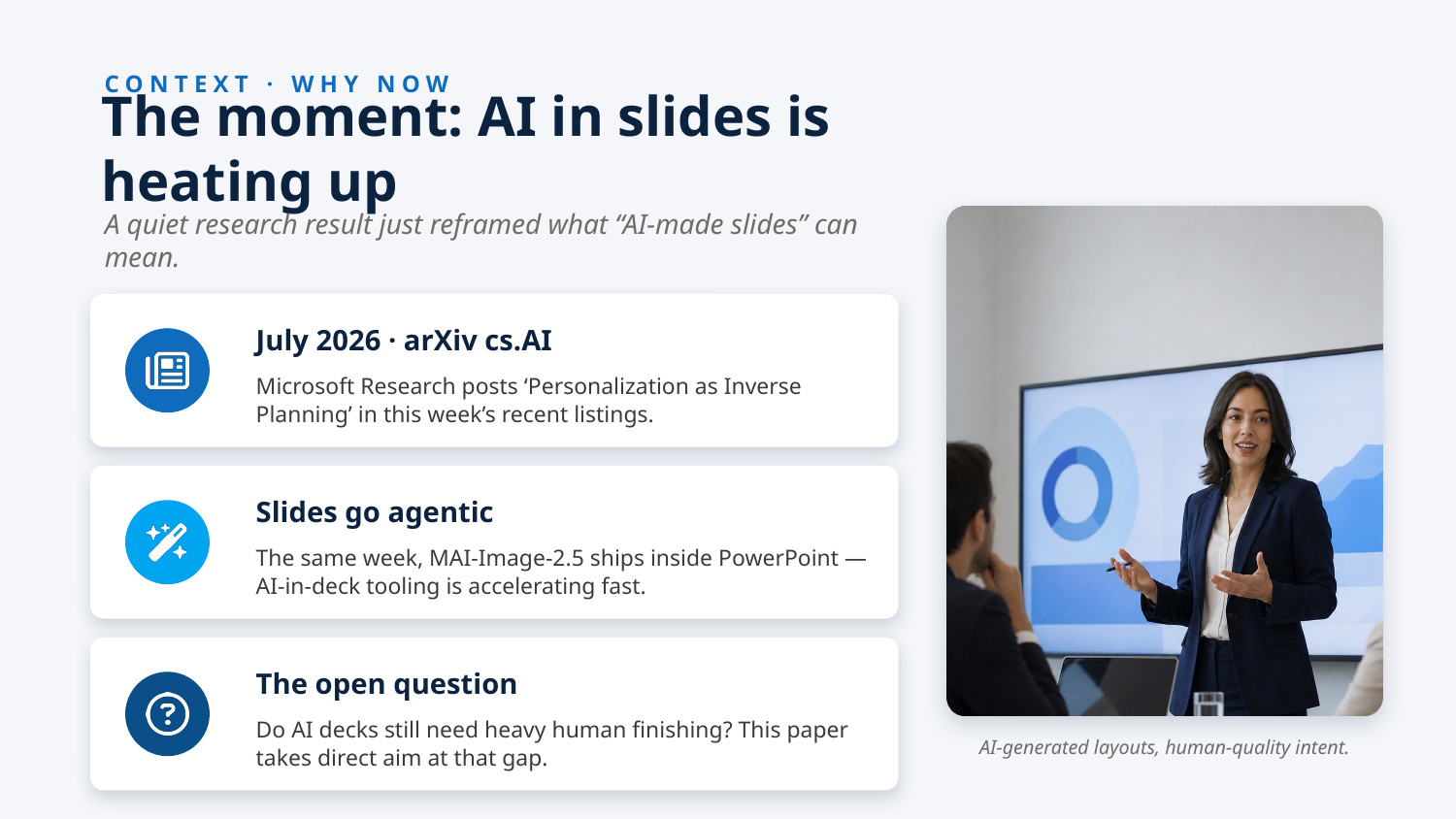
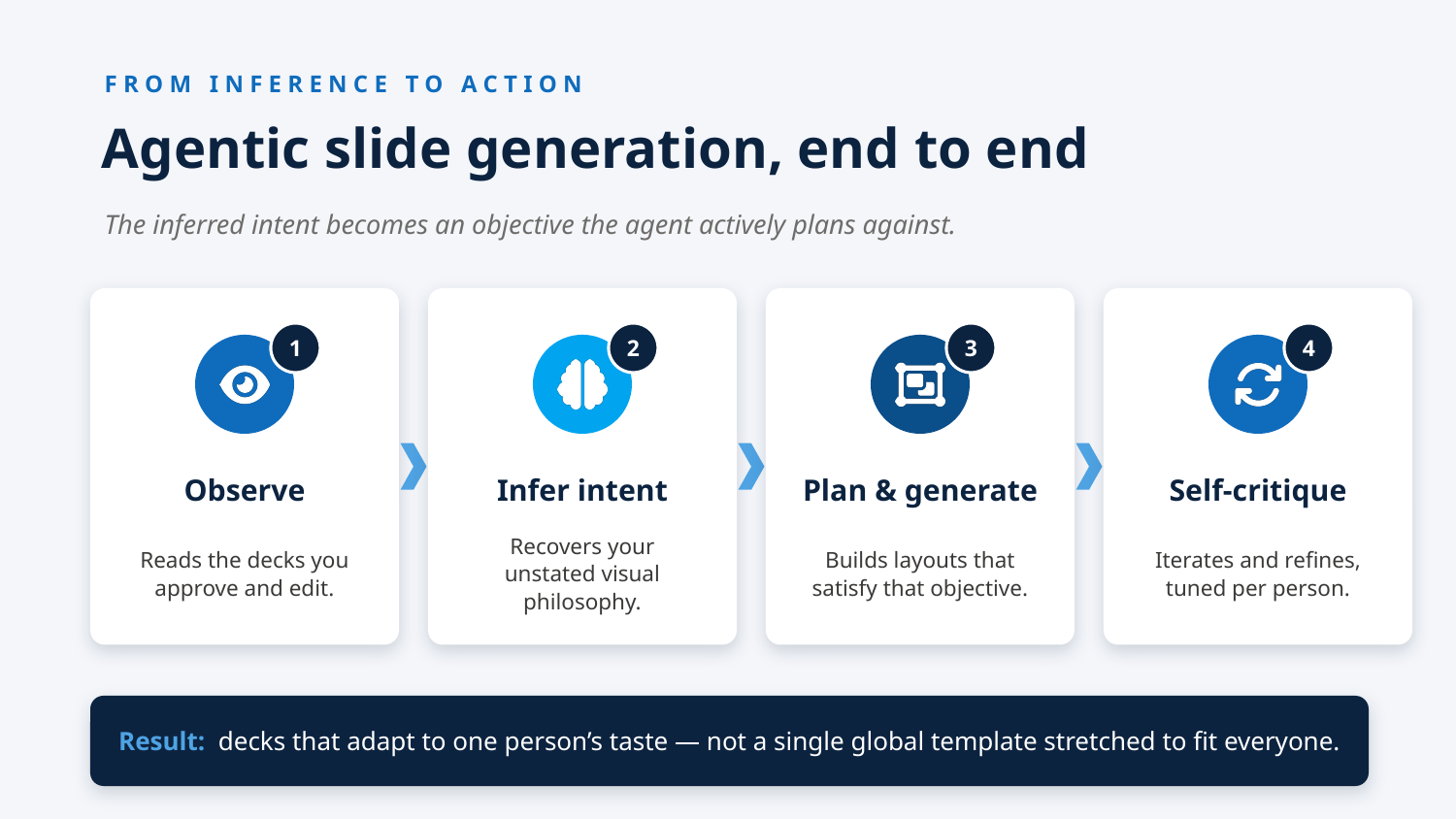
Ask an AI tool to build a slide deck and you usually get something serviceable and recognizable: same layout grid, same bullet rhythm, same stock-photo energy as every other AI deck. Researchers now have a name for the missing piece: Page-level Slide Personalization, or PSP, and a paper posted to arXiv argues it has stayed unsolved until now.
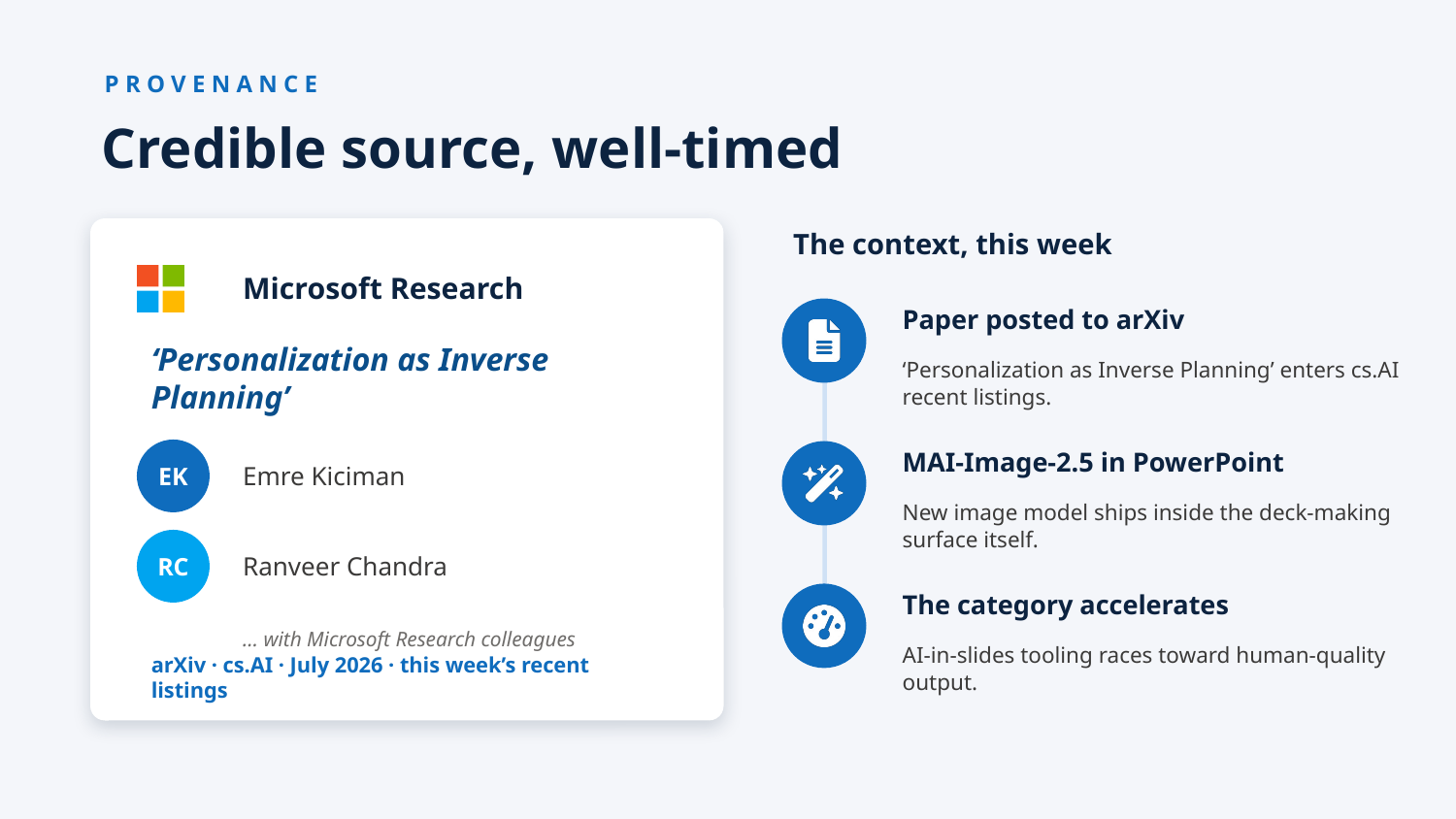
Key facts: A paper submitted to arXiv on July 1, 2026 defines Page-level Slide Personalization (PSP): matching a person’s unstated design habits, not just their template choices. It treats design intent as a hidden variable inferred from a few reference slides. The method corrupts real slides along three structural dimensions (layout, hierarchy, styling) across five element types, then trains two AI agents to repair the damage. The paper has been accepted to a major 2026 computer vision conference.
The slides embedded below show a related idea in practice: a ready-to-use deck on this same research, generated from a short brief by AskDeck. Back to the substance, because the substance is the interesting part.


Swipe or scroll sideways to flip through the 10-slide deck →
What is page-level slide personalization?
PSP is the task of matching not just a deck’s overall theme but the fine-grained choices on each page: spacing, hierarchy, alignment, and styling, the details that make a slide look like it came from a specific person rather than a generic template. Current AI agent-based methods struggle with this fine-grained work, relying on prespecified templates or lengthy user instructions that fail to capture what the paper calls latent design intent.
The distinction matters because most people cannot fully articulate their own visual habits. Someone who always left-aligns section headers rarely writes that down; it shows up only in slides already made, which is why the method treats those habits as something to infer rather than specify.
How does inverse planning solve this?
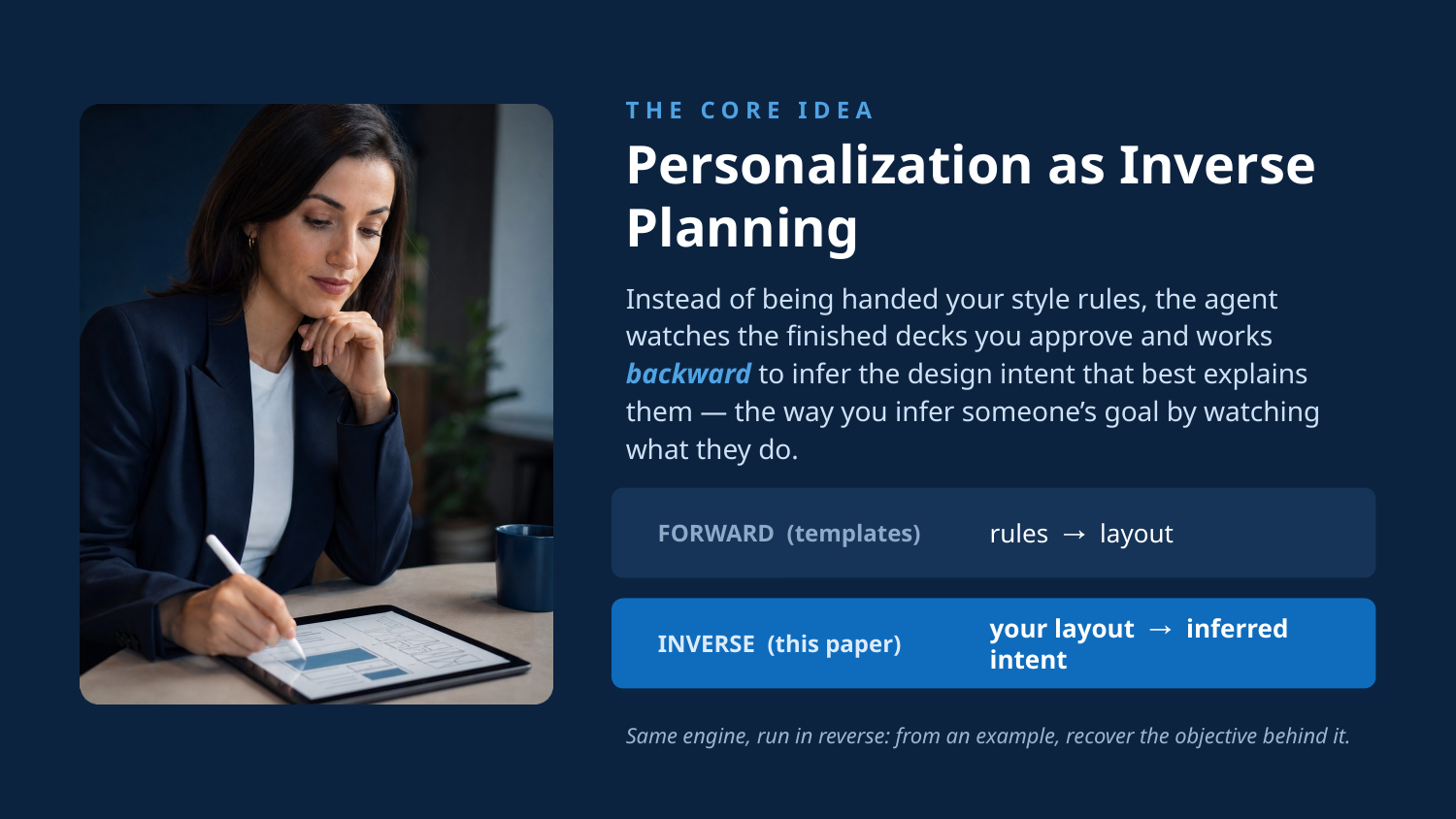
The paper reframes personalization as an inverse problem: instead of asking someone to describe their taste in words, the system works backward from a small set of reference slides to reconstruct the unwritten plan that produced them. The authors describe this as learning a design intent without assuming any knowledge of the specific software that eventually executes the plan. That separation is deliberate: the same inferred intent can be reused across different output tools without retraining the system each time the renderer changes.
What does “structural denoising” actually do?
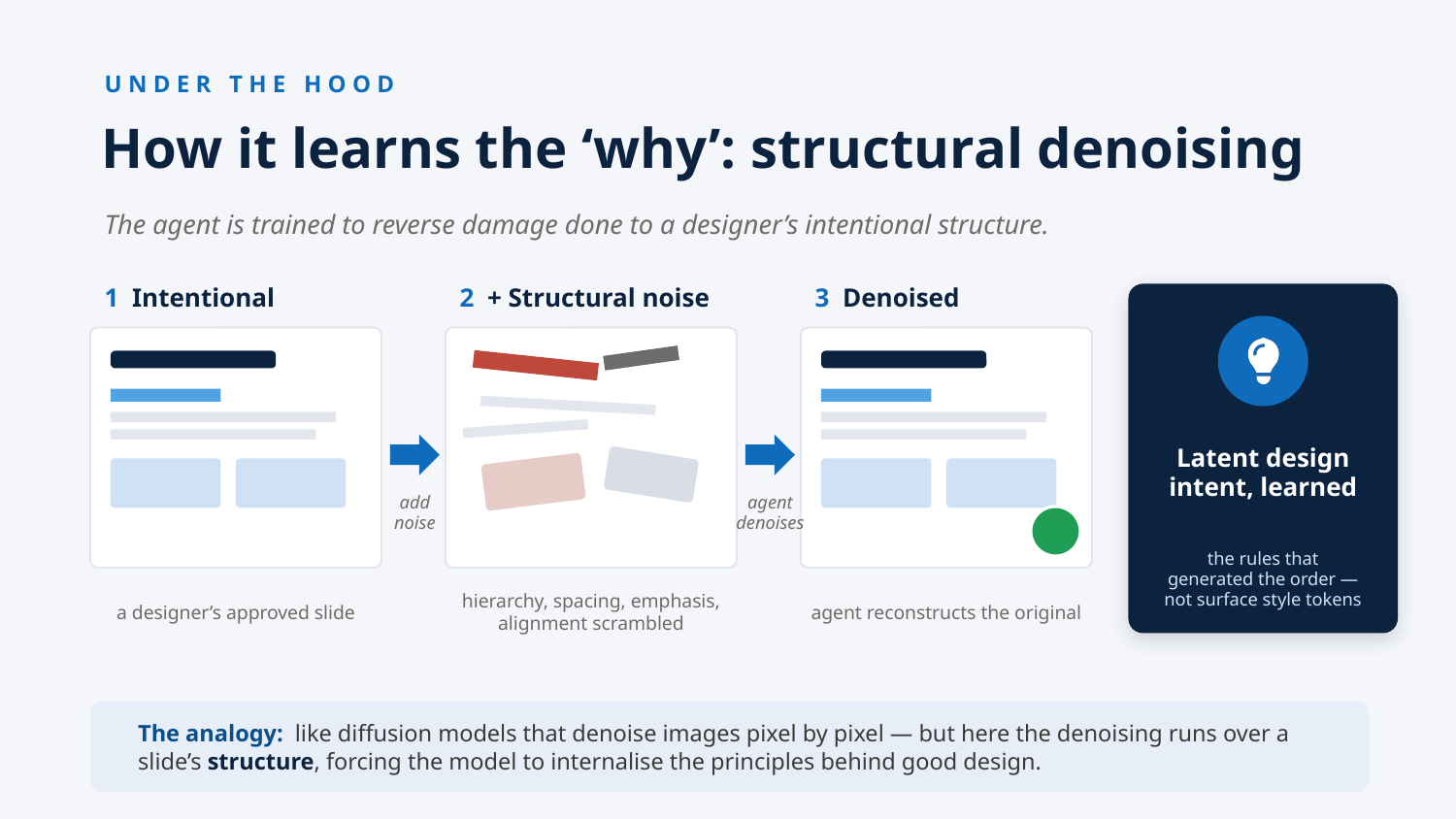
Structural denoising is the training trick that turns an unmeasurable goal, matching unstated taste, into something a machine can practice and be scored on. The method deliberately damages a real, well-designed slide, then trains the system to notice and undo the damage, standing in for the harder task of guessing intent from scratch.
The full paper treats page-level objects, text boxes, images, shapes, charts, and tables, as one category called visual elements, five kinds of things it can perturb. It corrupts a reference slide along three structural dimensions: shifting an element’s position, distorting its size relative to the page, and altering stylistic choices such as color. Because the correct fix is known in advance, the training signal is verifiable rather than a vague aesthetic judgment, normally the hardest part of teaching a machine about design taste.
Why does the system use two separate agents?
Two agents split a job otherwise too tangled to train reliably: one spots what is wrong with a damaged slide, the other fixes the underlying plan using that feedback. A critic reads a corrupted slide alongside reference examples and produces checkable feedback. A planner then drafts a plan from scratch or revises an existing one, similar to how a junior designer takes notes from an art director and redoes a layout.
The paper backs this split with theory, not just results: it includes a proof that structural denoising is a consistent stand-in for the true personalization goal, and a separate proof that splitting the work between two agents lowers the statistical noise in the reinforcement learning process used to train them.
Why does this matter beyond one paper?
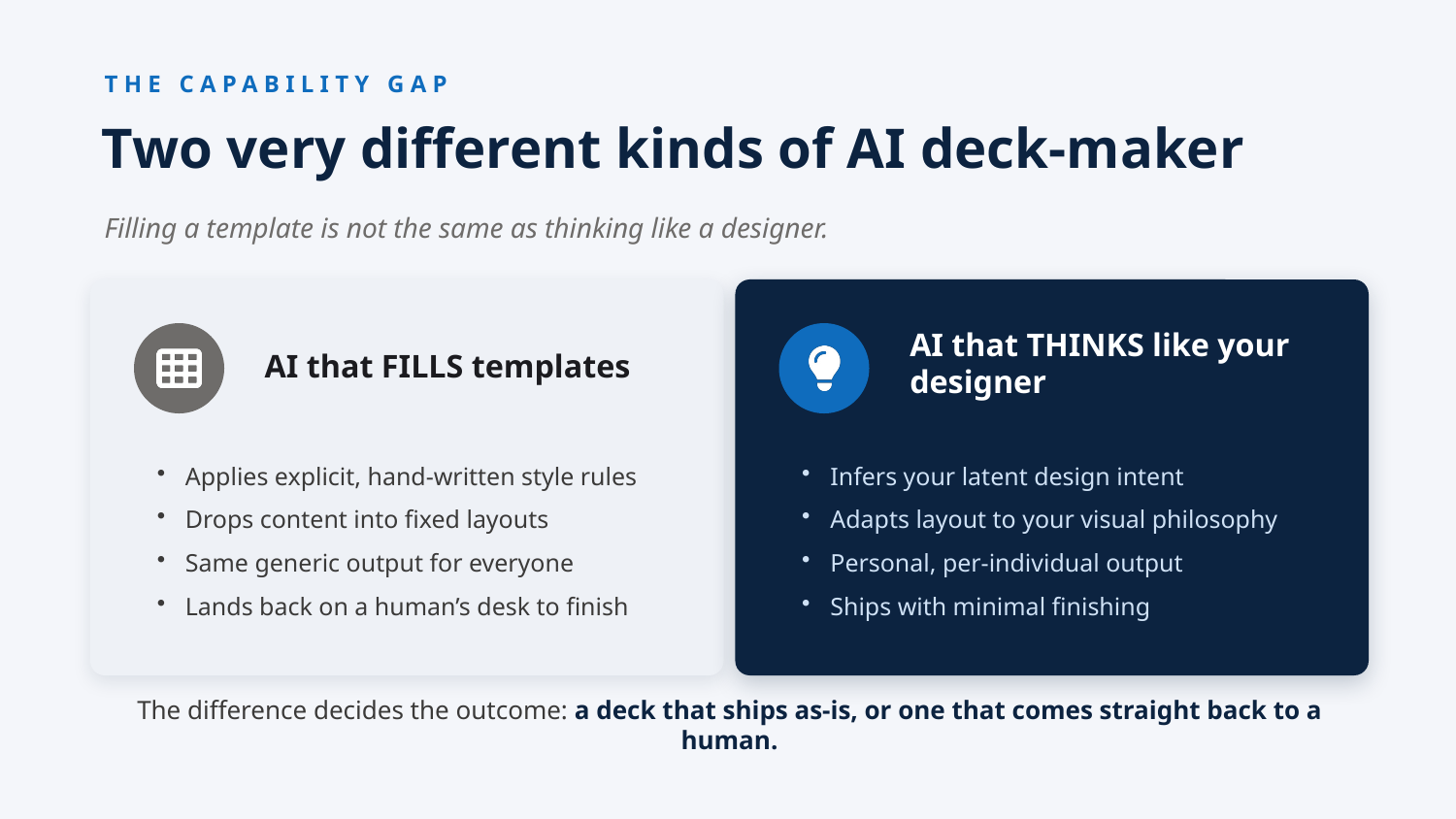
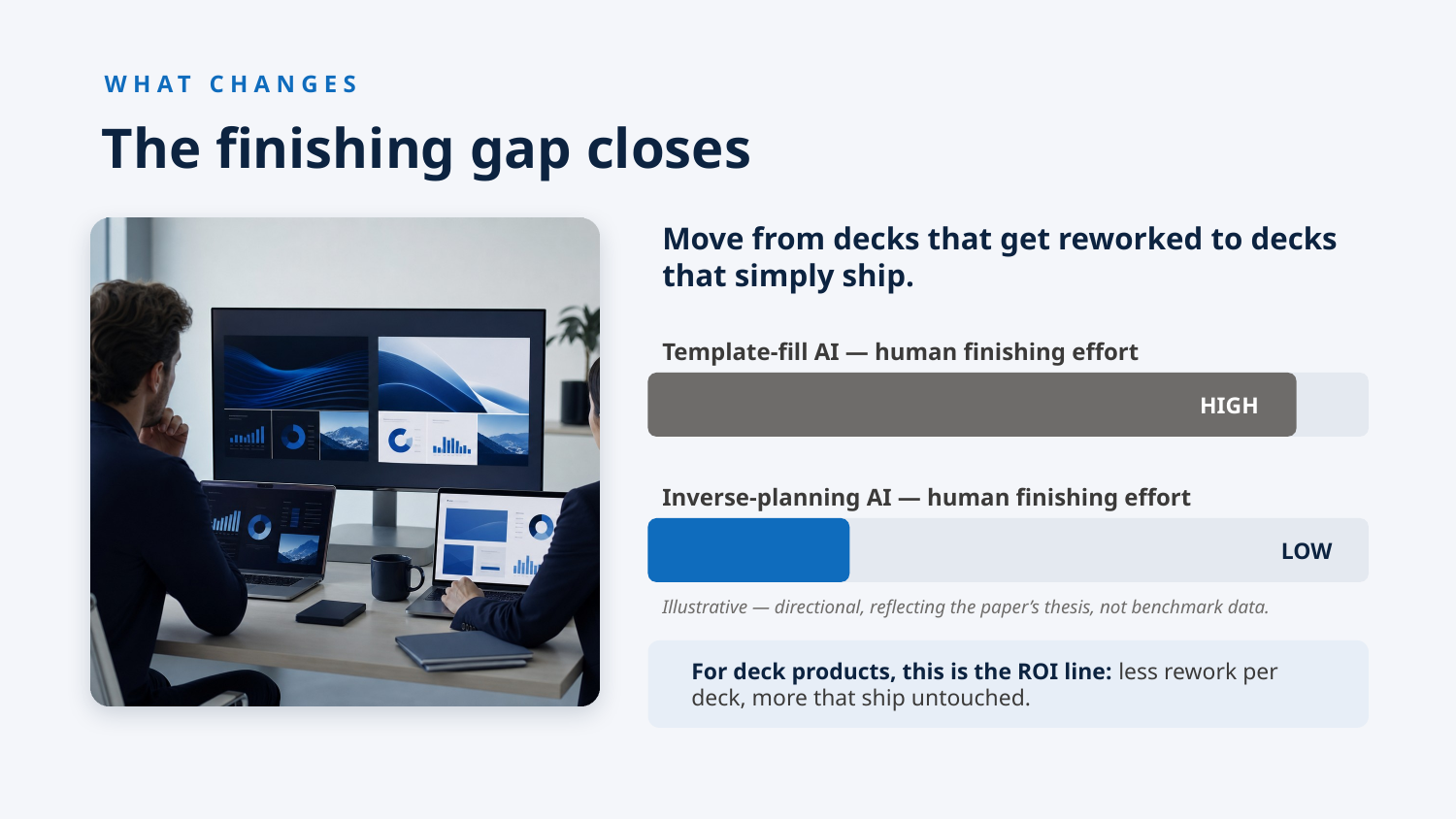
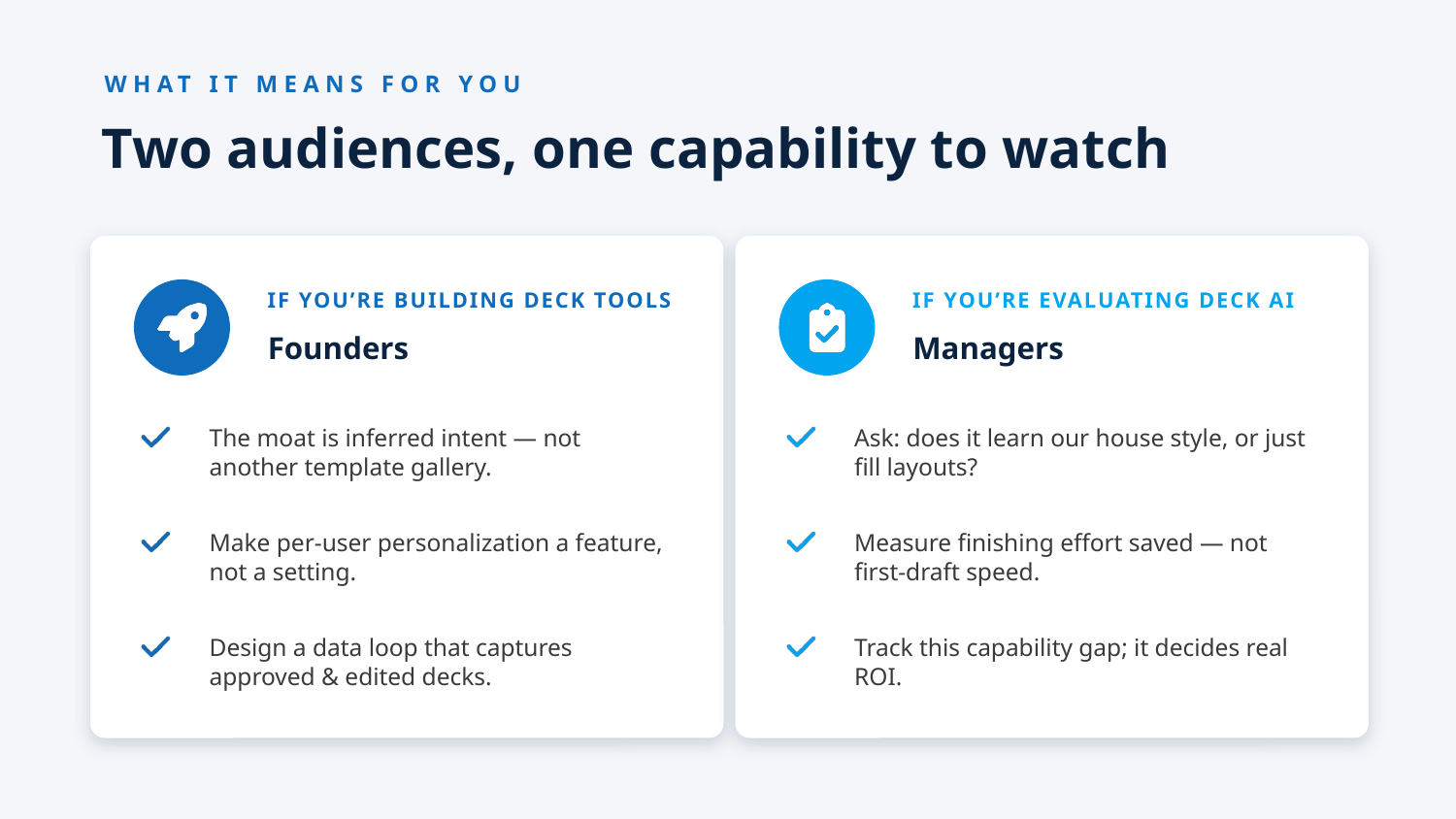
It draws a measurable line between two kinds of AI slide tools: ones that fill a template with content, and ones that infer a person’s design habits without being told what those habits are. For anyone evaluating an AI presentation tool, that is the question worth asking: does it format content into a layout, or does it learn a visual identity from examples. The gap between the two tends to decide how much manual cleanup a generated deck needs before it looks finished.
Common questions
Does this technology exist in a shipping product yet? No. The paper is a research contribution accepted to an academic computer vision conference for 2026, describing a training method and its results rather than a released feature.
Does inverse planning need to know the rendering tool in advance? No. Design intent is learned independently of whatever software eventually executes it, since tying the method to one tool is what makes the underlying optimization hard to solve directly.
What counts as a “structural” corruption? Changes to an element’s position, its size relative to the page, and stylistic attributes such as color, applied independently to individual text boxes, images, shapes, charts, or tables.
The example deck below on this research was put together with AskDeck from a short written brief. It is free to download and edit as a starting point for explaining a paper like this to a team.