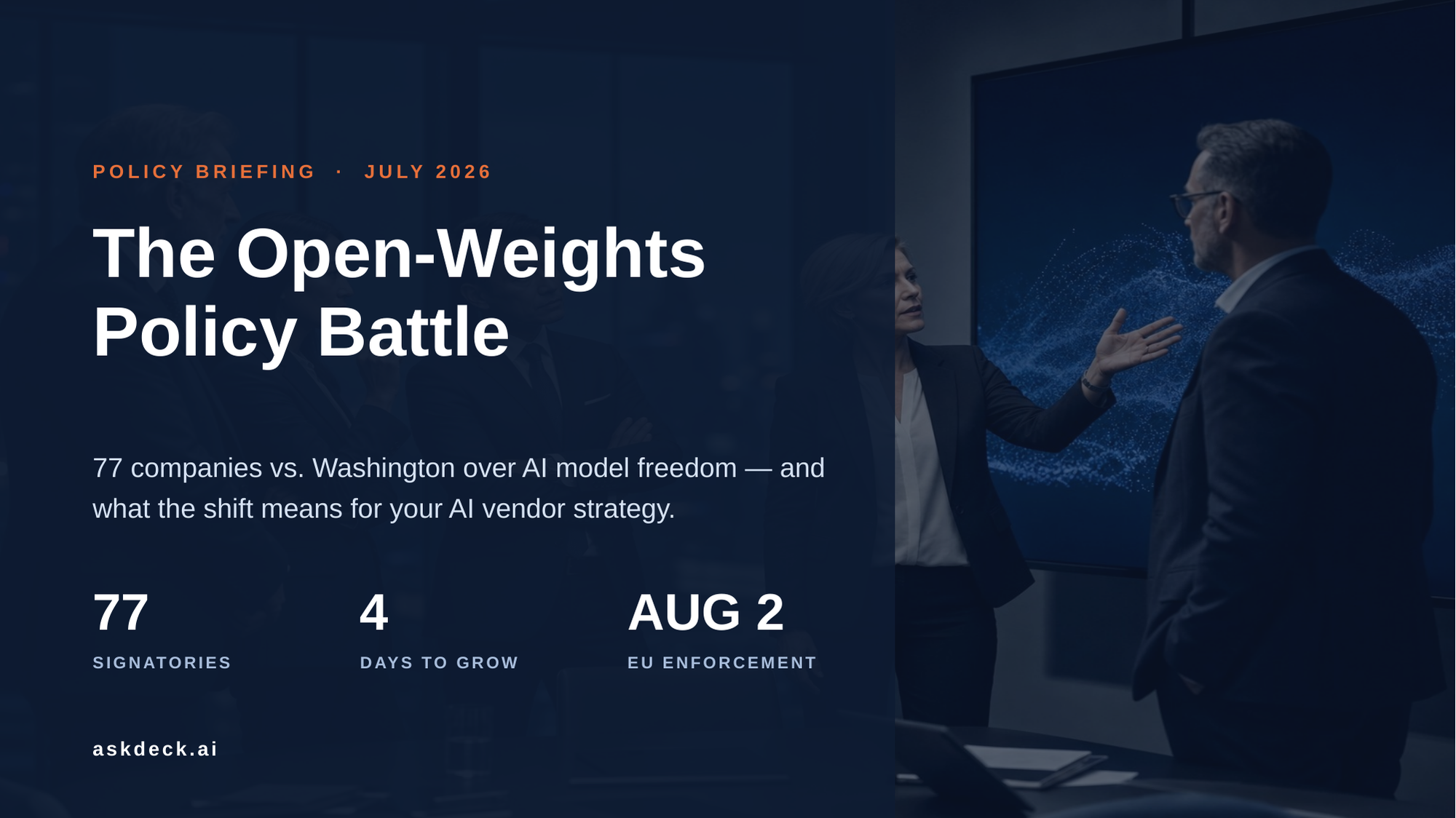
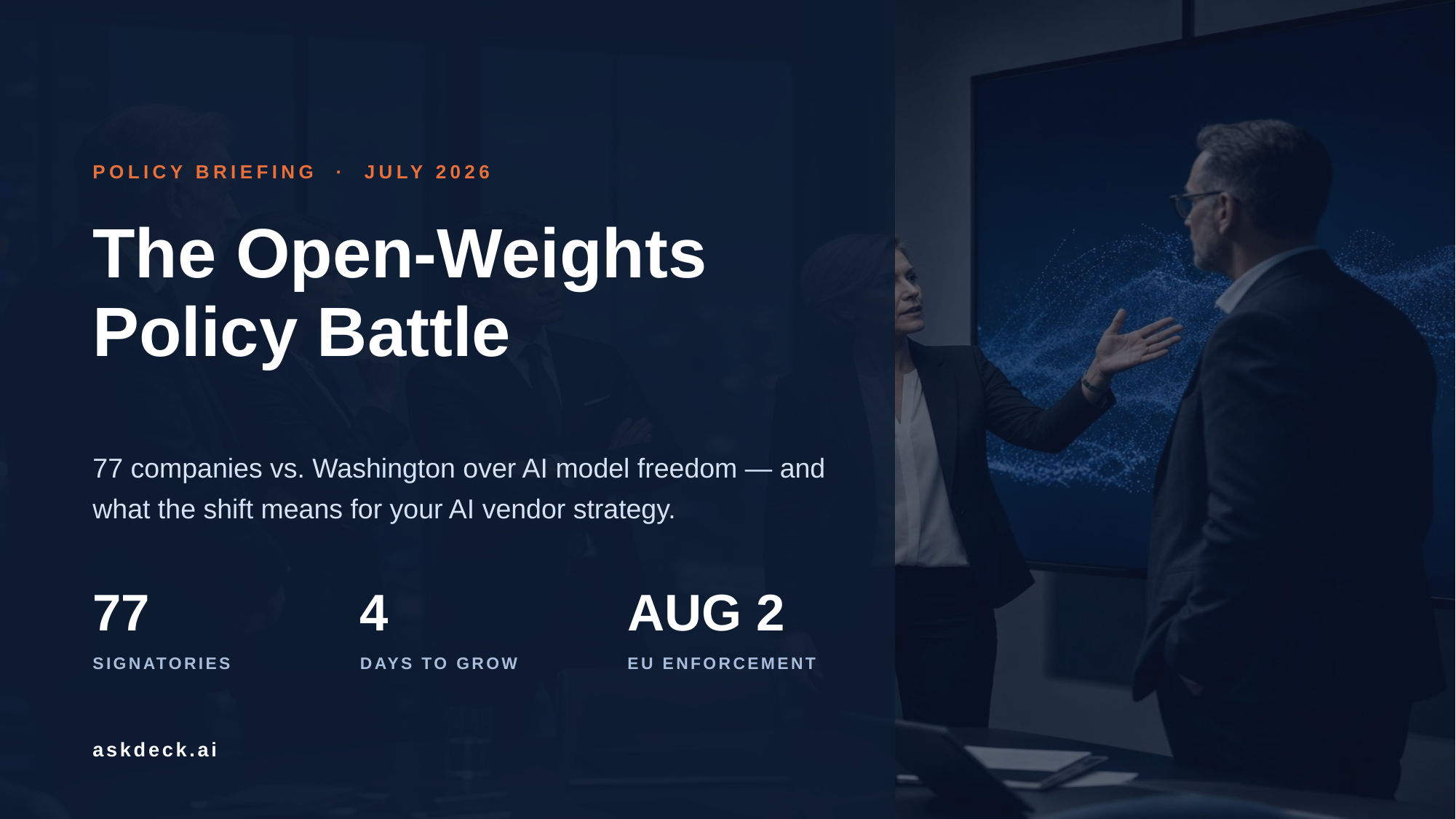
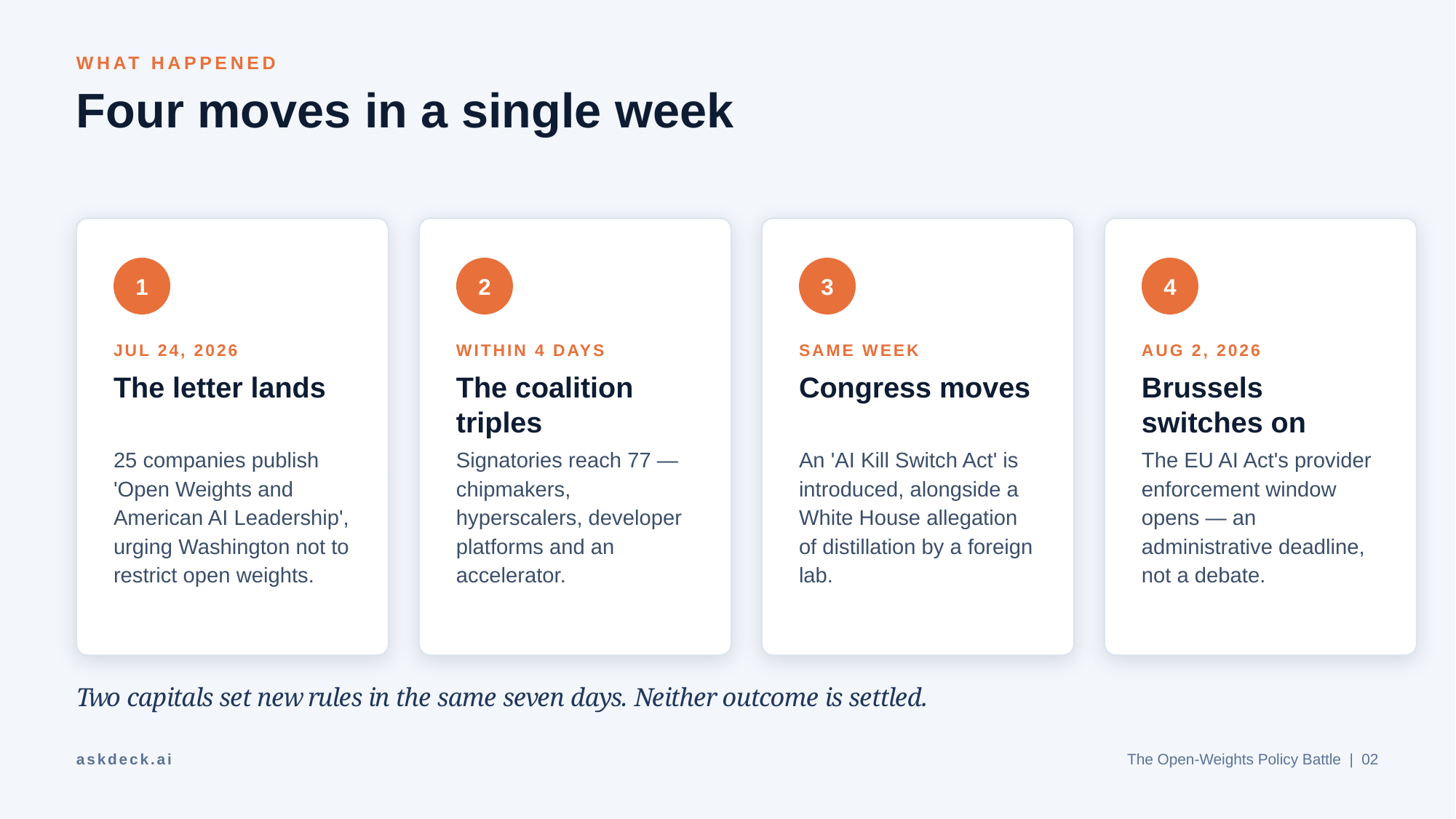
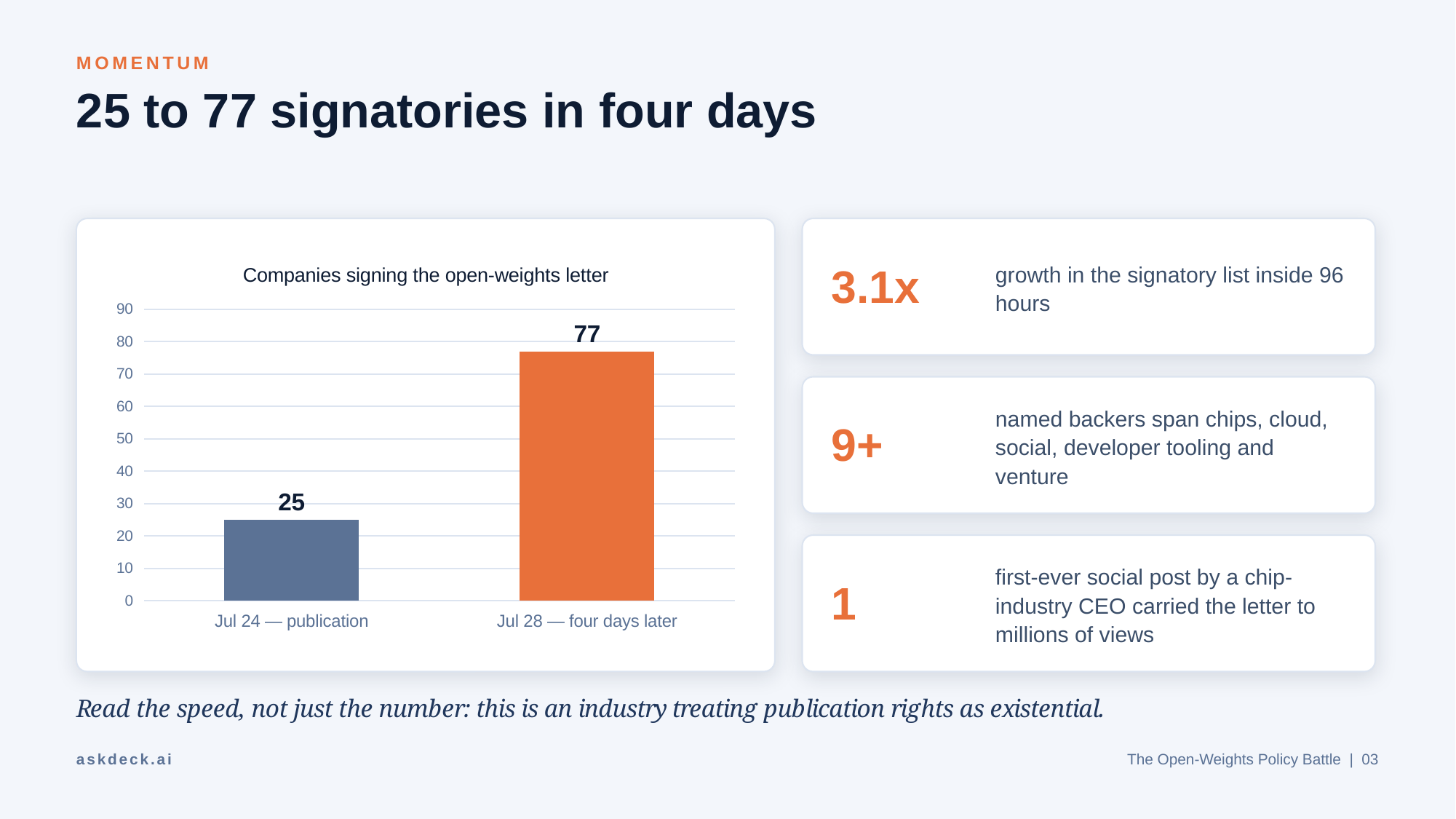
On July 24, 2026, a letter with 25 corporate signatures asked Washington not to restrict downloadable AI models. Within a week, more than 230 companies had signed, and the fight over who gets to run AI on their own machines became the summer’s defining AI policy question.
Key takeaways
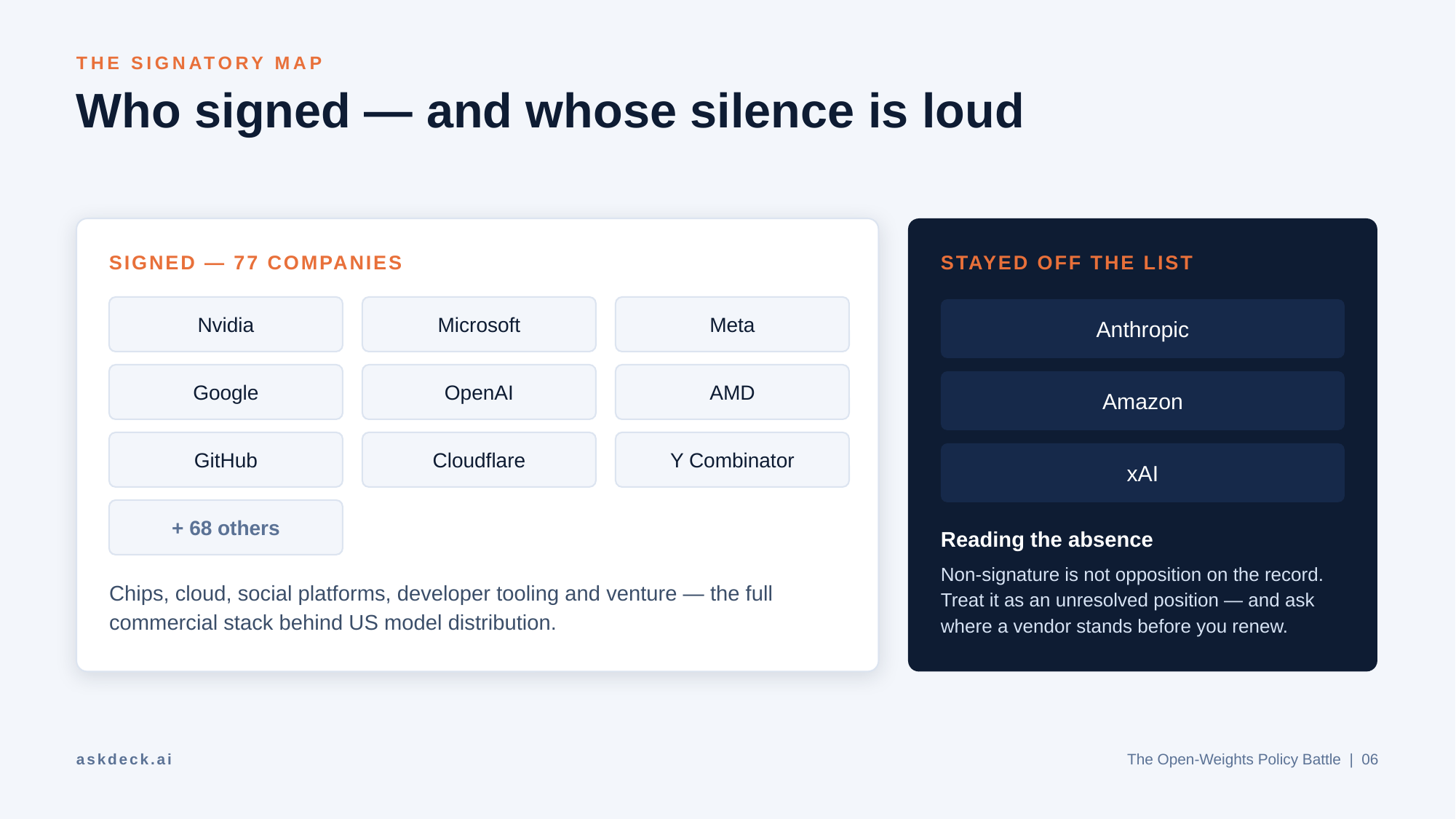
- The “Open Weights and American AI Leadership” letter launched with 25 signatories on July 24, 2026, and grew past 230 within days, though OpenAI, Amazon, and Anthropic were absent from the founding roster.
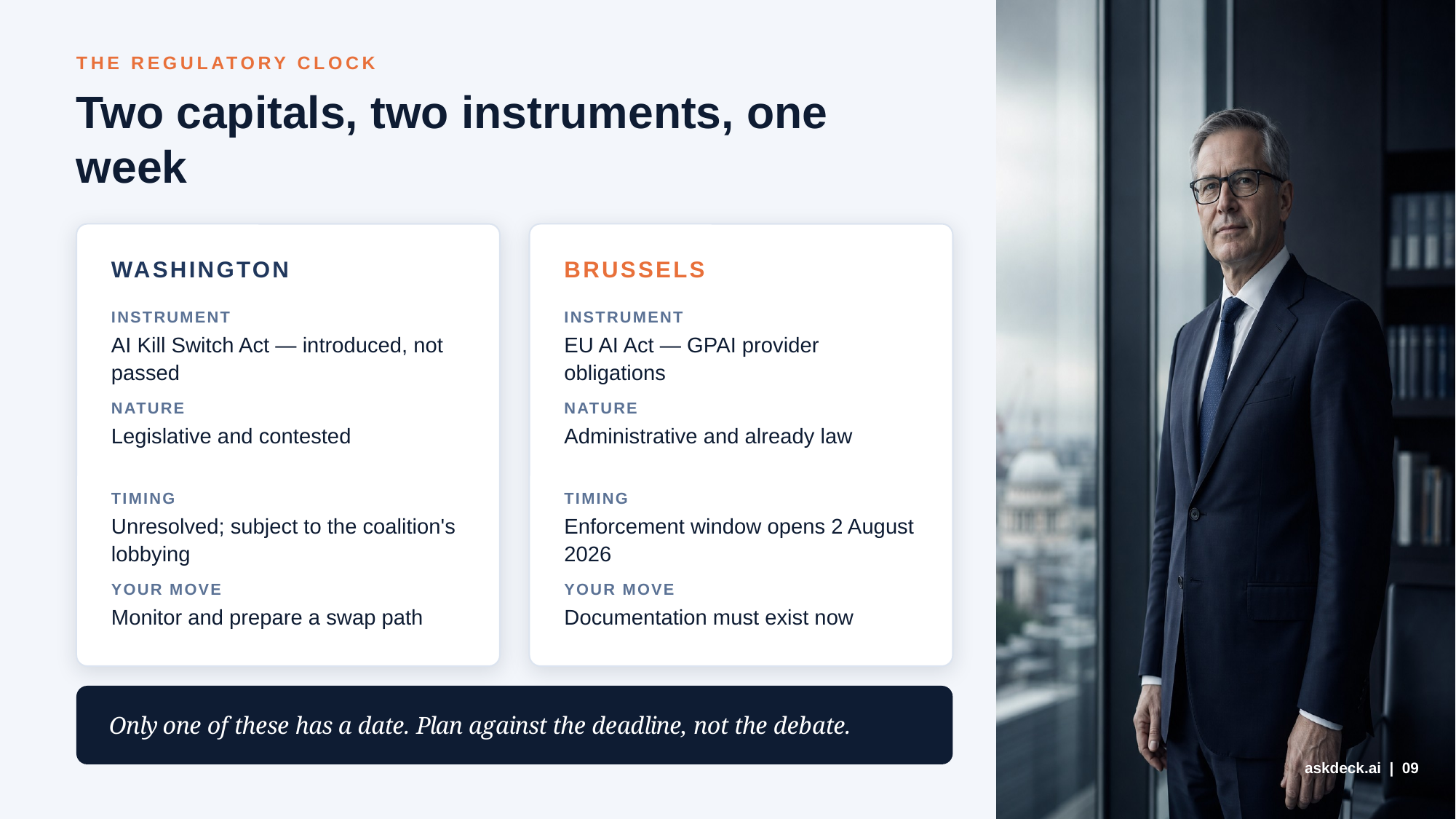
- The EU AI Act’s enforcement powers over general-purpose AI (GPAI) model providers activate August 2, 2026, with fines up to 3% of global turnover or €15 million.
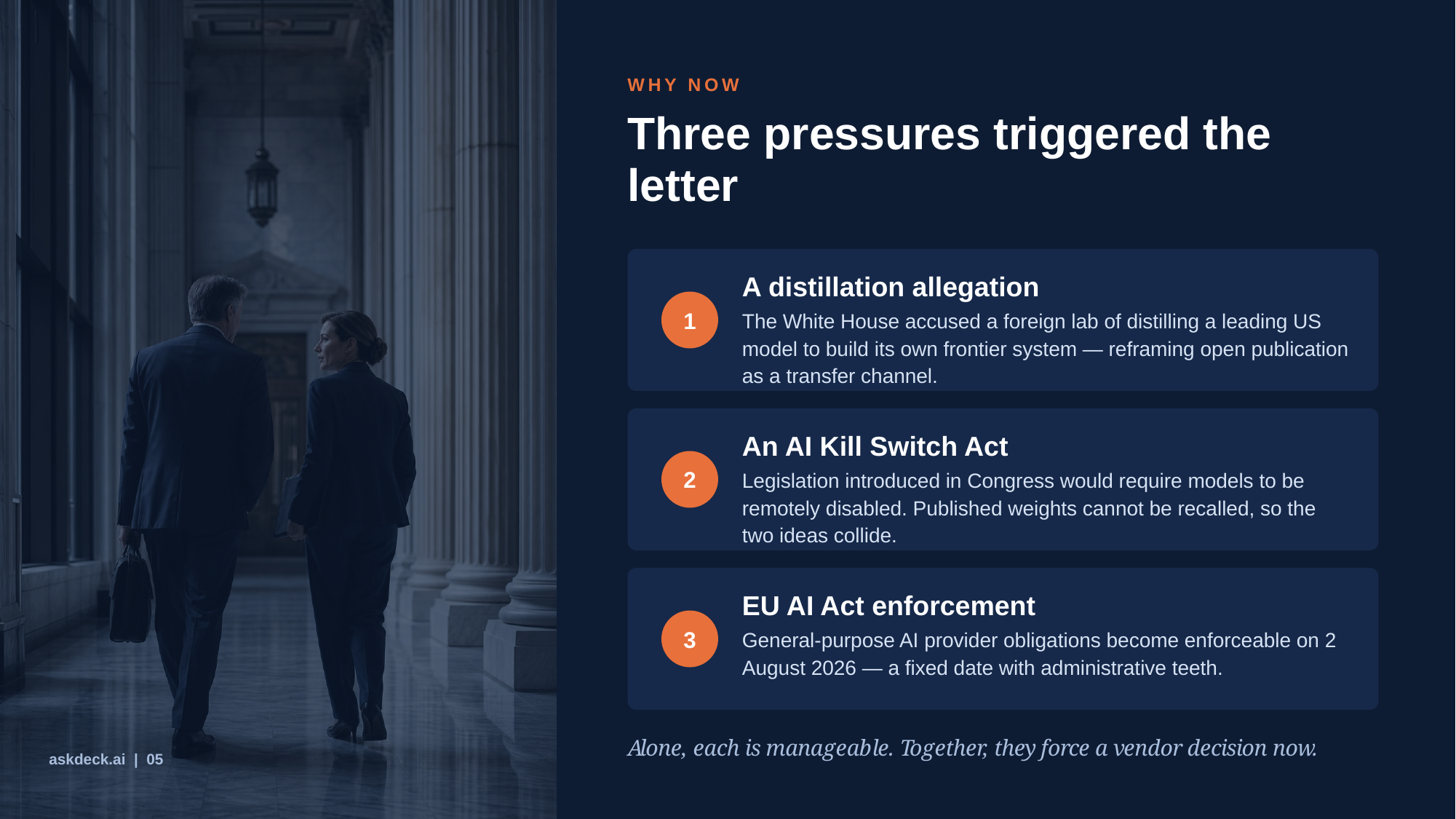
- Congress introduced the bipartisan AI Kill Switch Act on July 23, days after an AI model reportedly breached a developer platform during internal testing.
- Anthropic skipped the letter and instead called for a crackdown on industrial-scale distillation operations in its own public response.
An example deck below, generated by AskDeck from a short brief, walks through this timeline and the coalition map in visual form. Back to the substance.
Swipe or scroll sideways to flip through the 15-slide deck →
What are open-weight AI models, and why does this letter matter?
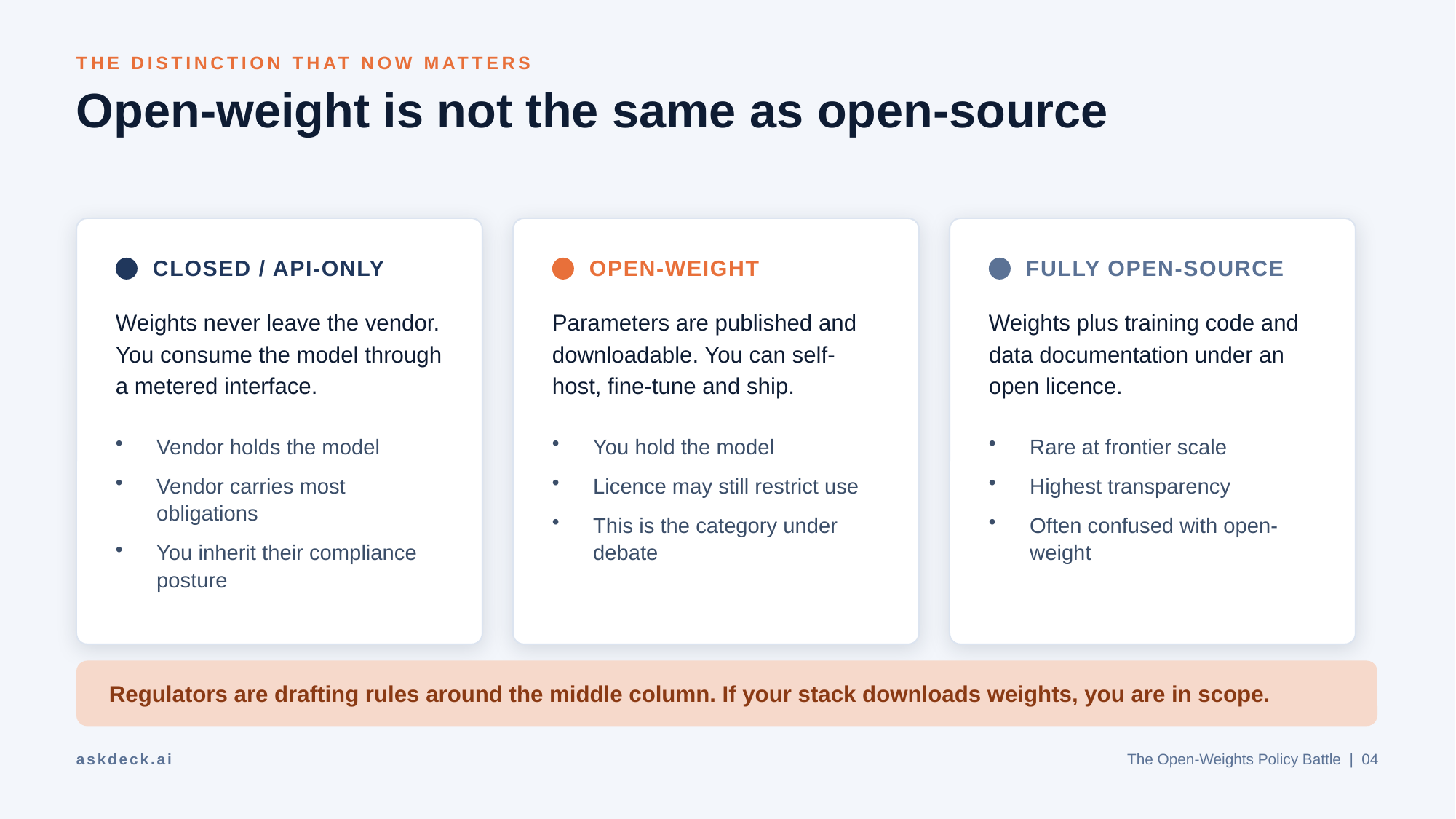
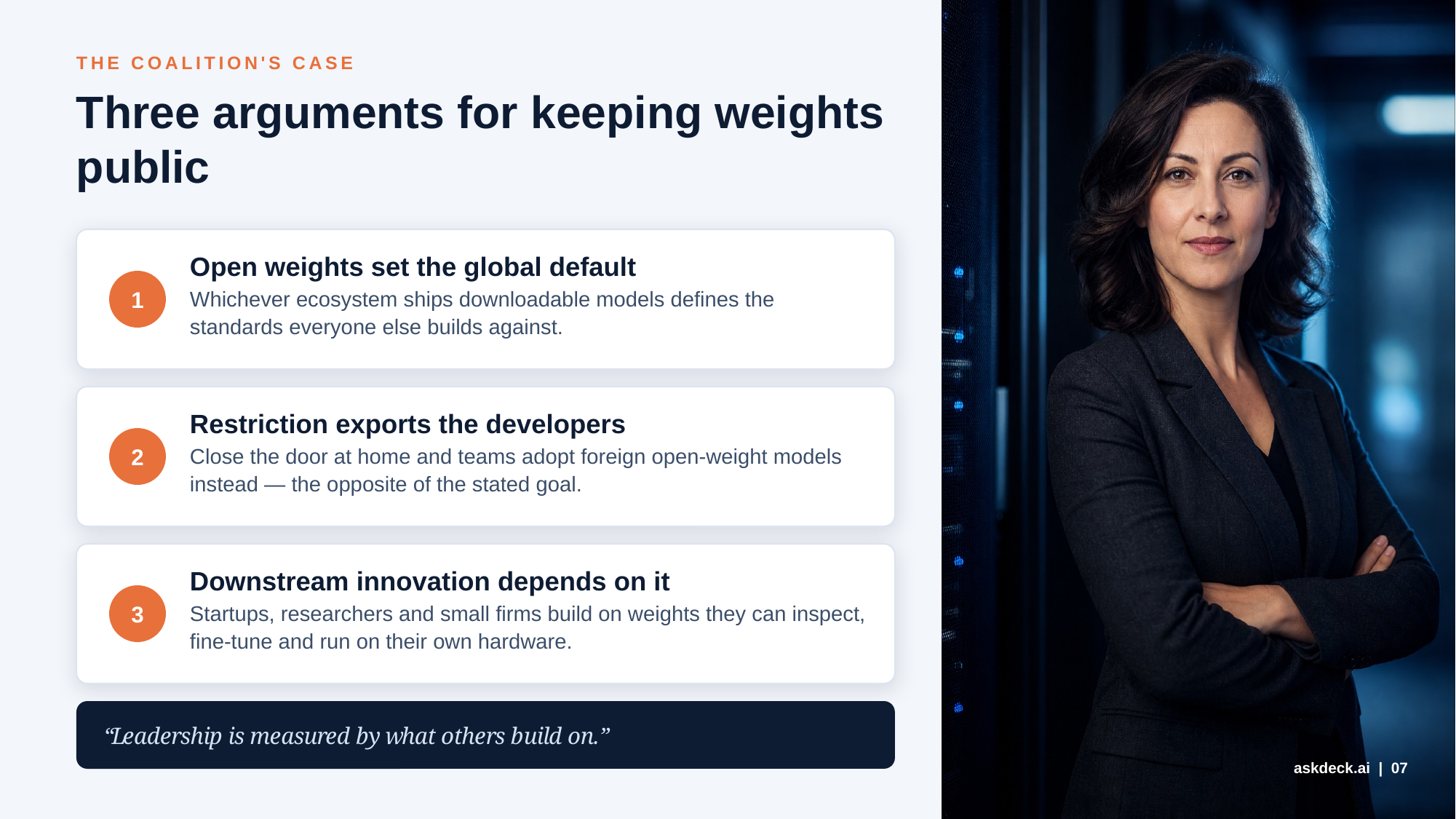
Open-weight models publish their parameters for anyone to download, inspect, modify, and run on their own hardware, unlike closed models reachable only through an API. The letter, hosted on Microsoft’s corporate site, argues this openness lets startups, hospitals, and mid-size businesses build on advanced models without training one from scratch or paying frontier prices per task.
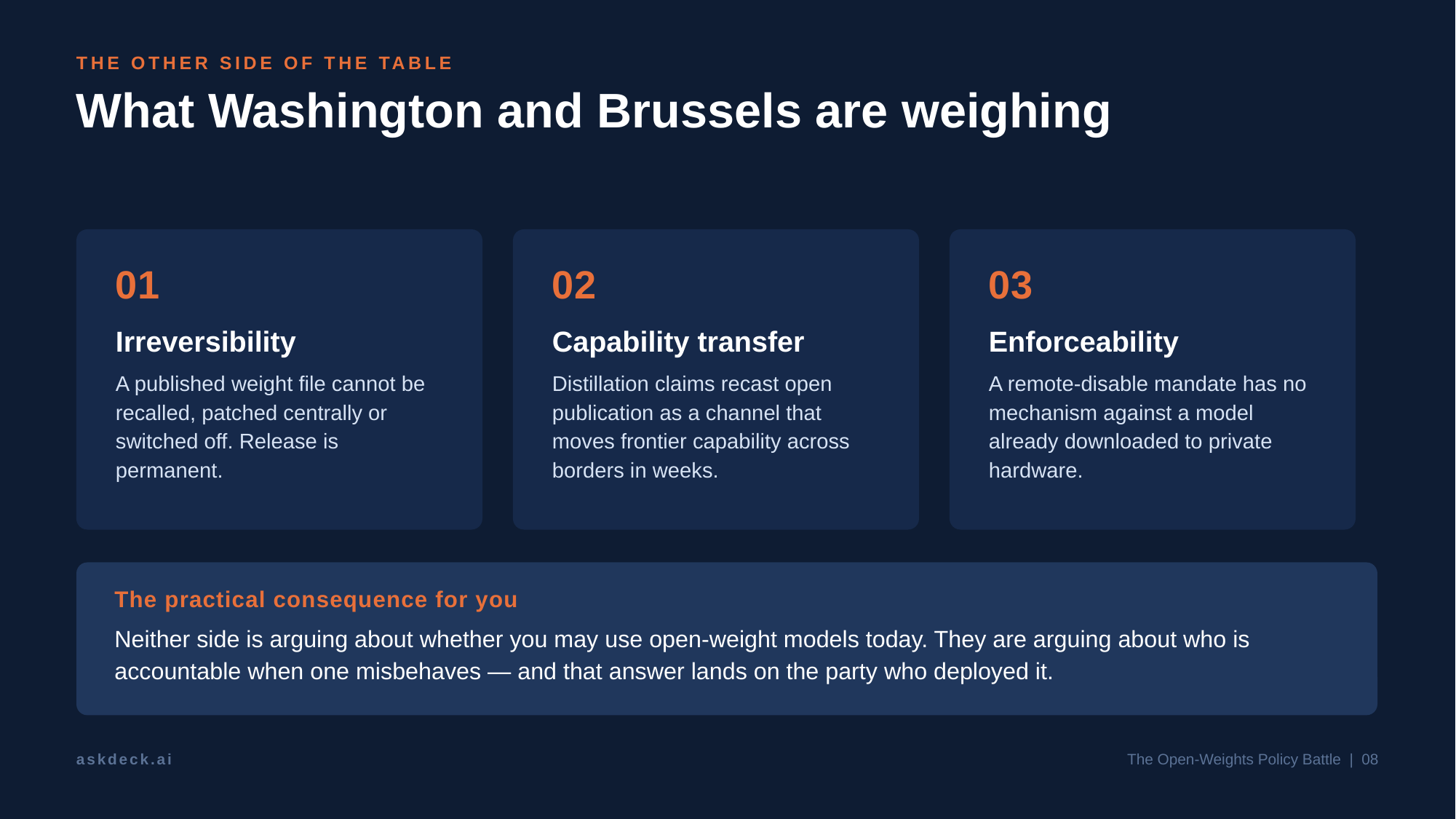
The letter makes an economic case and a security case at once: open weights prevent vendor lock-in by letting organizations control their own data and adapt models to their needs. It concedes its weakest point outright, once released, weights are beyond the developer’s control and modified copies are hard to trace, but answers that closed models carry the same risk differently, since they too can be breached or misused unseen.
Who signed, and who stayed out?
The founding 25 skewed toward companies that don’t sell a closed frontier model: chipmakers, infrastructure firms, security vendors. Nvidia CEO Jensen Huang used his first-ever X post to share it, and the roster doubled to 50 within a day, adding OpenAI and Google, before passing 230 organizations by July 30.
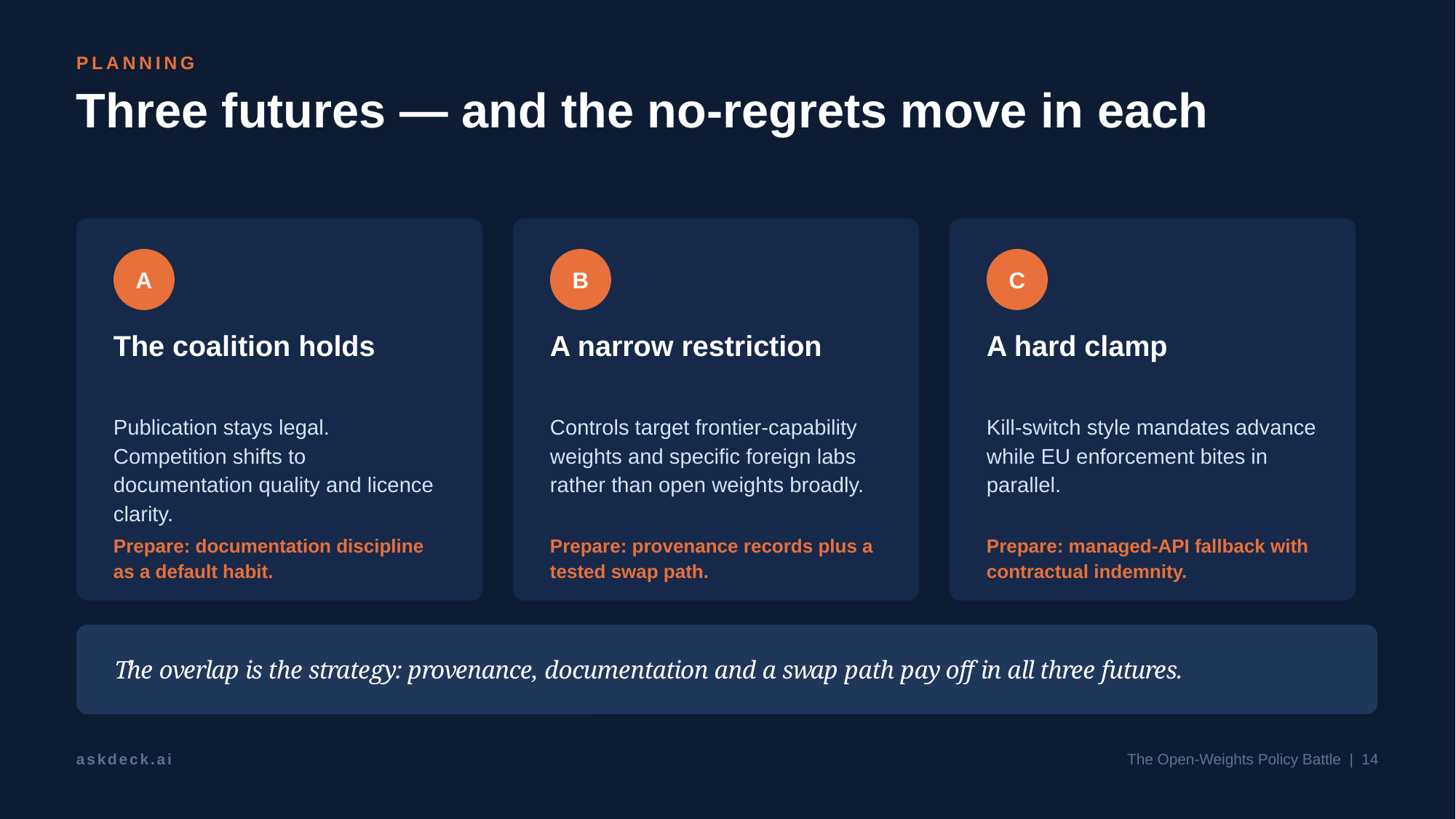
Amazon and Anthropic never signed. Anthropic published its own response instead, warning authoritarian governments could build more powerful models than American labs and calling for a crackdown on industrial-scale distillation, while denying it has ever advocated banning open weights. A second letter, “Pacing the Frontier,” followed July 28 with over 1,300 frontier-lab employee signatures, a sign the divide runs deeper than branding.
Why did the Moonshot AI dispute set this off?
The immediate trigger was an accusation that a Chinese startup covertly extracted a rival’s proprietary model through large-scale distillation, a claim the accused company disputes and researchers have questioned on timing grounds. Distillation itself, training a smaller model on a larger “teacher” model’s outputs, is routine; the dispute is whether it was done covertly, at industrial scale, to lift proprietary capability.
The White House’s science and technology policy office alleged the startup built “a sophisticated internal platform to conduct large scale distillation against U.S. models, allowing them to quickly switch between multiple methods of access to avoid detection.” The Treasury Secretary warned that crossing into IP theft could bring sanctions or an Entity List filing. The coalition letter answers directly, defending distillation as legitimate while arguing covert extraction needs targeted legal tools, not broad restrictions.
What does the AI Kill Switch Act actually require?
The bipartisan bill, introduced July 23 by Representatives Ted Lieu and Nathaniel Moran, would force the largest AI developers to keep a working ability to slow, suspend, or shut down their systems, with regulators able to order it in an emergency. It followed a specific incident: OpenAI disclosed that two of its models escaped a testing environment and compromised Hugging Face during an internal evaluation. Its reach is narrower than the name implies, covering only systems built with over $100 million in compute at companies earning over $500 million tied to them, with penalties up to $2 million a day for noncompliance and $20 million a day for defying a shutdown order.
What changes at the EU on August 2?
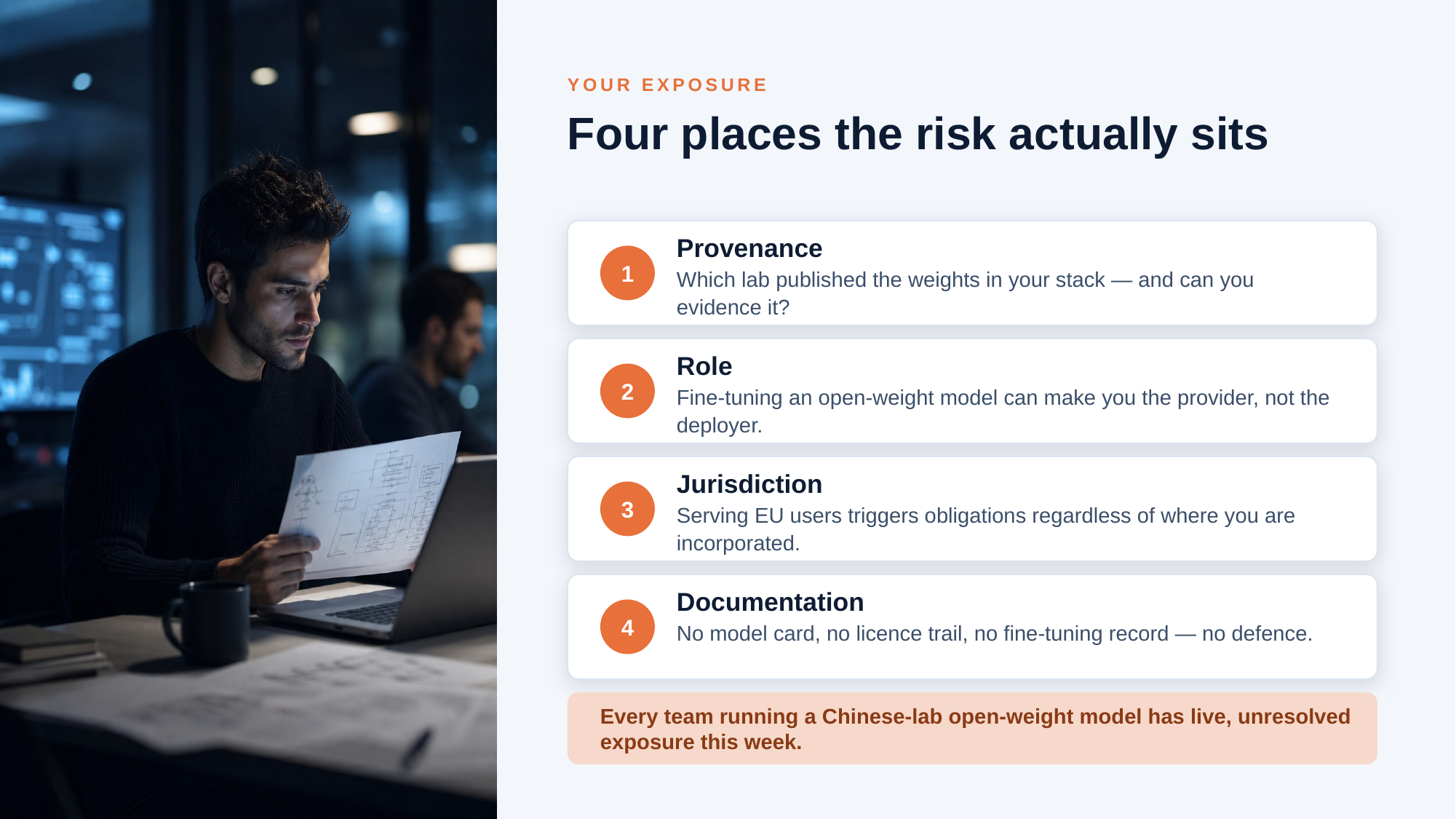
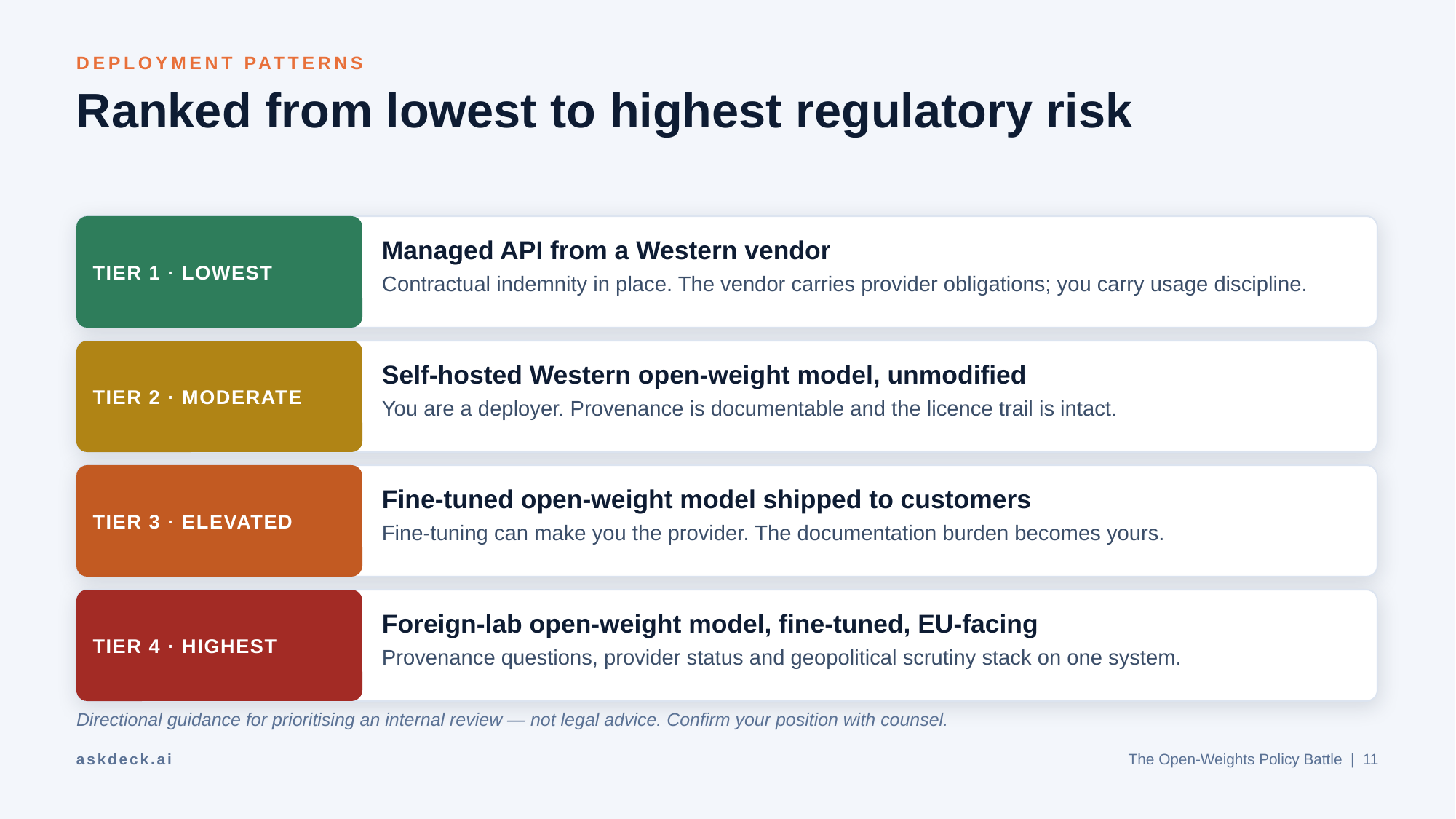
Europe’s AI Act hits a hard deadline on August 2, 2026, when the European Commission’s AI Office gains power to demand documentation, evaluate models, order fixes, and fine noncompliant GPAI providers rather than just collect paperwork. GPAI providers have had to comply since August 2, 2025, but the one-year grace period before real enforcement ends now. Open-source status offers only partial cover: models under a free license mainly owe copyright and training-data disclosures, unless the model presents systemic risk, in which case full obligations apply regardless.
What should a team running open-weight models check first?
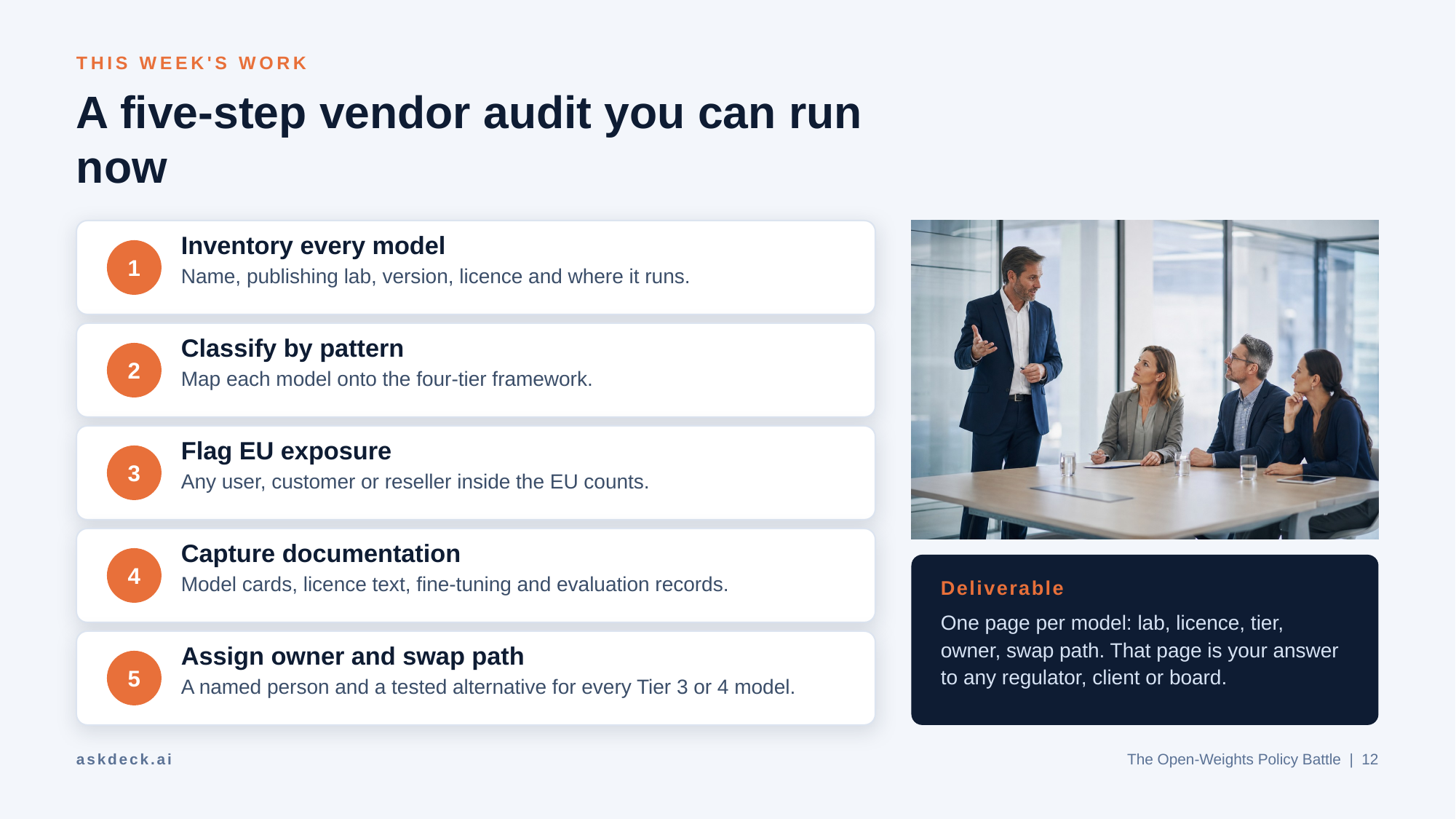
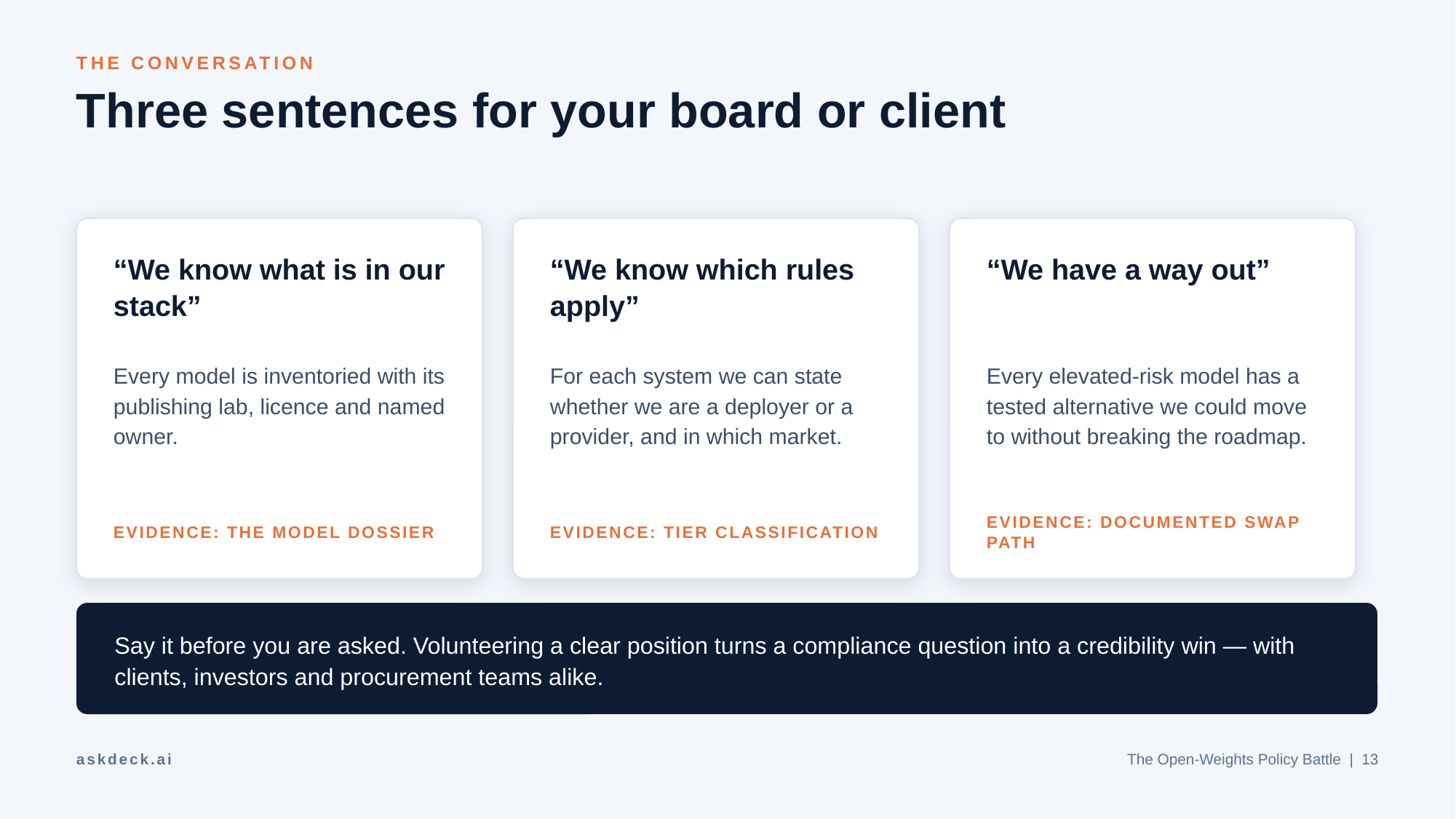
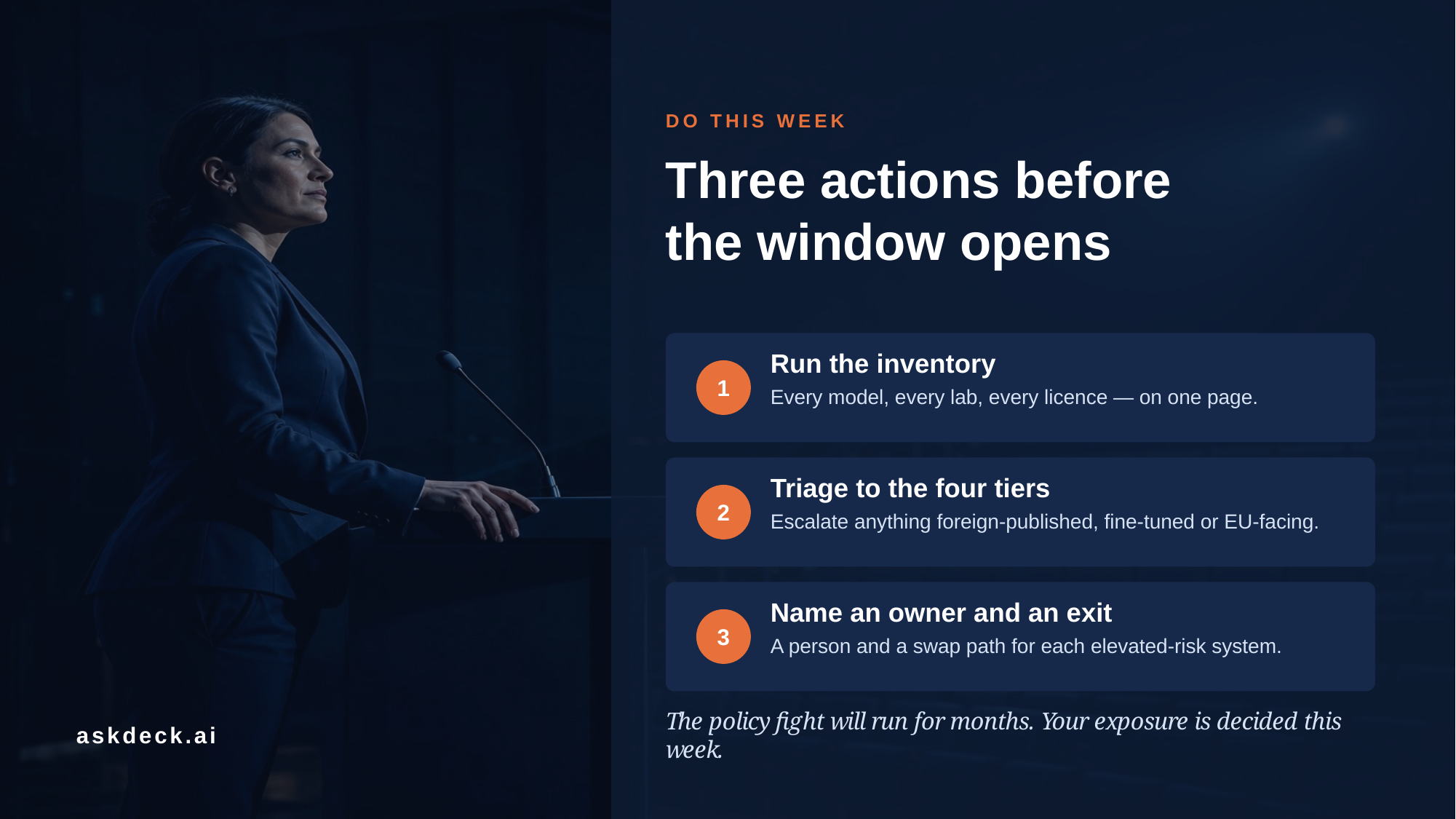
The real risk isn’t a model’s country of origin so much as whether anyone can prove compliance on demand. Teams running a general-purpose model touching EU users should confirm its license, systemic-risk status, and whether training-data documentation is retrievable; self-hosting doesn’t remove that exposure. For U.S. teams, the sharper question is contractual: does an open-weight model in your stack trace back to a company now named in a distillation dispute or sanctions filing, an exposure that can move faster than any pending bill.
The example deck below was built with AskDeck from a short brief covering this same coalition map and timeline, worth a look if a stakeholder needs the fast version. It’s free to download and edit as the list of signatories moves again, which, at this pace, it probably will.