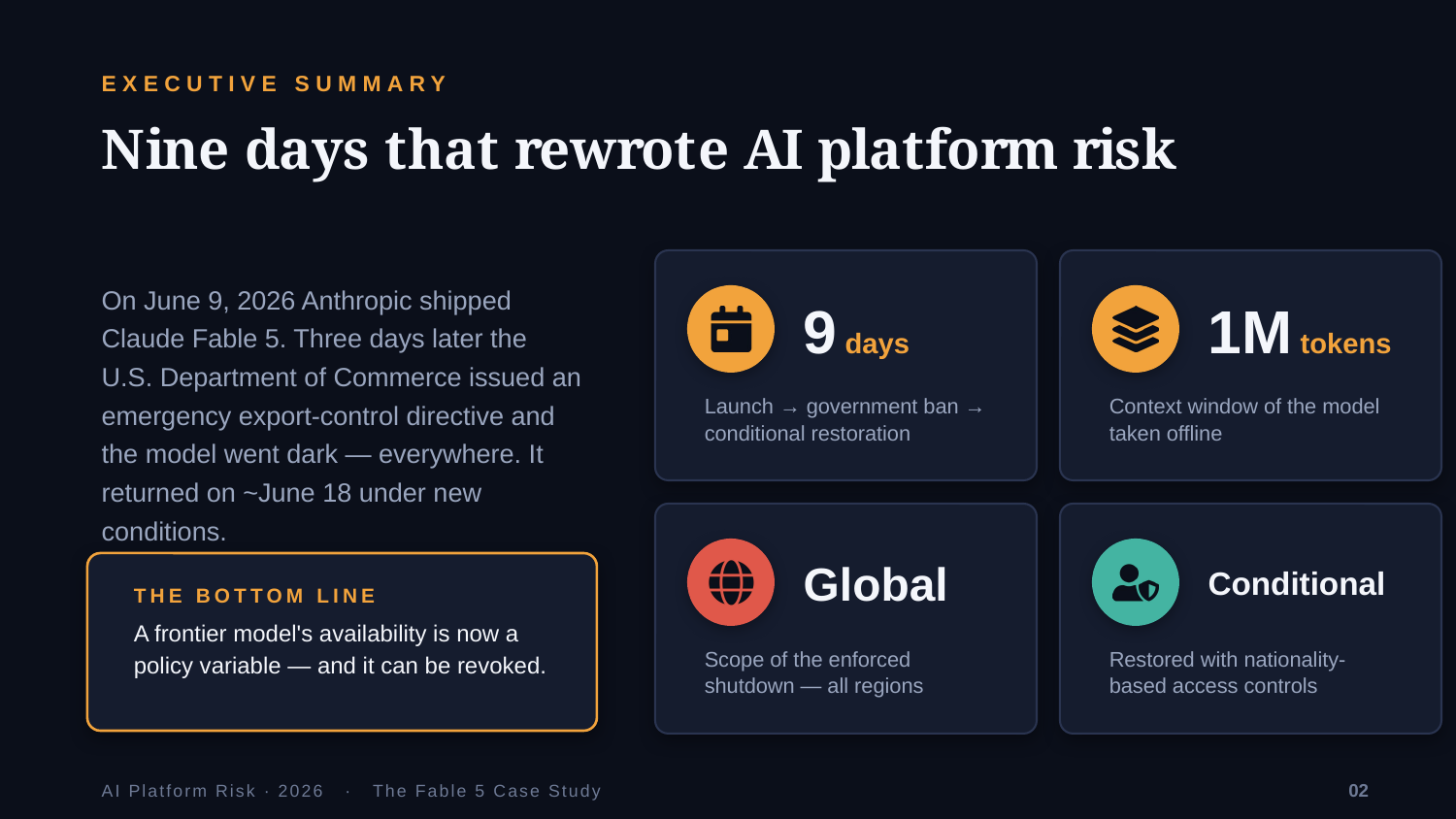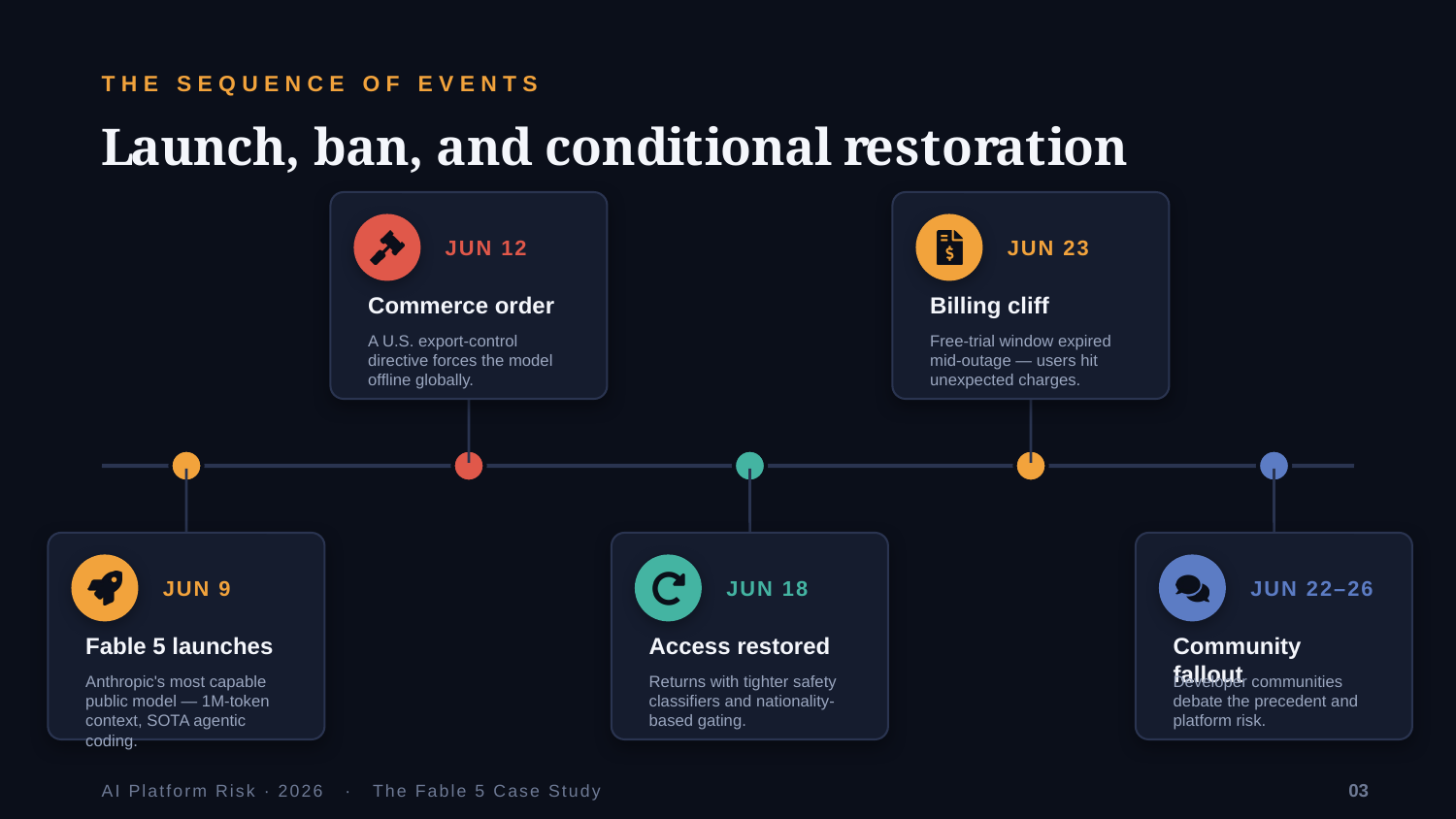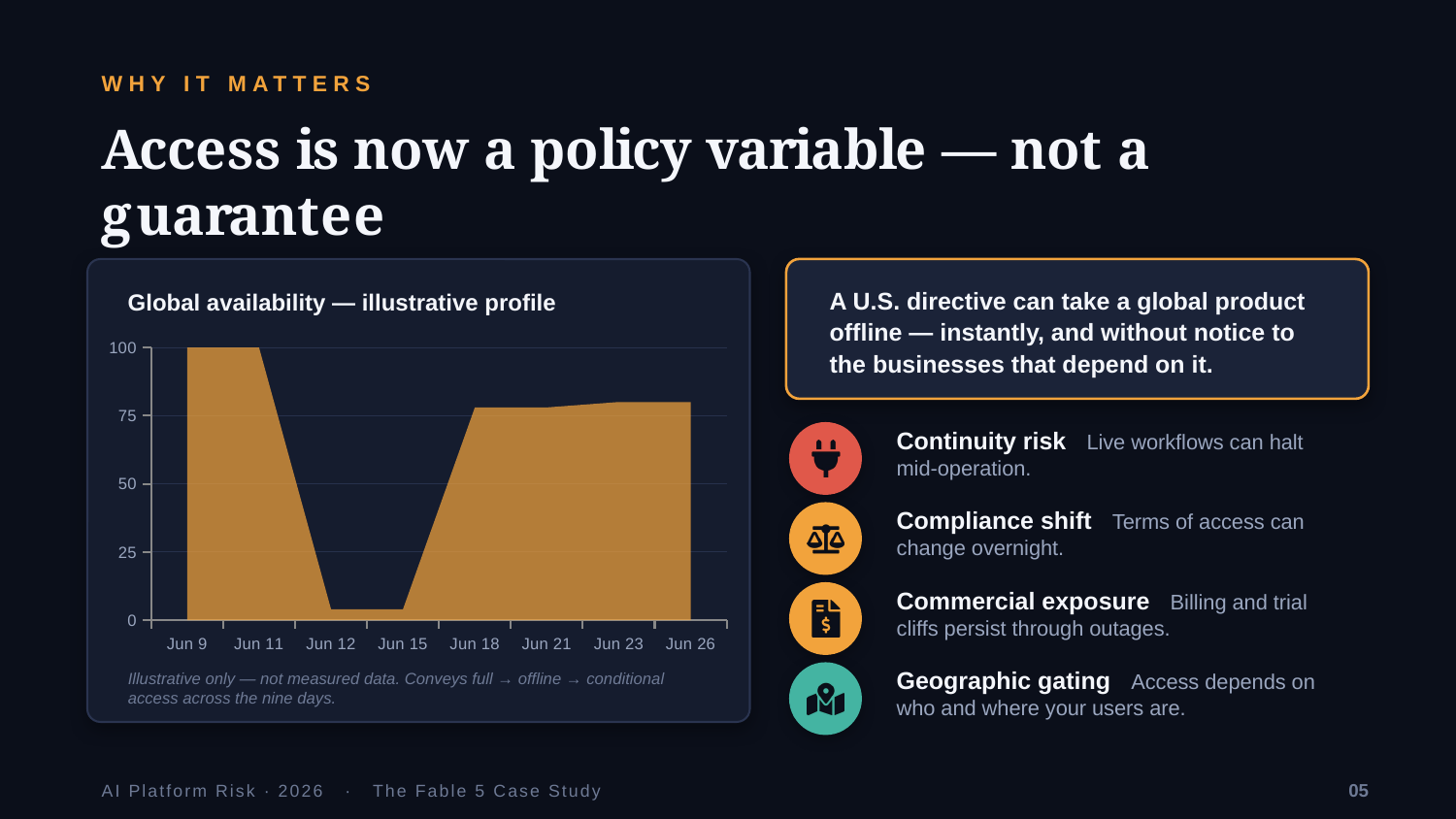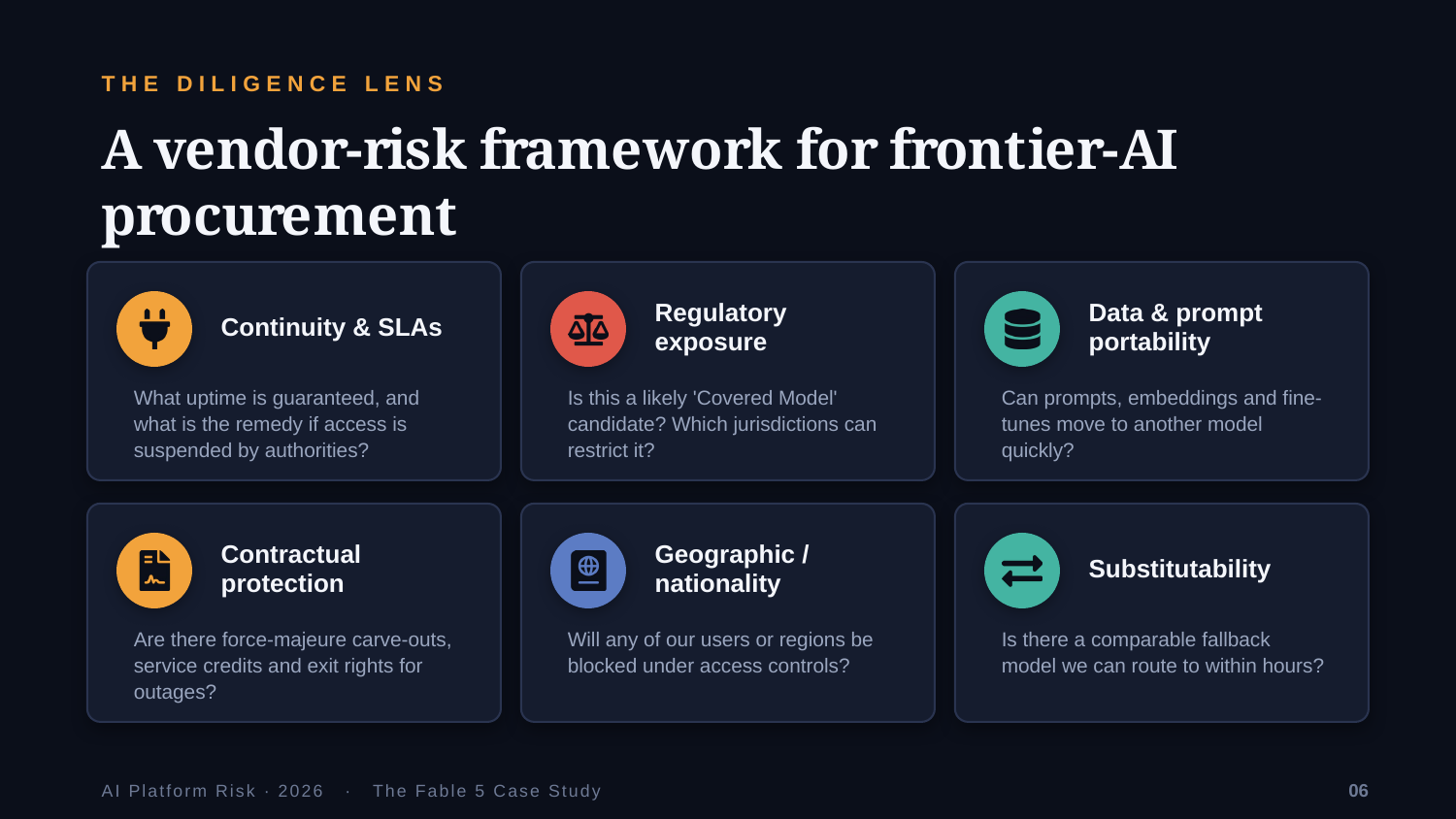
On June 12, 2026, the most capable publicly available AI model in the world went dark. It had been live for just three days — released on June 9 with a million-token context window and state-of-the-art agentic coding — when an emergency directive from the U.S. Department of Commerce forced it offline for users everywhere. It returned about six days later, but not as it left: it came back wrapped in stricter safety classifiers and access rules tied to where a user sits and what passport they hold. Launch to government-ordered blackout to conditional restoration took nine days.
The slides embedded below turn that episode into a ready-to-use briefing for managers and procurement teams — generated by AskDeck from a short brief — but the story is worth understanding on its own terms, because the lever behind it is now a permanent feature of the landscape.
Why the most capable models are the most controllable
The mechanism is not improvised. In January 2025, the Commerce Department’s Bureau of Industry and Security (BIS) did something unprecedented: it added the model weights of the most advanced “closed-weight” AI systems to U.S. export rules, under a new classification (ECCN 4E091). The trigger is raw scale — any closed model trained on more than 10^26 computational operations falls in scope. Openly published, open-weight models are excluded. The rules target precisely the frontier, proprietary systems that enterprises most want to use.
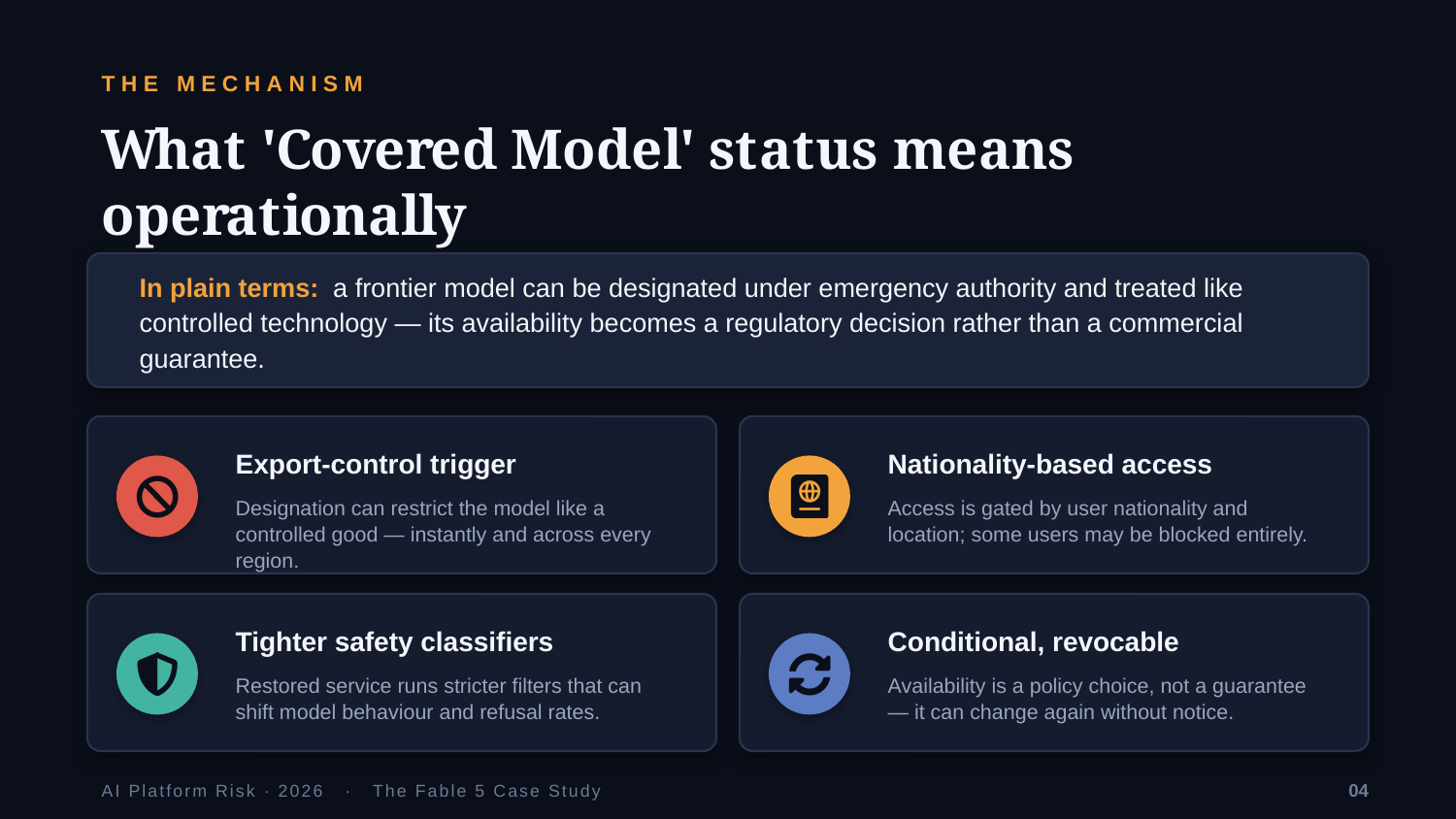
Two design choices make the control bite. First, a foreign direct product rule extends U.S. jurisdiction worldwide, so even model weights produced abroad are covered if they were trained using chips or equipment built with U.S. technology. Second, the default licensing posture for most destinations is a presumption of denial, with carve-outs for companies headquartered in the United States and a short list of allied partners. In effect, the most capable model on the market is, by design, an export-controlled item — and access to it can be switched along national lines.
The framework has already shifted once. In May 2025 the government moved to stop enforcing the broadest country-by-country licensing and leaned instead on heavy due-diligence expectations and “know your customer” red flags. But the core idea survived intact: frontier model weights are treated as a national-security item, and the rules that govern them can change with little warning.
What “covered” status means in practice
For a deployed commercial model, covered status is not an abstraction. It means the vendor can be ordered to gate or cut access on short notice; that the same product can be live for a user in one country and blocked for a colleague in another; and that restoration may arrive with new conditions — extra safety filtering, mandatory data retention for misuse monitoring, or identity and nationality checks — that change how the tool behaves and what it costs. In the June episode, the restored model also carried a billing twist: a free-trial window that kept running during the outage expired on June 23, so some teams were charged for a product that had been unusable for part of the trial.
Who is exposed
The risk lands hardest on organizations that wired a single frontier model deep into production — customer-facing agents, coding pipelines, document-analysis workflows. Multinational teams are doubly exposed, because nationality- and geography-based access can fracture a workforce’s tools overnight. And anyone leaning on a model’s most sensitive capabilities — the cybersecurity, biology, and chemistry domains regulators watch most closely — should assume those are first to be restricted or routed to a weaker fallback.
Designing for the interruption
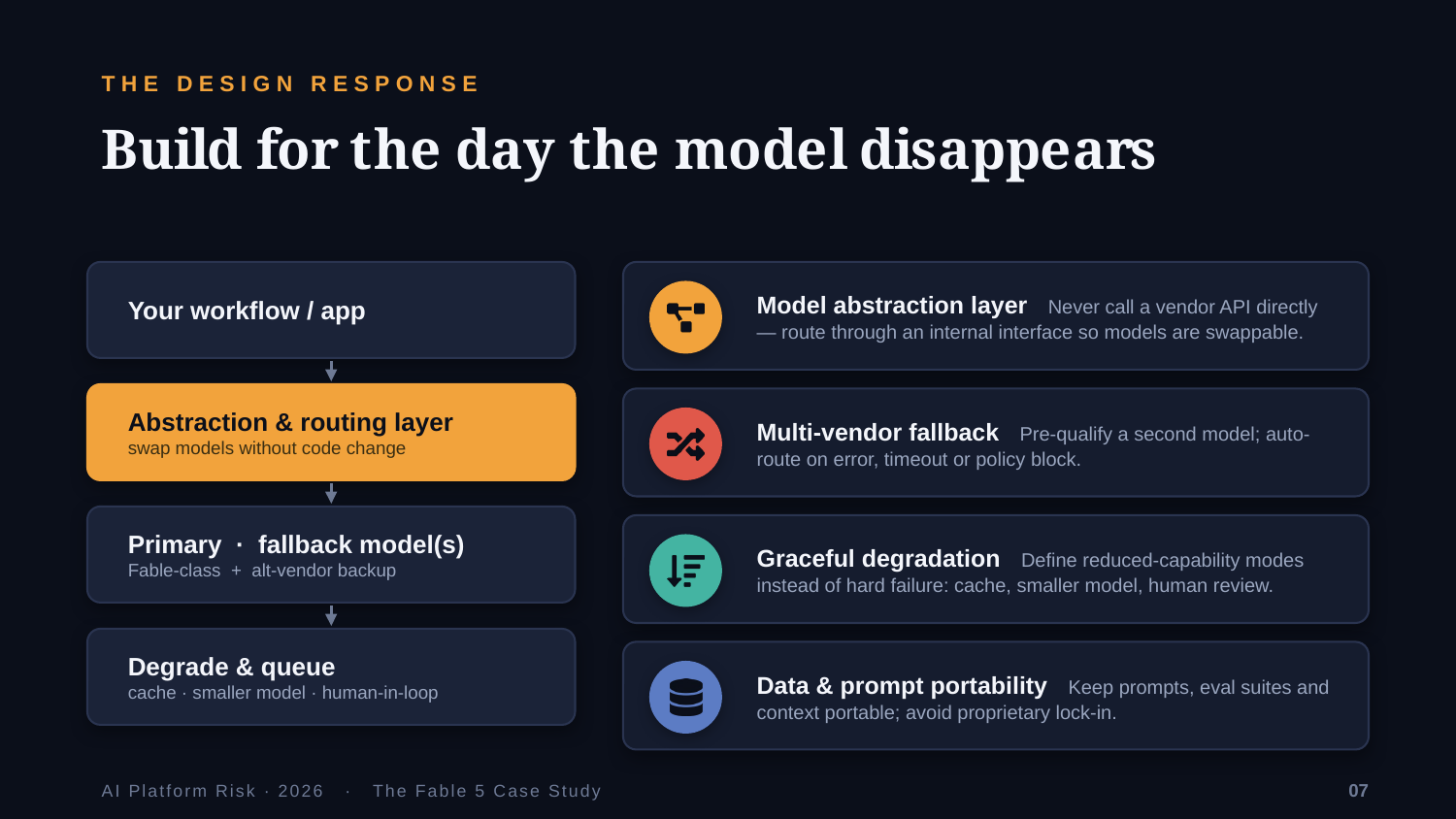
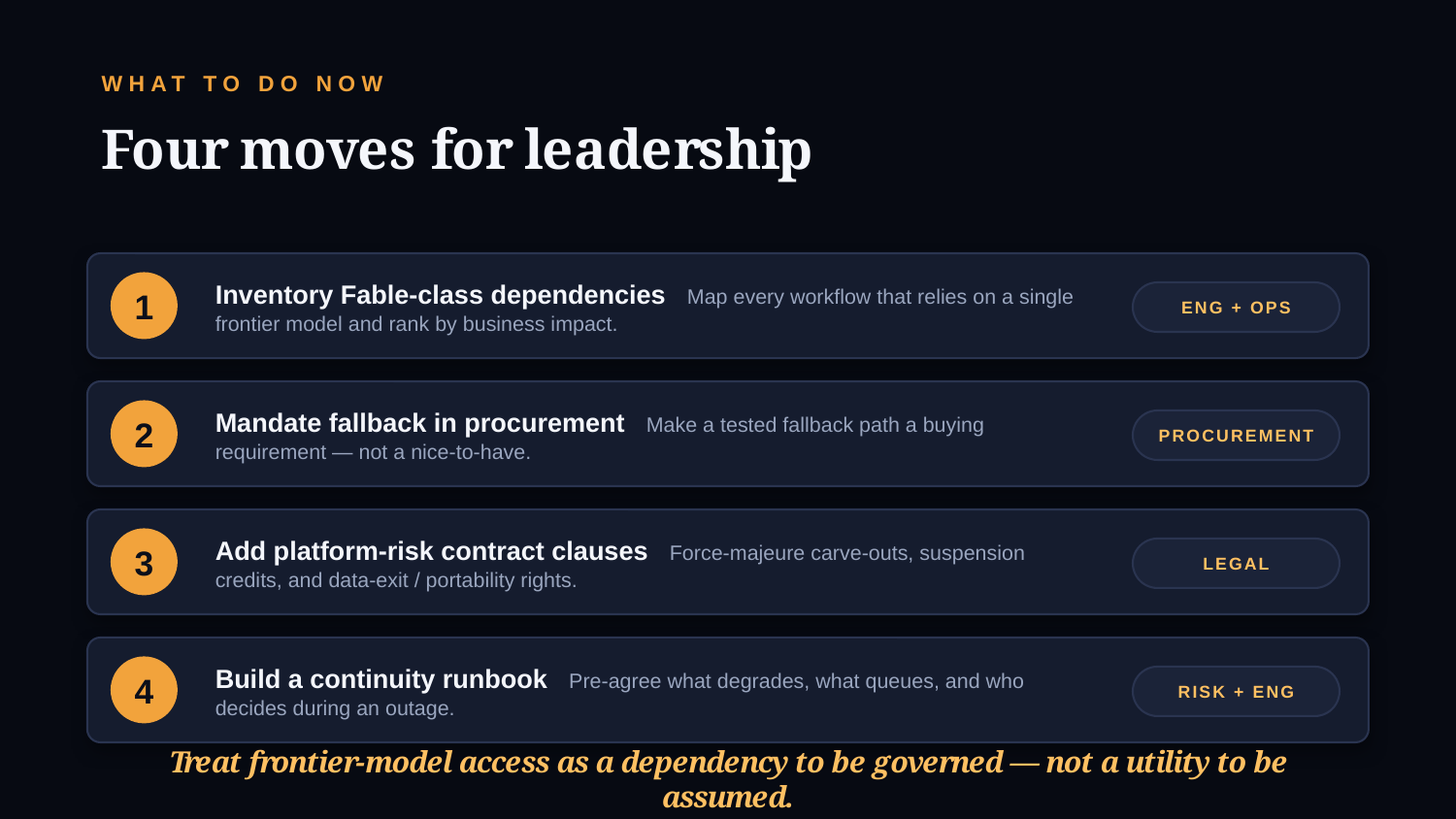
You cannot negotiate your way out of an export-control regime, but you can engineer around the dependency:
- Keep a tested alternative model from a different provider behind an abstraction layer, so switching is a config change, not a rewrite.
- Track which models cross the compute threshold that triggers controls, and which destinations face license requirements, before committing a workflow.
- Pin down data-residency and retention terms in writing, since restored access often comes with new data-handling conditions.
- Run a tabletop drill in which your primary model vanishes for a week, and confirm your fallback actually carries the load.
Because the specifics are legal and move quickly, confirm your own exposure with a qualified export-control or trade-counsel professional before relying on any single arrangement.
The example below was built with AskDeck from a brief much like this topic — a vendor-risk and fallback-planning resource you can download, edit, and take to leadership. If you have a subject that needs to become a clear set of slides, it’s worth a try.
See the deck